

A charge of four tenths of one per cent does not feel like a charge. It reads like a rounding error, the sort of number you scroll past on the way to the part of the page you think matters. That is precisely why what is expense ratio in etfs deserves a longer answer than the question seems to invite. The number is small. The mechanism behind it is not, and it is the only cost in this business that charges you for doing nothing at all.
This belongs under Protect. Every other cost a trader meets is attached to an action. You pay a spread because you opened something. You pay financing because you held something overnight. The expense ratio is different in kind: it is charged for the continued existence of your holding, every day, whether the market moved or not, whether you looked at it or not. Nothing below is a view on whether to own gold through a fund. It is the fee, read carefully, with the arithmetic done.
What is expense ratio in etfs, with the wording stripped back
An exchange traded fund is a company that holds something on your behalf. In the case of a gold fund, it holds bullion in a vault and issues shares against it. Running that arrangement costs money: the vault charges storage, the trustee charges a fee, somebody audits the bars, somebody files the paperwork, somebody markets the thing.
The expense ratio is the annual percentage of the fund's assets taken to cover all of that. If a fund states 0.40 per cent, it means that across a year, four tenths of one per cent of what the fund holds is consumed by the cost of holding it.
Two features of that sentence do the real damage, and both are easy to miss.
The first is that you never pay it. Not in the sense of writing a cheque. No invoice arrives, no line item appears on your statement, nothing is debited from your cash. The fund sells a sliver of its own gold to cover its costs, so each share quietly comes to represent slightly less metal than it did yesterday. The cost is real and it is yours, but it is collected by subtraction rather than by billing. There is no moment at which you are asked to approve it.
The second is that it is charged on the balance, not on the gain. A spread is charged when you trade. The expense ratio is charged on everything you hold, in the years the price rises and in the years it falls. A holding that has lost value still pays. A holding you have forgotten about still pays.
What the arithmetic actually does over a holding period
Here are two real figures, read from the issuer's own pages on 28 October 2026. The SPDR Gold Shares page states an expense ratio of 0.40 per cent. The SPDR Gold MiniShares page states 0.10 per cent. Same sponsor, same metal, four times the fee.
To see what that difference does, I need one simplifying assumption, and I want to be explicit about it because it is doing a lot of work: assume the gold price never moves for the whole period. That is obviously not a forecast. It is a way of isolating the fee so that the only thing changing in the numbers is the cost, not the market. Assume a 10,000 unit holding and a fee charged each year on whatever value remains.
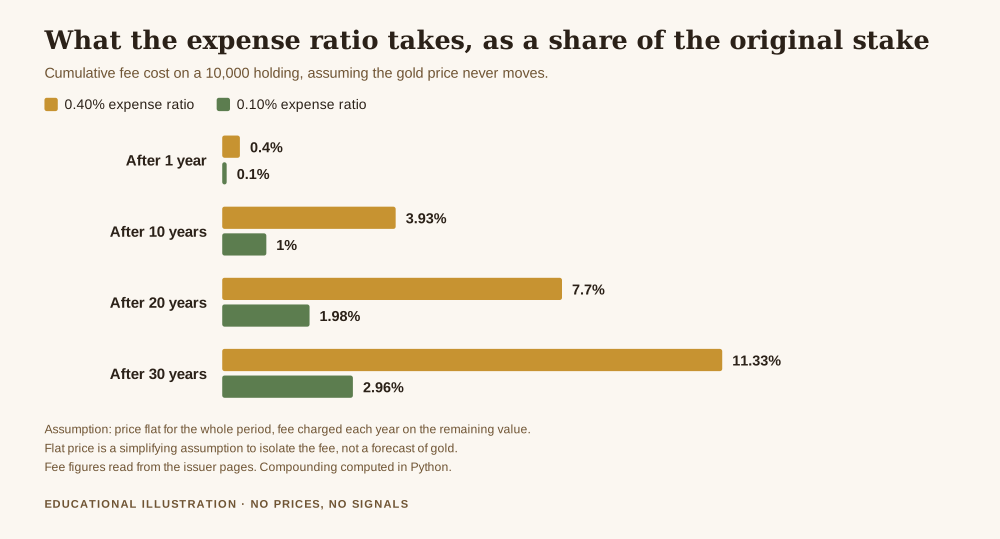
After one year the gap is 30 units, which is the figure that persuades people it does not matter. After ten years the 0.40 per cent holding has given up 392.88 and the 0.10 per cent holding has given up 99.55. After twenty years it is 770.32 against 198.11, a gap of 572.21 on the original 10,000, or 5.72 per cent of the stake. After thirty years the higher fee has consumed 11.33 per cent of the holding and the lower one 2.96 per cent.
One more way to hold it in your head. At 0.40 per cent, the fee alone eats a tenth of the holding in 26.3 years. At 0.10 per cent it takes 105.3 years to do the same damage. That is the same question asked twice, and the two answers sit in different human lifetimes.
Why "they are both small" is the wrong comparison
The instinct is to compare 0.40 and 0.10 to zero, notice that both are close to it, and move on. That framing is what makes the fee invisible. The useful comparison is between the two of them, and in that frame one is four times the other.
It helps to translate the fee into something you already price properly. A trader who would spend twenty minutes comparing brokers over a fraction of a point on the spread will accept a 0.30 percentage point difference in an annual fee without blinking, because one is called a spread and the other is called a ratio. The spread is paid once per trade. The ratio is paid every year, forever, on the whole position.
I am not arguing the cheaper fund is automatically the better one. Funds differ in size, in how tightly they track the metal, in how easily you can buy and sell them in the size you want, and in the tax treatment that applies where you live. A larger fund with a wider following may cost less to trade in and out of, and for someone who holds for weeks rather than decades the dealing cost may matter more than the annual one. That is a genuine trade-off, and it has an answer only once you know your own holding period.
The point is narrower than a recommendation: the fee is a known, published, compounding number, and most people never look it up. Whatever you conclude afterwards, the looking up is not optional.
What the expense ratio does not cover
A reader who stops at the expense ratio will still underestimate the cost of owning a fund, because the ratio is only one of four things taking money, and it is the only one printed in large type.
There is the spread between the bid and the offer on the shares themselves, paid on the way in and again on the way out. There is whatever your broker charges in commission. There is the gap between what the fund returns and what the metal does, which has its own name and its own causes and is worth understanding separately, covered in gold ETF tracking error. And there is tax, which depends entirely on where you are and is outside what I can usefully say.
The expense ratio is the easiest of the four to find and the easiest to compare across funds. That is a reason to start there, not a reason to stop there.
How to check the number yourself, in about a minute
This is not research. It is a lookup, and the fact that it takes a minute is exactly why skipping it is so common.
Go to the fund's own page, not a summary site and not a forum post. Find the line labelled expense ratio, gross expense ratio or sponsor's fee. Note the date you read it, because sponsors do change these, usually when a cheaper competitor appears. Then multiply it by the size of your holding and by the number of years you expect to hold, and look at the result before you decide it is immaterial.
If you cannot find the number on the issuer's own page in a minute, that is information too. A cost that is hard to locate is rarely hard to locate by accident.
The habit underneath this
There is a discipline here that transfers straight to a trading account, and it is the reason this article exists on a trading journal rather than an investing one.
Most costs in this business are decided before you act and paid long after. The spread is set before you click. The financing rate is published before you hold overnight. The expense ratio is printed before you buy a single share. In every one of those cases the number is available in advance, in writing, from the party charging it, and in every one of those cases most people meet it for the first time in hindsight.
What separates the two groups is not intelligence or experience. It is one step: doing the multiplication before committing rather than after. It took me longer to compute the thirty year figures than it took to find both fees. That ratio holds nearly everywhere, which is why the step gets skipped, and why skipping it compounds.
So the useful question is not whether 0.40 per cent is fair. It is whether you knew it was 0.40 per cent before you bought, whether you knew it is charged on the balance rather than the gain, and whether you knew that a fund from the same sponsor charges a quarter of it. If the answer to any of those was no, the fee was not the problem. The reading was.
Get the free Black Gold Market blueprint, a short document on protecting capital before you try to grow it, including the habit of pricing every cost before you commit rather than after. One email, no spam, unsubscribe anytime.
Get the free blueprint →Frequently asked questions
What is expense ratio in etfs, in one line?
It is the annual percentage of the fund's assets taken to cover the cost of running the fund, deducted from the fund's own holdings rather than billed to you, and charged on your whole balance every year regardless of whether the price rose or fell.
Do I pay it separately, or is it taken out somewhere?
It is taken out. The fund sells a small amount of what it holds to meet its costs, so each share comes to represent slightly less metal over time. You will not see a debit on your statement, which is why it is so easy to treat as hypothetical.
Is 0.40 per cent a lot?
Against zero it looks small. Against 0.10 per cent, which is what the same sponsor charges on its MiniShares product, it is four times as much. On a 10,000 holding with a flat price, the difference is 572.21 over twenty years, or 5.72 per cent of the original stake.
Does a lower expense ratio make a fund better?
Not on its own. Dealing spreads, fund size, how closely the fund tracks the metal and local tax treatment all matter, and for a short holding period the dealing cost can outweigh the annual one. The expense ratio is the easiest cost to compare, not the only one that counts.
Is the expense ratio the whole cost of owning a gold fund?
No. There is also the bid to offer spread on the shares, your broker's commission, tracking error against the metal, and tax. The expense ratio is the one printed most prominently, which is not the same as being the largest.
Where did these numbers come from?
The 0.40 per cent and 0.10 per cent are read from the issuer's own GLD and GLDM pages, linked above and checked on 28 October 2026. The 392.88, the 770.32, the 198.11, the 572.21, the 11.33 per cent, the 26.3 years and the 105.3 years are my own arithmetic on those published rates, assuming a 10,000 holding and a gold price that does not move. The flat price is a simplifying assumption to isolate the fee, not a prediction.
Where Black Gold Market fits
Black Gold Market is free to follow. Daily XAU/USD analysis with the level, the context and the risk stated before the trade, losing days included, on Telegram. There is a free blueprint for anyone who wants the capital protection material in one place, and an optional Kit for people who want the full method. Nothing here promises a profit, and nothing here is a signal service. The groundwork this article rests on is in protecting your capital when gold gets volatile, and the cost of the physical alternative is in what it costs to store gold.
About the author. Raphael writes Black Gold Market. He works on the part of this business that happens before the entry, the level, the context, and the risk, and he would rather spend ten minutes on a fee schedule than thirty years paying one he never read. Nothing in this article is a recommendation to trade, and no entry, stop or target discussed should be treated as a signal.