

Somebody sends you a photograph of what looks like a banknote, except it glints. There is gold in it, visibly, and a number in the corner. The obvious question is the one in the title, so let us answer it properly: what is a Goldback, how much metal is actually in one, and what are you paying on top of that metal when you buy one.
I am going to do this the way I do everything here. The product facts come from the issuer's own published pages, the conversions are my arithmetic and I show it, and there is no gold price anywhere in this article. The question is not whether Goldbacks are good or bad. It is what you are buying, measured.
What is a Goldback, in plain terms
A Goldback is a physical note with a measured quantity of 24 karat gold inside it. According to the issuer's own description of the product, the gold is produced using "patented technology that atomizes 24-karat gold down to 1/4000th of an ounce", and "the gold is then layered between two polymer sheets". The result is a durable note rather than a coin or a bar.
Each note carries a denomination number, and that number is not a currency value in the ordinary sense. It states the metal content. The issuer publishes the ladder: a 1 note contains one thousandth of a troy ounce of 24 karat gold, a 50 note contains one twentieth of a troy ounce, and the smallest, the quarter note, contains one four thousandth of a troy ounce.
Goldbacks are issued in regional series, each with its own artwork, serial numbers and anti counterfeiting features including UV reactive ink. They are marketed as a currency for local use, not as a bullion product, and that distinction matters more than anything else in this article.
The ladder, converted into metal you can weigh
Fractions of a troy ounce are hard to feel. So here is the same ladder in milligrams, which is a unit a kitchen scale and a jeweller both understand.
One troy ounce is 31.1034768 grams by definition. Divide that by each published fraction and the gold content falls out directly. A 1 note holds 31.103 milligrams of gold. A quarter note holds 7.776 milligrams. A 50 note, the largest, holds 1.555 grams.
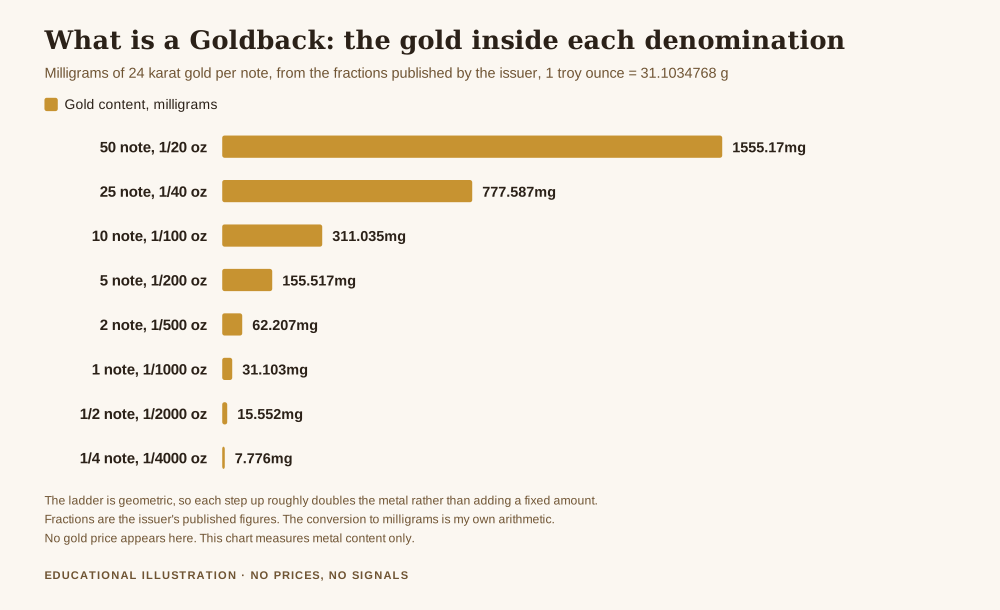
Two things are worth noticing in that chart. The ladder is geometric rather than linear, so each step roughly doubles the metal instead of adding a fixed amount. And the quantities at the bottom are genuinely tiny. Seven point eight milligrams is a speck. That is the entire point of the product, and it is also the source of everything that follows.
What you are actually paying for
Here is where the measuring gets useful, and I want to be careful to use only the issuer's own published figures.
On the same page that describes the technology, the issuer states that the result "is a physical currency that can be spent for as little as $2 to $3". That sentence refers to the smallest denomination, the quarter note, which contains one four thousandth of a troy ounce.
So do the multiplication. If a quarter note changes hands at 2 dollars, and it takes 4,000 quarter notes to assemble one troy ounce of gold, the implied cost of that troy ounce is 8,000 dollars. At 3 dollars a note, the implied cost is 12,000 dollars. That is my arithmetic, not the issuer's, and the only inputs are their published fraction and their published spending range.
Compare that implied figure to whatever an ounce of gold is fetching in the wholesale market on the day you read this, and you have the number that matters. I am not going to quote a gold price here, because this journal does not publish price levels, and because you can look it up in ten seconds and the comparison is more convincing when you do it yourself.
The gap is not a scandal. It is a manufacturing and distribution margin, and the issuer is open about its components. Its exchange rate page says the rate "reflects the current market value of gold as well as the labor, technology, and counterfeiting security required to create Goldbacks". Atomising gold to four thousandths of an ounce, laminating it, printing security features and distributing the result through a merchant network costs real money. Somebody pays for it, and that somebody is the buyer.
What follows from this is a single practical rule. A Goldback is a manufactured product with gold inside it, priced like a manufactured product. It is not a cheap way to accumulate metal, and nothing on the issuer's site claims it is.
Why the exchange rate is not a gold price
This is the part most likely to cost somebody money, so read it twice.
The Goldback exchange rate is published by the issuer and, per its own page, updated daily at 10am Mountain Time. It moves with gold, because the metal content is real. But by the issuer's own description it also contains the labor, technology and security costs quoted above, and those are not market determined in the way a metal price is.
That means a change in the Goldback exchange rate over time is a change in two things at once: the metal and the margin. A rise in the quoted rate does not tell you, on its own, that gold rose by that amount. Those are separate measurements with separate causes, and treating one as a proxy for the other is the error to avoid.
The issuer's own site illustrates the difficulty. It states that Goldbacks "have appreciated nearly 20% on average per year", and on the same page a comparison table lists an average annual growth rate of 14.47 per cent for Goldbacks since inception in 2019, alongside figures for other assets measured over ten years. Those two statements about the same product sit a few hundred pixels apart, and they do not agree with each other.
The comparison table has a second problem, and it is the one worth learning from. Its rows cover different periods. The Goldback figure runs from 2019. The other rows run over ten years. A number since 2019 and a number since 2016 are not comparable quantities, whatever the column heading says, and no conclusion about relative performance survives that mismatch. If you want to know how the metal itself did over either window, the honest route is to look up gold's own record for those exact dates, which takes a minute and does not depend on anybody's marketing page.
I am not accusing anyone of anything. I am pointing at an arithmetic problem that is visible on the page, because spotting that kind of problem is a transferable skill and it will save you more money on other products than it will on this one.
Where small denominations come from
It would be easy to read all this as an argument that hyperfractional gold is silly. It is not. There is a real demand behind it, and the World Gold Council's published Gold Demand Trends research shows where it comes from.
In its Q2 2026 release, dated 5 August 2026, the Council reported total gold demand including over the counter activity unchanged year on year at 1,269 tonnes for the quarter, taking first half demand to 2,522 tonnes, up 2 per cent, with a record value of 380 billion US dollars. The same body of research repeatedly notes that jewellery demand has been subdued in volume terms because high prices weigh on affordability, while bar and coin investment has held up better.
Read those two observations together. Demand in value terms at a record, volumes under pressure from affordability. That is a market where buyers want exposure to the metal but cannot comfortably buy it in the unit sizes the market traditionally offers. Products that break the ounce into smaller pieces exist because that pressure is real.
Which brings us to the honest summary of the trade off. Smaller units cost more per unit of metal, because the manufacturing cost per piece does not shrink as fast as the piece does. You are paying for divisibility and for spendability. Whether that is worth it depends entirely on whether you will actually use those properties, and most buyers of small gold products never do.
What this article does not say
It does not say Goldbacks are a scam. The metal content is published, the fractions are specific, and the issuer is open about the rate containing non metal costs. That is more disclosure than many products offer.
It does not say they are legal tender. They are a privately issued product used by a network of participating merchants, and that is a different thing from money a court will make somebody accept.
It does not quote a current exchange rate. The rate on the issuer's page is loaded dynamically and I could not read it from a plain request, so rather than guess, I have used only the fraction and the spending range the issuer states in words.
And it does not tell you to buy or avoid them. It tells you to separate the metal from the margin before deciding, which is the same thing I would say about a coin with a high premium, a numismatic piece, or any gold product sold on a story.
Get the free Black Gold Market blueprint, a short document on protecting capital and on separating a claim from its source before you act on it. One email, no spam, unsubscribe anytime.
Get the free blueprint →Frequently asked questions
What is a Goldback, in one sentence?
A privately issued polymer note containing a published fraction of a troy ounce of 24 karat gold, sold as a spendable currency within a merchant network rather than as a bullion product.
How much gold is in a 1 Goldback?
One thousandth of a troy ounce, which is 31.103 milligrams, using the definition that one troy ounce is 31.1034768 grams. The quarter note holds 7.776 milligrams and the 50 note holds 1.555 grams.
Are Goldbacks worth more than the gold inside them?
Yes, and the issuer says so. Its exchange rate page states that the rate reflects the market value of gold plus the labor, technology and counterfeiting security needed to make the notes. The premium pays for manufacturing and distribution, not for extra metal.
Are Goldbacks legal tender?
They are a privately issued product accepted by participating merchants. That is not the same as legal tender, and acceptance depends on the business in front of you rather than on law.
Does the Goldback exchange rate track the gold price?
It moves with gold because the metal content is real, but it is not a gold price. By the issuer's own description it also contains non metal costs, so a change in the rate combines a change in the metal with a change in the margin.
Does any of this matter for trading XAU/USD?
Not directly. A contract on the gold price and a physical note are different instruments with different costs and different purposes. What carries across is the habit of separating the asset from the wrapper before you pay for either.
Where Black Gold Market fits
Black Gold Market is a free journal about reading gold and protecting capital, written for people who would rather check a primary source than be told what to think. Nothing here is sold on a promise of returns and there is no signal service. The free blueprint is a short document on protecting capital and on the unglamorous checks that decide whether a claim holds up. The piece underneath all of it is how to protect your capital when gold gets volatile, and two companions to this one are allocated versus unallocated gold and how much it costs to store gold.
About the author. Raphael writes Black Gold Market. He has a weakness for products that look like money and a habit of weighing them anyway, which is how an afternoon that started with a photograph of a shiny note ended in a spreadsheet of milligrams. What matters to him is the level, the context, and the risk, in that order.
This article is educational and is not financial advice. Trading gold and other leveraged products carries a high risk of losing money rapidly, and no entry, stop or target discussed should be treated as a signal. The gold content fractions, the eight denomination ladder, the description of the atomizing and lamination process, the 2 to 3 dollar spending range for the smallest denomination, the statement that the exchange rate reflects the market value of gold plus labor, technology and counterfeiting security, the daily 10am Mountain Time update and the growth claims of nearly 20 per cent a year and 14.47 per cent since inception are all quoted from the issuer's own About and Exchange Rate pages, linked above and checked live before publication. The gold demand figures of 1,269 tonnes in Q2 2026, 2,522 tonnes for the first half and a record value of 380 billion US dollars are from the World Gold Council's Gold Demand Trends release dated 5 August 2026, also linked. The conversion of each fraction into milligrams, and the implied 8,000 to 12,000 dollars per troy ounce derived from the issuer's own 2 to 3 dollar range for a one four thousandth ounce note, are my own arithmetic on the definition that one troy ounce is 31.1034768 grams. No gold price is quoted anywhere in this article. Decide your own risk, and never trade money you cannot afford to lose.