

Ask what is gold filled base metal and you will usually get an answer about jewellery quality, which misses the point. The phrase describes a sandwich: a core of cheap metal, usually brass or nickel, with a layer of real gold alloy bonded to the outside. The useful question is not whether that counts as gold. It is how much gold the law actually obliges the seller to put there before they are allowed to print the words on the tag, and the answer is a surprisingly precise fraction. In the United States the Federal Trade Commission's jewellery guides set that fraction, and once you know it you can price any such item in your head instead of taking the seller's word.
What is gold filled base metal, in one sentence
Gold filled means a layer of gold alloy has been bonded mechanically to a base metal core, by soldering, brazing, welding or rolling, and that the layer is at least one twentieth of the weight of all the metal in the article. The base metal is the part doing the structural work. The gold is a skin, and the rule is about how thick a skin has to be before the word is allowed.
Two details in that sentence carry all the weight. The first is mechanical bonding, which separates gold filled from anything applied by electroplating. The second is the one twentieth by weight, which is the only number in the whole subject that tells you what you are buying.
The four terms, and the minimum each one guarantees
There are four markings in common use, and they are not interchangeable. The guides set each one out separately.
Gold filled. A plating of gold alloy of not less than 10 karat fineness, affixed by a mechanical process to all significant surfaces, where the plating is at least one twentieth of the weight of the metal in the entire article. The karat fineness has to be printed immediately before the term, and in equally conspicuous type, which is why a correct mark reads 14K gold filled rather than just gold filled.
Gold plate, gold overlay, rolled gold plate. Same mechanical process and the same minimum 10 karat alloy, but the threshold drops to one fortieth of the weight of the metal in the article. Half as much gold, different word, and the two sit next to each other in the same display case.
Gold electroplate. Applied by an electrolytic process rather than mechanically, minimum 10 karat alloy again, and specified by thickness instead of weight: a minimum of 0.175 microns throughout, which the guides note is about seven millionths of an inch.
Heavy gold electroplate. The same process at a minimum of 2.5 microns, about one hundred millionths of an inch.
Notice that the first two are measured as a share of the object's weight while the second two are measured as a depth. That is not an accident of drafting. It means the gold content of a plated item depends on how large the item is, and the gold content of a filled item does not.
What that means on a real object
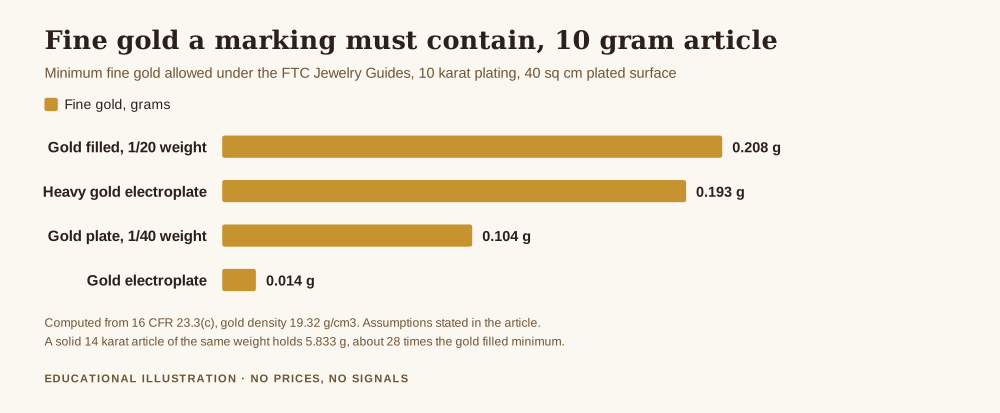
Numbers in fractions are easy to nod along to and hard to feel, so here is the arithmetic on something you could hold. Assume an article with 10 grams of metal in total, assume the plating is 10 karat because that is the minimum the rule allows, and assume 40 square centimetres of plated surface. Gold has a density of 19.32 grams per cubic centimetre. Those are my assumptions, stated so you can change them.
Gold filled at one twentieth means 0.5 grams of 10 karat alloy. Since 10 karat is ten parts in twenty four, that is 0.208 grams of fine gold. Gold plate at one fortieth gives 0.25 grams of alloy, so 0.104 grams of fine gold. Electroplate at 0.175 microns over 40 square centimetres is 0.0007 cubic centimetres of gold, which is 0.014 grams. Heavy electroplate at 2.5 microns is 0.193 grams.
Read those four figures against each other and the hierarchy stops being a matter of marketing language. A minimum gold filled article carries about fifteen times the fine gold of a minimum electroplated one. And the one that sounds most impressive, heavy gold electroplate, lands just below plain gold filled on these assumptions, which is the sort of thing the words alone will never tell you.
For scale, a solid 14 karat article of the same 10 grams holds 5.833 grams of fine gold, about 28 times the gold filled minimum. Minimum gold filled works out at roughly 2 per cent of the object's weight in fine gold. That is the honest answer to what you are buying when the tag says gold filled, and it is why the price of such an item should sit far closer to the price of the labour than to the price of the metal.
The deception the rule names out loud
One passage in the guides is worth reading twice, because it describes a specific construction that exists only to mislead. It is deceptive to use gold plate, gold filled, rolled gold plate or gold overlay to describe a product where the layer of gold plating has been covered with a base metal such as nickel, which is then covered with a thin wash of gold, unless that arrangement is disclosed.
Read that slowly. Gold, then base metal, then a whisper of gold on the outside. The object passes a surface test, carries a legitimate sounding mark, and the gold you can see is not the gold you are paying for. The fact that a federal guide had to name this construction specifically tells you how often it has been built.
It also explains why a scratch test or an acid test on the outer surface proves very little on a plated item. Those tests read the skin. The question is what sits underneath it, and the only honest answers come from weight, from displacement, and from a mark you can verify.
The karat mark has a legal tolerance, and it is small
If an item is marked with a karat fineness, the National Stamping Act sets how far the real metal may fall short of the mark. The actual fineness must not be less than the marked fineness by more than three one thousandth parts, tested on a part that contains no solder. When the whole article is assayed as one piece including solder and brazing alloys, the allowance is three one thousandth parts for a watchcase or flatware, and seven one thousandth parts for any other article.
Three parts per thousand is 0.3 per cent. Seven is 0.7 per cent. These are manufacturing tolerances, not room for interpretation, and that matters for a practical reason: an item whose assay comes back meaningfully below its mark is not within a grey area. It is mismarked, and a seller who shrugs at a gap of several per cent is telling you something about the seller.
What the word solid is not allowed to mean
There is a related trap worth knowing, because it catches people who have correctly learned to avoid plating. An article made throughout of gold alloy but built with a hollow centre, tubing for example, should disclose the hollow centre next to the karat mark, and should not be described as solid. A 14 karat hollow bangle is gold all the way through the metal that is present. There is simply much less metal present than the size suggests.
So solid, in the trade sense, is a claim about construction rather than about purity, and it is the claim most often made loosely. Gold filled is at least an honest word about a sandwich. Solid applied to a hollow piece is not.
How to check any of this yourself in ten minutes
None of the figures above need to be taken from me.
- Open the jewellery guides linked below and find section 23.3. Read paragraph (c)(2) and you will see one fortieth for gold plate and overlay, and the sentence that raises it to one twentieth for gold filled.
- In the same paragraph, read (c)(3) for the electroplate thicknesses, 0.175 microns and 2.5 microns, with the inch equivalents in brackets.
- Read paragraph (b)(7) for the gold over base metal over gold wash construction described above.
- Take the weight of an item in grams, divide by 20, then multiply by the karat number and divide by 24. That is the minimum fine gold its gold filled mark guarantees.
- Open the National Stamping Act section linked below and search for one thousandth parts to confirm the tolerances.
Every number in this article comes out of those five steps. That is the standard I would like applied to anything else you read about this market, including what I write.
Why a trading journal cares about jewellery law
Because the habit transfers, and because the failure mode is identical. In both cases a word on a label is standing in for a quantity, and the person using the word benefits from you not checking which quantity. Gold filled sounds like gold with something extra. It means one twentieth by weight, minimum, over a core of brass.
The same gap sits between a trading claim and the arithmetic behind it. A seller says a strategy is proven, a signal channel says it is accurate, and the number that would settle it is never shown. The reader who divides the weight by twenty is the same reader who asks how many trades that record covers, and both questions are unwelcome in the same way.
Protecting capital is mostly this. Not cleverness, and not prediction, just a standing refusal to accept a word where a number belongs.
Get the free Black Gold Market blueprint, the capital protection material in one place, for anyone who would rather check a claim than take it on trust. One email, no spam, unsubscribe anytime.
Get the free blueprint →Frequently asked questions
Is gold filled real gold?
The layer is real gold alloy, at least 10 karat, bonded mechanically to a base metal core. It is not solid gold, and the guides require it to be at least one twentieth of the article's metal weight. On a 10 gram piece at the minimum, that is 0.5 grams of alloy holding about 0.208 grams of fine gold, with the other 9.5 grams being the base metal underneath.
What base metal is usually underneath?
Commonly brass, sometimes nickel or another inexpensive alloy. The guides do not prescribe which base metal is used, they govern what the gold layer must be and what the seller is allowed to call it. If you have a nickel sensitivity, the marking will not answer that question for you and you have to ask separately.
Is gold filled better than gold plated?
By gold content, yes, and by a defined margin rather than a vague one. Gold filled requires at least one twentieth of the metal weight, gold plate and rolled gold plate require one fortieth, so the minimum is twice as much. Against electroplate the gap is far wider, roughly fifteen times on the worked example above.
Can I test gold filled at home?
Only partly, and that limitation is the important part. Surface tests read the skin, which on a plated or filled item is genuinely gold, so they tell you little about the core. Weight against displacement gives you an overall density that will sit well below solid gold. For anything you are paying a real sum for, an assay by a professional is the answer rather than a kit.
Does gold filled hold its value?
Its metal content is small, so most of what you pay sits in design, brand and labour rather than in gold. That is not an argument against buying it, it is an argument against buying it as metal exposure. If the reason for the purchase is to own gold, the quantity question above is the one to answer first.
Where Black Gold Market fits
Black Gold Market is free to follow. Daily XAU/USD analysis with the level, the context and the risk stated before the trade, losing days included, on Telegram. There is a free blueprint for anyone who wants the capital protection material in one place, and an optional Kit for people who want the full method. Nothing here promises a profit, and nothing here is a signal service. The groundwork this article rests on is in protecting your capital when gold gets volatile, the same measure before you trust it habit is applied to raw metal in the difference between gold and pyrite and to finished items in the difference between real and fake gold, and the seller side of the question is in how to spot a gold trading scam.
Outside sources used here: the FTC jewellery guides at 16 CFR 23.3 for the gold filled, gold plate and electroplate definitions and thresholds, and the National Stamping Act at 15 U.S.C. 295 for the marking tolerances.
About the author. Raphael writes Black Gold Market. He came to gold through the macro side rather than the chart side, and his standing complaint is that most commentary states a conclusion without ever showing where the number came from. He would rather hand you a smaller claim you can check yourself than a large one you have to trust. Figures here are from the published sources linked above, the calculations state their assumptions so you can repeat them, nothing in this article forecasts the price of gold or is a recommendation to trade or buy any metal, item or dealer, it is not investment advice, and no entry, stop or target discussed should be treated as a signal.