

A member asked me last month why his account was smaller at the end of a flat quarter. He had finished roughly where he started on the trades themselves, by his own count, and still the balance had slipped. He wanted to know where it went. That question, how much does it cost to trade gold, is one almost nobody answers properly, because the answer is not a single number on a schedule. It is four separate charges, and only one of them is printed where you can see it.
So let me count all four. I will price them per standard lot, because that is the only unit that stays stable, and I will not use a gold price anywhere in this article. You do not need one. Most of these costs are fixed in dollars per ounce traded, which means they are the same whatever the metal happens to be worth this morning.
Everything numerical below is my own calculation from assumptions I state as I go, apart from two published figures I have sourced and linked. Nothing here is a recommendation to trade.
How much does it cost to trade gold, counted properly
Start with the unit. A standard lot of spot gold is 100 ounces. Throughout this article I assume a spread of 0.30 dollars an ounce on the round turn and a commission of 3.50 dollars a side on a raw spread style account. Both are assumptions, chosen because they are unremarkable, and both are things you can replace with your own broker's numbers in about two minutes. The structure of the answer does not change when you do.
On those assumptions, one lot costs 30 dollars in spread and 7 dollars in commission to open and close. Thirty seven dollars, round turn, before the position has done anything at all.
That number looks small, and this is exactly where the reasoning usually stops. It should not, because the thirty seven dollars is not the cost. It is the cost per round turn, and the bill is set by how many round turns you do.
The bill is your turnover, not your fee schedule
Trade one lot a day across 250 trading days and the dealing cost is 9,250 dollars a year. At a tenth of a lot a day it is 925 dollars. At two lots a day it is 18,500 dollars.
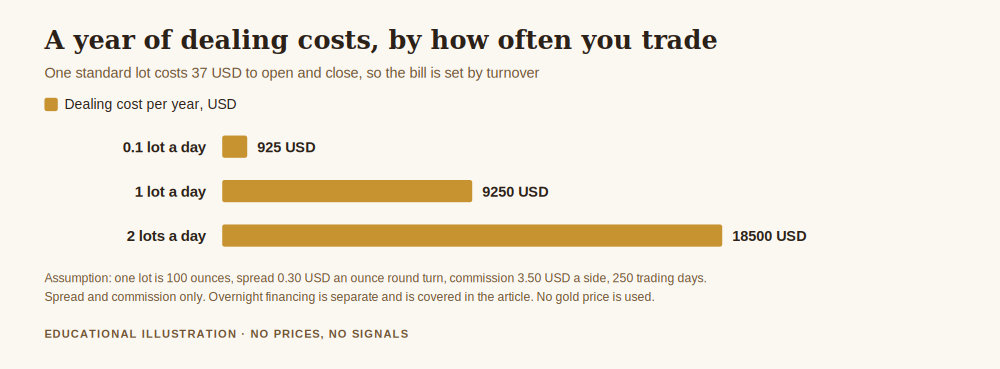
Read that chart as a statement about behaviour rather than about brokers. Nothing in it changes the spread or the commission. The only variable is how often you trade, and it moves the annual cost by a factor of twenty.
There is a second way to express the same figure that I find lands harder. Nine thousand two hundred and fifty dollars across 250 lots of 100 ounces is 37 cents per ounce traded. Every ounce that passes through your account, in and out, leaves 37 cents behind. If you cannot name an edge that is reliably larger than 37 cents an ounce, the arithmetic has already decided the outcome, and no amount of chart reading will overturn it.
What that bill looks like next to your account
Costs mean nothing in isolation. Set that one lot a day habit, 9,250 dollars a year, against the account paying it:
- On a 2,000 dollar account, 462 per cent of the account, which is not a cost structure, it is a countdown.
- On a 5,000 dollar account, 185 per cent.
- On a 10,000 dollar account, 92 per cent.
- On a 25,000 dollar account, 37 per cent.
- On a 50,000 dollar account, 18 per cent.
The same trader, with the same method and the same broker, is in a completely different business at the top of that list and the bottom of it. The small account is not losing because the method is worse. It is losing because the turnover was copied from somebody with ten times the capital, and dealing costs do not scale down when your balance does.
This is the single most useful thing I know about trading costs, and it is why I treat turnover as a risk parameter rather than a matter of style. If you want the other half of this calculation, how much you need to trade gold approaches it from the capital side.
The third charge: financing, which runs while you sleep
A leveraged gold position is a borrowed position, and borrowed money is charged for. That charge tracks short term dollar interest rates, so it is not something your broker invents freely.
In the Federal Reserve's H.15 release of selected interest rates dated 1 October 2026, the effective federal funds rate stood at 3.88 per cent. Treat that as the floor. Holding a position for 30 days at that rate costs about 0.32 per cent of the position's value, and 90 days costs about 0.96 per cent. Brokers add a markup on top, and a realistic two points of markup takes the 30 day figure to roughly 0.48 per cent and the 90 day figure to about 1.45 per cent.
Notice what that does to the comparison between styles. A day trader pays almost no financing and a very large dealing bill. A position trader holding for a quarter pays one round turn of spread and commission, and then something in the region of one and a half per cent of the position's value in financing. Neither is cheaper in general. They are different cost structures, and the one that suits you depends on how often you intend to deal. What swap charges actually are goes through the nightly mechanics in more detail.
The fourth charge: the one with no invoice
The three above are quantifiable in advance. The fourth is not, and it is the reason my member's quarter did not balance.
Spread is not constant. It is narrow when the market is calm and wide when it is not, which means it is widest at precisely the moments most people choose to trade: the minute of a release, the first seconds of a session, the gap after a weekend. The 0.30 dollars an ounce I assumed above is a quiet market number. If a third of your trades happen in conditions where the spread is three times that, your real average is not 0.30, and your real annual bill is not 9,250 dollars.
You cannot look this up. You can only measure it, by recording the spread at the moment you dealt rather than the spread advertised on the website. A month of that in a journal will tell you more about your cost base than any fee comparison table.
Where the regulator's numbers fit in
Two published figures are worth holding alongside your own arithmetic.
The first is leverage. Under the product intervention measures agreed by ESMA, the European Securities and Markets Authority, retail leverage on gold CFDs is capped at 20 to 1, with a margin close out at 50 per cent of required margin and negative balance protection on a per account basis. Leverage is not itself a cost, but it decides how large a position your deposit can carry, and position size is the multiplier on every charge in this article.
The second is the outcome. In the same announcement, ESMA reported that national regulators found between 74 and 89 per cent of retail accounts typically lose money on CFDs, with average losses per client ranging from 1,600 to 29,000 euros. I do not quote that to be grim. I quote it because the cost arithmetic above is a substantial part of the explanation, and it is the part that is entirely within your control.
What this calculation does not include
Three things, named so you do not mistake the figure for the whole truth.
It excludes the cost of being wrong, which is far larger than any of this and is governed by position size rather than by fees. It excludes platform, data and withdrawal charges, which vary enormously and which you should add from your own statement. And it excludes tax, which depends on where you live and is outside what I can usefully say.
What it does include is the part that is fixed, knowable and payable whether or not you are right. That is the part worth getting straight before anything else, because it is the only part of your trading you can reduce this week with certainty.
If you want the broker side of the decision, commission against spread compares the two fee models directly and works out where the crossover sits. This article is the layer above that one: once you have picked a model, the number that decides your bill is how often you deal.
A ten minute audit of your own cost base
Replace my assumptions with yours. Open your statement and take the last full month. Count the lots you actually traded, not the trades, because two trades of half a lot cost the same as one trade of a full lot. Multiply the lot count by your own round turn figure, the one you worked out above. That is your monthly dealing bill. Multiply by twelve.
Now put that annual number next to your account balance and say the percentage out loud. Most traders I have done this with have never seen the figure before, and the reaction is consistent: nobody argues with it, and nobody carries on trading at quite the same frequency afterwards. It is the rare piece of trading arithmetic that changes behaviour on the day you do it, because unlike a losing trade, there is nothing to dispute and nobody to blame.
Then do the second half, which takes longer and matters more. For one month, write down the spread at the moment you dealt. Not the advertised spread, the one on your ticket. At the end of the month compare the average against the number you assumed. The gap between those two figures is the cost you have been paying without knowing it, and in my experience it is the larger half of the surprise.
Get the free Black Gold Market blueprint, a short document on protecting capital before you try to grow it, including how to work out your own annual dealing bill before it works itself out on your statement. One email, no spam, unsubscribe anytime.
Get the free blueprint →Frequently asked questions
How much does it cost to trade gold per lot?
On the assumptions in this article, a spread of 0.30 dollars an ounce and a commission of 3.50 dollars a side, one standard lot of 100 ounces costs 37 dollars to open and close. Your own figure will differ, and the way to find it is to take your broker's typical gold spread, multiply by 100, then add both sides of the commission.
Is a zero commission account cheaper?
Not automatically, because the commission is usually folded into a wider spread instead. The only way to compare is to convert both to the same unit: total dollars per lot on the round turn. A zero commission account with a spread 0.10 dollars an ounce wider than a raw account is charging you 10 dollars a lot for the privilege, against the 7 dollars of commission you avoided.
Do I pay the spread twice?
You pay it once per round turn, which is the figure used throughout this article. The confusion arises because you see it immediately: a position shows a small loss the moment it opens, and that is the spread being charged at entry rather than an extra charge at exit.
How much does financing add?
It depends entirely on how long you hold. At the 3.88 per cent effective federal funds rate in the Fed's H.15 release of 1 October 2026, plus a realistic two points of broker markup, roughly 0.48 per cent of the position's value over 30 days and about 1.45 per cent over 90. For an intraday position it is nil, which is why the comparison between styles has to include both charges rather than one.
Why do you not use a gold price in the calculation?
Because the dealing costs do not need one. Spread and commission are quoted per ounce and per lot, so they are the same in dollars whatever gold is worth. Financing is the one charge that scales with the price, which is why I express it as a percentage of the position's value rather than as a number of dollars.
What is the single fastest way to cut this bill?
Deal less often. Changing broker might move the bill by a fifth. Halving your turnover halves it exactly, and it is the only lever in this article that you control completely and can pull tomorrow.
Where Black Gold Market fits
Black Gold Market is a free journal about reading gold and protecting capital, written for traders who would rather understand a mechanism than be handed a conclusion. Everything on the site is free to read and there is nothing to buy to follow along. The optional piece is the Sustainable Trader's Blueprint above, a short document on protecting capital before trying to grow it. We do not promise profits, we do not publish results, and we do not think anyone can tell you what your account will do. The piece this one sits underneath is how to protect your capital when gold gets volatile.
About the author. Raphael writes Black Gold Market. He traded for two years without once adding up what his turnover was costing him, and the month he finally did it he cut his trade count by half and his results improved, which told him something uncomfortable about the trades he had been removing. Nothing in this article is a recommendation to trade, and no entry, stop or target discussed should be treated as a signal.