
The question arrives in almost the same words every week. Someone has decided to trade gold, they have found a broker, and before anything else they want to know how much do you need to trade gold in the first place, meaning the size of the cheque they have to write.
That question has two answers, and they differ by roughly a factor of ten. One of them is printed on the broker's website in large friendly numbers. The other one decides whether you are still trading in a year. Most people find the first number, act on it, and then meet the second number later, under much worse conditions.
This article separates the two. There is no gold price anywhere in it, and there does not need to be, because both answers are ratios rather than prices.
How Much Do You Need to Trade Gold, in Plain Terms
When a broker tells you the minimum to open a gold position, they are quoting margin. Margin is the deposit the firm holds while your position is open. It is not a fee and it is not the cost of the trade. It is collateral, and the size of it is set by a leverage cap.
For retail clients in Europe, that cap is not a matter of taste. The European Securities and Markets Authority set it in its product intervention measures of 27 March 2018, and the wording is specific: leverage limits of 20:1 for non-major currency pairs, gold and major indices
. Gold is named directly, in the same clause as non-major currency pairs.
A cap of 20 to 1 means the deposit is one twentieth of the position, which is 5.00 percent. That gives an arithmetic so simple it fits on one line.
- Notional value of 1,000, margin required 50
- Notional value of 5,000, margin required 250
- Notional value of 10,000, margin required 500
- Notional value of 20,000, margin required 1,000
- Notional value of 50,000, margin required 2,500
So if you take the question literally, the answer is small. A few hundred units of account currency will hold a position. This is true, it is checkable, and it is the reason the marketing on most broker pages leads with it.
Why Margin Answers a Different Question
Here is the part that gets skipped. Margin tells you whether the firm will allow the position. It says nothing at all about whether the position will survive an ordinary bad week.
Those are genuinely different questions, and confusing them is the single most expensive mistake a new gold trader makes. Margin is a permission. Survival is an arithmetic. The broker checks the first one for you, automatically, every time you click. Nobody checks the second one except you.
Think about what the margin number leaves out. It does not know where your stop is. It does not know how much of your account one losing trade will remove. It does not know how many losing trades you are likely to string together. It is a collateral calculation, and collateral calculations are indifferent to your survival.
The Number That Actually Decides: Your Smallest Possible Loss
Work the problem from the other end. Instead of asking what the broker requires, ask what the smallest trade you can physically place would cost you if it goes wrong.
Gold positions are quoted in ounces. The common broker convention, and it is a convention rather than a law, is that one standard lot is 100 ounces, one mini lot is 10 ounces, and one micro lot is 1 ounce. The micro lot matters more than anything else on this page, because it is the floor. You cannot trade less than the smallest size your broker offers.
Now put a stop on it. Call the distance from your entry to your stop S, measured in account currency per ounce. If the stop is hit, a one ounce position loses exactly S. A ten ounce position loses ten times S. There is no way around this: it is multiplication.
The standard risk discipline, and the one this journal keeps returning to, is that no single trade should cost more than about 1.00 percent of the account. Turn that into a requirement and you get the real answer:
Account needed = 100 × (the money you lose if the stop is hit).
Run it for a mini lot of 10 ounces at three plausible stop distances, and the numbers stop being abstract.
- Stop of 5 per ounce: the trade risks 50, so the account needs about 5,000
- Stop of 10 per ounce: the trade risks 100, so the account needs about 10,000
- Stop of 20 per ounce: the trade risks 200, so the account needs about 20,000
At the micro level of one ounce, the same three stops need roughly 500, 1,000 and 2,000. That is the honest entry point, and notice that it is driven entirely by the stop distance, which is a property of the market and your method, not of the broker.
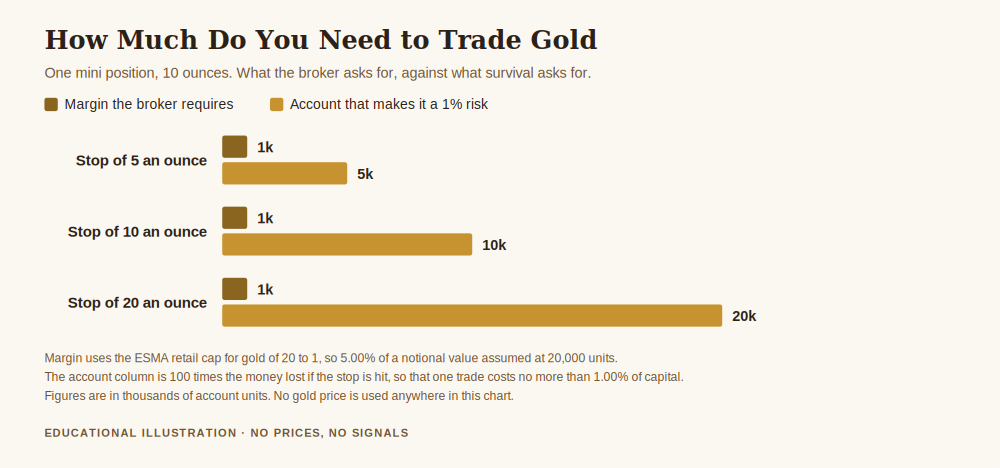
Look at what the chart does. The dark bar, the margin the broker requires, is flat. It is the same 1,000 whatever the stop distance, because margin is calculated from the size of the position and not from the risk in it. The light bar, the account that keeps the same trade to a 1.00 percent risk, quadruples across the same three rows.
For that middle row, the mini position with a stop of 10 an ounce, the two answers are 1,000 and 10,000. The account you actually need is ten times the deposit you are asked for. Both numbers are correct. They are answers to different questions, and only one of them is about you.
What a Losing Streak Does to Each Answer
The gap widens under pressure, which is exactly when it matters. Suppose the trades go against you several times in a row, as they eventually will. Capital remaining after n consecutive losses is (1 - r) to the power of n, where r is the share of the account risked each time.
- At 1.00 percent per trade: 5 losses leave 95.10 percent, 10 leave 90.44 percent, 20 leave 81.79 percent
- At 2.00 percent per trade: 5 losses leave 90.39 percent, 10 leave 81.71 percent, 20 leave 66.76 percent
- At 5.00 percent per trade: 5 losses leave 77.38 percent, 10 leave 59.87 percent, 20 leave 35.85 percent
The trader who funded the account to the margin number is not risking 1.00 percent per trade. They cannot be. If the smallest position they can open already costs 100 when the stop is hit, and they deposited 1,000, then every single trade is a 10 percent risk whether they intended it or not. Twenty ordinary losing trades take an account like that down to about an eighth of what it started with.
This is why the answer to how much you need is not a preference. Underfunding does not make you a smaller trader. It makes you a trader whose position size was chosen by the broker's minimum rather than by you.
The Close-Out Rule You Do Not Control
There is one more mechanism worth knowing, because it removes your discretion entirely. The same ESMA measures include a margin close out rule on a per account basis
, standardising the level at 50 percent of minimum required margin, alongside negative balance protection on a per account basis
.
Read that carefully. Negative balance protection is genuinely good news, and it is the reason a retail account in a protected jurisdiction cannot end a bad day owing money it never deposited. But the close-out rule is not a courtesy. When your equity falls under that threshold, the firm closes positions. Not you, and not at a moment of your choosing.
An account funded to the margin minimum lives permanently close to that line. A single ordinary move against a thinly funded position can put you inside the close-out zone, and the position is then shut at whatever price exists at that instant. The account was never really trading a method. It was waiting to be closed out.
Get the free Black Gold Market blueprint, a short document on sizing an account from the stop rather than from the broker's minimum, including the arithmetic used on this page. One email, no spam, unsubscribe anytime.
Get the free blueprint →Frequently Asked Questions
How much do you need to trade gold, in one sentence?
Enough that the smallest position you can open costs no more than about 1.00 percent of the account when the stop is hit, which for a one ounce position with a stop of 10 an ounce is roughly 1,000 units of account currency, and considerably more for larger positions.
Can I start with the broker's minimum deposit?
You can open an account and place trades, yes. What you cannot do is control your risk per trade, because the smallest available position will already be a large share of a small account. The deposit minimum is a commercial threshold, not a risk assessment.
Does the 20 to 1 cap apply to me?
It applies to retail clients of firms under the European regime described in the ESMA measures linked above. Other jurisdictions set their own caps, and some allow considerably more leverage. Higher leverage lowers the margin required and changes nothing at all about the survival arithmetic in the middle of this article.
Why does this article not use a gold price?
Because it does not need one, and a price would date the page within a week. Margin is a percentage of notional value, and the account requirement is a multiple of the money lost at the stop. Both are ratios, so both hold at any price.
Is a micro lot account worth trading at all?
It is worth trading if the arithmetic works, meaning the loss at your stop is about 1.00 percent of what you deposited. A properly sized small account is a real trading account. An underfunded larger position is not, whatever the equity figure says.
Where did the numbers in this article come from?
The 20 to 1 leverage cap for gold, the 50 percent margin close out level and negative balance protection are quoted from the ESMA measures linked above, which was checked live before publication. Every other figure is computed from the stated assumptions, a 1.00 percent risk limit and the lot conventions of 1, 10 and 100 ounces, and no figure depends on the price of gold.
Where Black Gold Market Fits
Black Gold Market is free to follow. Daily XAU/USD analysis with the level, the context and the risk stated before the trade, losing days included, on Telegram. There is a free blueprint for anyone who wants the capital protection material in one place, and an optional Kit for people who want the full method. Nothing here promises a profit, and nothing here is a signal service.
Protect comes first, and an account sized from the broker's minimum has skipped that step entirely. How to protect your capital when gold gets volatile is the pillar this article belongs under, position sizing so one trade cannot hurt you turns the same arithmetic into a repeatable routine, and what is a margin call and how to avoid one covers what happens when the close out rule described above actually fires. More about who writes this is on the about page.
About the author. Raphael writes Black Gold Market. He works on the part of this business that happens before the entry, the level, the context, and the risk, and he has a long standing objection to the habit of quoting beginners a deposit minimum as though it were a plan. Nothing in this article is a recommendation to trade, and no entry, stop or target discussed should be treated as a signal.
Disclaimer: This article is general educational content about margin, position sizing and account funding in retail gold trading. It is not financial advice, not investment advice and not a recommendation to buy, sell or use any product, venue or firm. Regulatory wording is quoted from the source linked in the text and may change. Trading leveraged products carries a substantial risk of loss and most retail accounts lose money. Figures are illustrative calculations from stated assumptions, not predictions or performance claims.