

A trader who has been using a spot account hears that the futures market is where the real gold price is set, looks at a commission schedule, and concludes the whole thing costs a few dollars a trade. So how much does it cost to trade gold futures gets answered with the one number that happens to be printed, and the much larger number, the one that never appears on any statement, goes uncounted for as long as the position is open.
This belongs under Protect. Not because futures are dangerous in some special way, but because a cost you cannot see is a cost you cannot budget for, and a position held across several months can quietly hand over more than the entire commission bill for the year.
In my inbox, about 92 messages mention leverage in some form. That is a keyword count in messages, not a survey, and it settles nothing on its own. But the suspicion in them is the right suspicion. One reader wrote: "Just an observation, rates at this site is not correct or maybe to much margin they are taking for each trade." Another asked: "Hi, is everything under control? If no margin remains, the account will be burned?" A third said simply: "Yea ive tried trading xauusd and that leverage is even worse." People can feel that something is being charged. They usually cannot name it.
It has a name, and it has a size you can compute to three decimal places.
How much does it cost to trade gold futures, counted in four parts
The bill splits into four, and they are not the same kind of thing.
One, the brokerage commission. A per contract charge, each way. It is printed, it is small, and it is the one every comparison article talks about.
Two, the exchange and clearing fees. Also per contract, also printed, also small. They vary by venue and by membership status, and your broker passes them through.
Three, the bid and ask. You buy at one price and sell at the other, and in a liquid contract the gap is narrow. You pay it once on the way in and once on the way out, and again every time you roll.
Four, the financing. This is the one with no invoice, and for anyone holding longer than a few days it is almost always the largest of the four.
The charge with no invoice
A futures contract is an agreement to settle at a date in the future. You are not holding the metal now, you are holding a claim on it later, and you did not pay for it today. Somebody is carrying the cost of having the metal now instead of then, and the market prices that in rather than billing you for it.
The result is that the price of a contract for a later month is normally higher than the price of a nearer month, and the gap is not a forecast. It is arithmetic. If the gap were much larger than the cost of carrying the metal, a trader could buy the metal, sell the far contract, store it and pocket the difference without taking a view. People do exactly that, which is what keeps the gap close to the carrying cost rather than close to anyone's opinion.
So when your near contract expires and you move the position to the next month, you sell the cheaper one and buy the dearer one. The difference leaves your account. No line item appears, because nothing was charged. The money went into the price.
That is the whole mechanism. Everything else here is putting a number on it.
The arithmetic, with the assumptions written out
The carrying cost has three components: the financing of the money, the storage and insurance of the metal, and any income the metal earns from being lent out. Storage and lending tend to be small and tend to partly cancel, so I am going to set both to zero and say so plainly, because a reader who knows they exist should know I left them out on purpose. What remains is the financing, and the honest proxy for the financing is a short term interest rate.
The Federal Reserve publishes those in its H.15 selected interest rates release. In the release dated 23 October 2026, carrying figures for 22 October, the effective federal funds rate was 3.88 per cent and three month Treasury bills were 4.04 per cent.
Take 3.88 per cent as the annual rate. Then the financing carried by a futures position works out as a share of the contract's value:
Held for six weeks, about 0.448 per cent of contract value. Held for a quarter, about 0.970 per cent, which is 97 basis points. Held for two quarters, about 1.940 per cent. Held for a full year through four quarterly rolls, about 3.880 per cent.
At the three month bill rate of 4.04 per cent instead, each of those rises slightly: 0.466, 1.010, 2.020 and 4.040 per cent respectively.
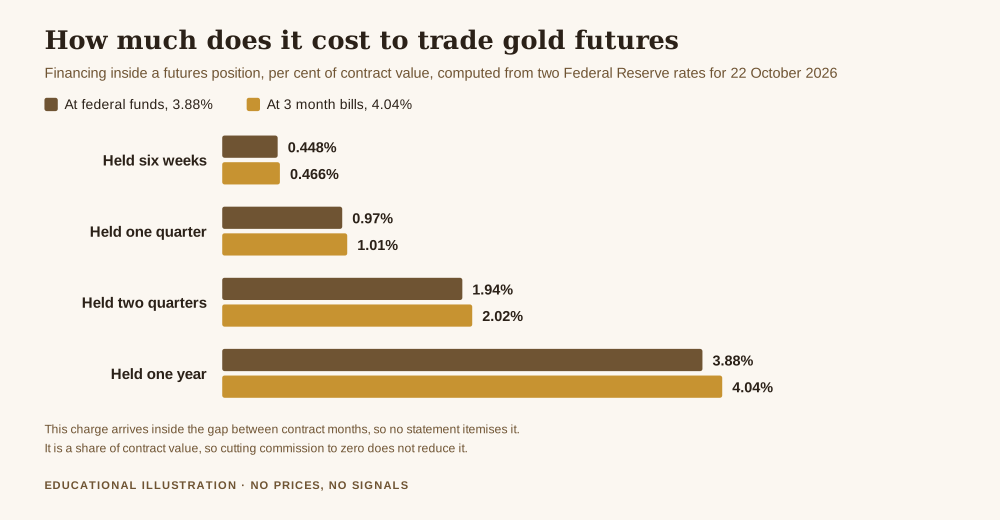
Notice that I have not used a gold price anywhere. I do not need one. The financing is a share of whatever the contract is worth, so the percentage holds whether the metal is expensive or cheap, and whether you hold one contract or forty. That is also why this number survives every promotion a broker will ever run.
Why cutting commission to zero does not touch this
Here is the part worth sitting with. Commissions and exchange fees are charged per contract. Financing is charged as a percentage of value. Those are different units, and they scale differently.
A broker can compete the commission down. A venue can rebate fees. None of that changes the relationship between a near contract and a far one, because that relationship is set by the cost of money and the absence of free lunches, not by anybody's pricing department. If every commission in the market went to zero tomorrow, a position held for a quarter would still have paid about 0.97 per cent of its value at these rates.
Run it forward and the scale becomes clear. At 3.88 per cent, the accumulated financing on a continuously held position reaches 10 per cent of contract value in about 2.58 years. A trader who rolls a position quietly for three years and wonders why the account has not kept pace with the metal has their answer, and it was never a trading mistake.
This is the same shape of problem as the one I worked through in the full bill for trading gold on a spot account, where the financing arrives as an overnight charge instead. Different plumbing, same money, and it is worth comparing the two before deciding the futures route is cheaper.
Get the free Black Gold Market blueprint, a short document on protecting capital before you try to grow it, including how to total the real cost of holding a position before you open one. One email, no spam, unsubscribe anytime.
Get the free blueprint →What the margin number is, and what it is not
One confusion is worth clearing, because it costs people real money.
The margin on a futures position is not a cost. It is a deposit. It sits in your account as collateral and it comes back when the position closes. Confusing the deposit with the price of the trade leads to two opposite errors: people think futures are expensive because the deposit is large, or they think the position is cheap because the deposit is a small fraction of the contract's value.
The deposit is set by a risk model rather than by your broker's goodwill, and it can be raised while you are holding. I went through who actually sets it and what happens when it moves in the piece on SPAN margin. The short version: plan for the number to change, because it does, usually at the least convenient moment.
What the deposit does cost you is the return you are not earning on it elsewhere. At the same week's rates, money parked as collateral is money not earning 4.04 per cent in bills, and that is a real figure to include in your own total even though nobody charges it to you.
What this calculation does not include
I would rather name the gaps than let them sit under the number.
It leaves out commission and exchange fees, which vary by broker and venue and which I cannot quote from a primary source without naming a firm. Find your own and add them.
It leaves out the bid and ask, paid on entry, on exit and at every roll. In a liquid contract this is narrow, but four rolls a year means eight extra crossings you would not have paid holding a single position.
It sets storage and the gold lending rate to zero. Both are real. In ordinary conditions they are small and partly offsetting, but when metal is tight the lending rate can move enough to shrink or even invert the gap between contract months, which is the condition I described in the piece on backwardation. When that happens, the sign of this calculation can flip, and the curve stops behaving like a simple financing charge.
It uses a published policy and bill rate rather than the specific rate embedded in any particular contract pair. The embedded rate is what you actually pay, and it can sit a little above or below these. These rates tell you the right order of magnitude and where the number comes from, which is the part most people are missing.
What a trader should actually do with this
Decide your holding period before you ask what the trade costs, because the answer depends almost entirely on that. A position you expect to close inside a week is dominated by commission and the bid and ask. A position you intend to hold for months is dominated by financing, and the commission comparison you spent an evening on will not matter.
Then write the financing into the plan as a number, not a feeling. At these rates, roughly 0.97 per cent of contract value per quarter. If the move you are expecting is smaller than the cost of waiting for it, that is useful to know before you are in, not after.
Frequently asked questions
How much does it cost to trade gold futures per contract?
The printed part, commission plus exchange and clearing fees, is small and varies by broker. The unprinted part is financing, which at a 3.88 per cent annual rate is about 0.970 per cent of contract value per quarter. For anything held beyond a few weeks the second number is the larger one.
Is trading futures cheaper than a spot or CFD account?
On commission, often. On financing, not inherently, because both routes make you pay for not having put up the full value of the metal. One charges it overnight and shows it, the other embeds it in the gap between contract months and does not. Compare the all in figure over your actual holding period rather than the headline fee.
Why does the far month cost more than the near month?
Because somebody has to finance and store metal between now and then. If the gap were much wider than that cost, traders would buy metal, sell the far contract and collect the difference risk free, and that activity pulls the gap back toward the carrying cost.
Does the margin deposit count as a cost?
No. It is collateral and it is returned. The real cost attached to it is the return you forgo by having it sit there, which at the same week's three month bill rate was 4.04 per cent a year.
Does rolling four times a year cost four times as much financing?
No. The financing accrues with time, not with the number of rolls, so four quarterly rolls and one continuous position carry roughly the same financing. What four rolls do add is four extra crossings of the bid and ask.
Where did the numbers in this article come from?
The 3.88 and 4.04 per cent rates are for 22 October 2026, from the Federal Reserve H.15 release published 23 October 2026 and linked above. Everything else, the 0.448, 0.970, 1.940, 3.880 per cent figures and the 2.58 years, is my own arithmetic from those rates, assuming the rate holds, storage and gold lending set to zero, and no commission or bid and ask included. Every one of those assumptions is stated so you can repeat the sum or reject it.
Where Black Gold Market Fits
Black Gold Market is free to follow. Daily XAU/USD analysis with the level, the context and the risk stated before the trade, losing days included, on Telegram. There is a free blueprint for anyone who wants the capital protection material in one place, and an optional Kit for people who want the full method. Nothing here promises a profit, and nothing here is a signal service.
About the author. Raphael writes Black Gold Market. He works on the part of this business that happens before the entry, the level, the context, and the risk, and he would rather total a holding cost on paper than discover it in a year of flat performance. Nothing in this article is a recommendation to trade, and no entry, stop or target discussed should be treated as a signal.