

Ask a dozen people how much does it cost to start mining gold and you will get a dozen answers that are all wrong in the same direction, because almost all of them answer a different question: what a mine costs. A mine is the end of the road, not the start of it. The start is a filing cabinet, a fee schedule and a date in September, and the whole of it is published by the United States government in figures you can add up yourself in a few minutes. That is what this article does. It takes the published fees, states every assumption out loud, and shows you what the first years actually cost before a single shovel of gravel moves.
How much does it cost to start mining gold, the number you can actually look up
On federal land in the United States, the right to look for gold begins with a mining claim, and a mining claim has a price list. The Bureau of Land Management publishes it. Read on 29 November 2026, the BLM mining claim fee page sets three charges on a new claim: a location fee of 49 US dollars, a processing fee of 25 US dollars, and an annual maintenance fee of 200 US dollars for a lode claim, a mill site or a tunnel site. Placer claims, which is what most people picture when they picture gold, are charged at 200 US dollars for each 20 acres or part of 20 acres.
Add the three and the first year of one new claim is 274 US dollars. Every year after that is 200 US dollars, due on or before 1 September, and the consequence of missing the date is not a late fee. It is forfeiture. The claim stops being yours.
That last sentence is the whole character of this business compressed into a line, and it is why I find the question worth answering properly. The cost of starting is small. The cost of continuing is annual, unforgiving and entirely independent of whether the ground has given you anything.
The arithmetic over a realistic horizon
Nobody proves out a piece of ground in twelve months, so one year is the wrong unit. Here is the same fee schedule run forward, calculated here from the published figures.
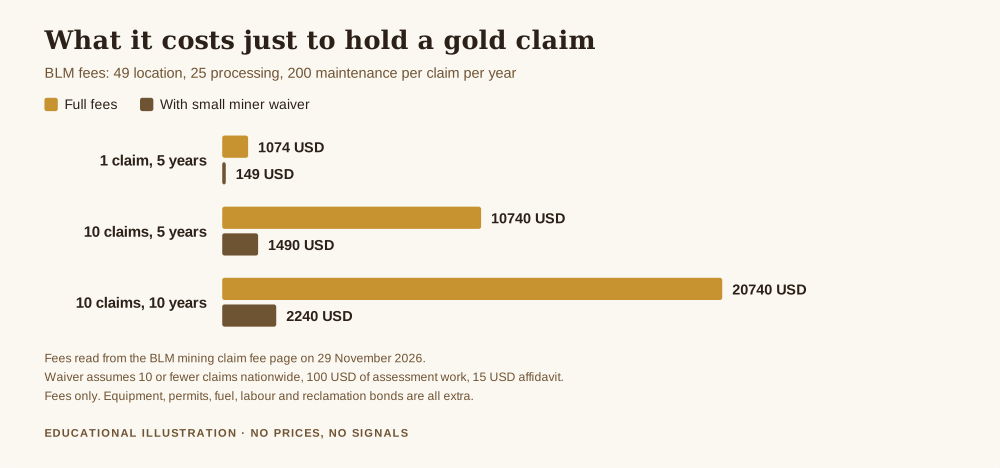
One claim held for five years is 274 US dollars in the first year and 200 US dollars in each of the next four, which is 1,074 US dollars. Ten claims held for five years is ten times that, 10,740 US dollars. Ten claims held for ten years is 20,740 US dollars. None of those numbers buys equipment, fuel, a permit, an assay, labour or a reclamation bond. They are the cost of keeping your name on the paperwork.
The placer figure is worth converting, because it is quoted per 20 acres and that hides its size. At 200 US dollars for each 20 acres, the rate works out at 10 US dollars per acre per year. A claimant who likes the look of 200 acres is committing to 2,000 US dollars a year before any other cost exists.
The waiver that changes the shape of the answer
There is a provision in the schedule that most summaries skip, and it matters more than anything else on the page for a person starting out. The small miner waiver removes the maintenance fee entirely for a claimant who, with all related parties, holds ten or fewer claims nationwide. In its place the claimant must perform 100 US dollars of assessment work per claim and file an affidavit, which costs 15 US dollars per claim.
Run the same three cases again under the waiver. One claim for five years falls from 1,074 US dollars to 149 US dollars. Ten claims for five years falls from 10,740 to 1,490. Ten claims for ten years falls from 20,740 to 2,240. That is a reduction of roughly 86 per cent in the ten year case, and it is available to exactly the person asking this question for the first time.
Read the waiver the other way round and it tells you something the fee schedule is quietly enforcing. The moment you hold an eleventh claim, every claim you own reverts to the full 200 US dollars a year. Going from ten claims to eleven does not add 200 US dollars to the annual bill. It adds 2,200, because the eleventh claim costs its own fee and removes the waiver from the other ten at the same time. The system is built with a step in it, and the step is placed precisely where an enthusiastic beginner would otherwise wander across it without noticing.
This is the same discipline that governs protecting your capital when gold gets volatile. Know the fixed cost before you take the position, because the fixed cost is the part that does not care how the year goes.
What the fees buy, and what they do not
A claim is permission to look, and a priority in line if you find something. It is not permission to dig at scale, it is not a permit, and it is not ownership of the land. The gap between holding a claim and operating a mine is where the costs stop being published and start being specific to your ground, your state, your water and your neighbours.
I am not going to invent a number for that gap, and you should distrust anyone who gives you one casually, because it depends on things no article can know. What can be shown is the scale of the operation the published data describes, and that comparison is the most useful thing in this whole article.
How much does it cost to start mining gold at industrial scale, read through the production data
The United States Geological Survey publishes a gold chapter in its Mineral Commodity Summaries every year. The February 2026 edition estimates domestic gold mine production in 2025 at 160 metric tonnes, down from 163 tonnes in 2024. It reports that gold was produced at more than 40 lode mines across 12 states, at several large placer mines in Alaska and at numerous smaller placer operations. Nevada accounted for about 64 per cent of domestic production and Alaska for about 22 per cent.
Then comes the sentence that answers the question better than any cost estimate could. The top 25 operations yielded about 94 per cent of the gold mined in the United States.
Sit with that for a moment. Across more than 40 lode mines, several large placer mines and numerous smaller ones, twenty five operations produce 94 per cent of the metal. Calculated from those figures, everything else in the country, every small placer operation and every marginal lode mine put together, shares the remaining 6 per cent, which is about 9.6 tonnes a year between them.
Two more numbers worth computing
The same chapter gives United States reserves of 3,000 tonnes. Divide that by the 2025 production estimate of 160 tonnes and you get 18.8 years of reserve life. That calculation assumes production stays flat and no new reserves are added, neither of which is what happens in practice, so treat it as a sense of scale rather than a forecast. It is the number that explains why exploration continues even when nobody is short of gold today.
The chapter also reports mine and mill employment of 13,000 people. Divide 160 tonnes by 13,000 and the output is 12.3 kilogrammes per employee per year, which converts to about 396 troy ounces per employee per year at 32,150.7466 troy ounces to the tonne. That is a capital intensive, machinery heavy, highly concentrated industry, and the figure tells you so without anybody needing to quote a capital budget.
For context on the global picture, worldwide production in 2025 was an estimated 3,300 tonnes against 3,280 in 2024, which puts the United States at about 4.8 per cent of world output. More on where the metal comes from is in how much gold is mined each year in the world, and the running cost side of the same question is in how much it costs to mine gold per ounce.
Three different questions wearing the same words
By now the shape of the honest answer should be visible. The question splits into three, and they are separated by orders of magnitude.
The first is the cost of holding ground. That is the BLM schedule, it is published, and for a person within the small miner waiver it runs from 149 US dollars over five years for a single claim to 2,240 US dollars over ten years for ten claims. This is the only version of the question with a precise, lookup answer, and it is the version most people are actually asking.
The second is the cost of working that ground yourself at small scale. Equipment, fuel, access, water, seasonal labour, assays, permits and reclamation obligations. This has no general answer, because it is set by your specific site and your state's rules rather than by a national fee table.
The third is the cost of building an operation that would register in the national statistics. The production data says that is a top 25 proposition in a field where 25 operations hold 94 per cent of output, which is not a business anyone starts. It is a business that is financed, permitted and constructed over many years by companies that already do it.
Conflating the third with the first is how people end up believing this is either trivially cheap or impossibly expensive. It is neither. It is cheap to begin and expensive to continue, and the gap between those two facts is where most of the disappointment lives.
What this has to do with holding gold rather than digging it
Most readers here will never file a claim, and that is fine, because the figures still earn their place. Mining cost sets the floor under supply. When people argue about where the metal comes from and what it costs to bring out of the ground, these are the published numbers the argument should be built on, not the ones in a video.
There is also a plainer lesson, and it is the one I would keep. The published, boring, annual, unavoidable cost is the one that decides whether a venture survives long enough to matter. A claim is lost in September for an unpaid 200 US dollars, not because the geology was wrong. The parallel with an account is exact, and it is the reason the first pillar comes first.
Get the free Black Gold Market blueprint, a one page guide to protecting capital before trying to grow it, including how to price the fixed costs of a position before you commit to it. One email, no spam, unsubscribe anytime.
Get the free blueprint →Frequently asked questions
How much does it cost to start mining gold in the simplest case?
On federal land, 274 US dollars for the first year of one new claim, made up of a 49 dollar location fee, a 25 dollar processing fee and a 200 dollar annual maintenance fee, according to the BLM fee page read on 29 November 2026. A claimant holding ten or fewer claims nationwide can use the small miner waiver instead, which replaces the maintenance fee with 100 US dollars of assessment work and a 15 dollar affidavit per claim.
What happens if I miss the annual fee?
The claim is forfeited. The BLM schedule sets the deadline at on or before 1 September each year and states that failure to pay results in loss of the claim. This is not a penalty structure with escalating charges, it is a cliff, which is why the annual date matters more than the annual amount.
Is a placer claim cheaper than a lode claim?
Not necessarily, because placer claims are charged by area. The schedule sets 200 US dollars for each 20 acres or part of 20 acres, which works out at 10 US dollars per acre per year. A small placer claim costs the same as a lode claim, and a large one costs considerably more.
Does a claim let me start digging?
No. A claim establishes your right to the minerals and your priority in line. Operating permits, environmental review, water rights and reclamation obligations are separate, they vary by state and by the scale of what you propose, and they are not covered by any national fee schedule.
Could a small operation ever compete with the big mines?
The published data suggests the honest answer is no, not on volume. The USGS reports that the top 25 operations produced about 94 per cent of United States gold in 2025, leaving roughly 9.6 tonnes a year to be shared among everyone else. Small operations exist and some of them work, but they are not competing in the same arithmetic.
Why does this article not give a figure for building a mine?
Because there is no published national figure for it, and a number invented to fill the gap would be worse than silence. Permitting, construction and financing costs are site specific and span years. Where a figure is given in this article, it either comes from a government source linked in the text or it was calculated here from those sources with the assumptions written out.
Where this leaves you
The plain answer to how much does it cost to start mining gold is 274 US dollars for the first year of a single federal claim, or 149 US dollars across five years if you qualify for the small miner waiver, and after that it is whatever your particular ground demands. The published fee is small, knowable and the same for everyone. Everything above it is specific to you and is not knowable from an article.
Protect, master, grow, in that order. The fee schedule is a good teacher of the first pillar, because it punishes one thing only, which is failing to cover a fixed cost on a fixed date. Ground is not lost to bad geology nearly as often as it is lost to an unpaid 200 US dollars in September.
The fee figures in this article, namely the 49 US dollar location fee, the 25 US dollar processing fee, the 200 US dollar annual maintenance fee per lode claim, the 200 US dollars per 20 acres for placer claims, the small miner waiver condition of ten or fewer claims nationwide, the 100 US dollars of assessment work and the 15 US dollar affidavit, were read from the Bureau of Land Management mining claim fee page linked above on 29 November 2026. The production figures, namely 160 tonnes of United States mine production in 2025 against 163 tonnes in 2024, more than 40 lode mines in 12 states, Nevada at about 64 per cent and Alaska at about 22 per cent of domestic output, the top 25 operations at about 94 per cent, United States reserves of 3,000 tonnes, mine and mill employment of 13,000 and world production of 3,300 tonnes in 2025 against 3,280 in 2024, come from the United States Geological Survey Mineral Commodity Summaries gold chapter of February 2026, also linked above. The derived figures of 274, 1,074, 10,740, 20,740, 149, 1,490 and 2,240 US dollars, the 10 US dollars per acre per year, the roughly 86 per cent reduction, the 2,200 US dollar step at the eleventh claim, 18.8 years of reserve life, 4.8 per cent world share, 9.6 tonnes outside the top 25, and 12.3 kilogrammes or about 396 troy ounces per employee per year were calculated here in Python from those published figures, using 32,150.7466 troy ounces to the tonne and assuming flat production with no reserve additions where reserve life is quoted. No gold price, entry, stop or target appears anywhere in this article.
Black Gold Market publishes daily gold analysis with the level, the context and the risk written out, and the free blueprint above is the one page version of the capital rules used here. Following along is free, the Kit is optional, and nothing here promises a profit.
About the author. Raphael writes Black Gold Market around three ideas in a fixed order: protect, master, grow. Capital that survives the bad month is the only capital that gets to compound, and the published work shows the level, the context, and the risk so you can judge the reasoning yourself. This is education and not financial advice, your own circumstances decide what any of this means for you, and no entry, stop or target discussed should be treated as a signal.