

Every few months somebody works out that the ocean contains gold, and the idea arrives with the force of a discovery. The metal is right there, dissolved in water that nobody owns, and no shaft has to be sunk to reach it. So how much does it cost to extract gold from seawater sounds like a question about engineering, something a better pump or a cleverer resin might eventually solve. It is not. It is a question about one measured number, and once you have that number the answer stops being an opinion.
This belongs under Protect, which may look like an odd home for a piece about chemistry. It belongs there because the same habit that makes a trader buy a story instead of a position is the habit that makes this idea sound plausible. Something is true, gold really is in the water, and the truth of it gets mistaken for a reason to act. The discipline is identical in both cases: find the quantity, do the arithmetic, and let the result decide.
The quantity in this case comes from the United States National Oceanic and Atmospheric Administration, and it is small enough that writing it down is most of the work.
How much does it cost to extract gold from seawater, starting from the concentration
NOAA's ocean facts page on gold in the ocean states the position plainly. There is gold in seawater, its concentration is "on the order of parts per trillion", and one study found "only about one gram of gold for every 100 million metric tons of ocean water in the Atlantic and north Pacific". The same page adds that there is also undissolved gold in and on the seafloor, a mile or two underwater and encased in rock, and concludes that there is currently no cost effective way to extract any of it at a profit.
That one sentence about one gram per 100 million tonnes is the whole article. Everything below is arithmetic performed on it, and I have written out every assumption so you can repeat the sum or reject it.
Start with the unit the gold market actually uses. A troy ounce is 31.1034768 grams by definition, and the USGS puts one metric ton at 32,150.7 troy ounces. So the water required for a single troy ounce of dissolved gold is 31.1034768 multiplied by 100 million, which is 3.11 billion metric tons of seawater.
Numbers that large stop meaning anything, so convert them. At a seawater density of about 1.025 tonnes per cubic metre, 3.11 billion tonnes is 3.03 billion cubic metres, or 3.03 cubic kilometres. An Olympic swimming pool is 50 metres by 25 metres by 2 metres, which is 2,500 cubic metres. One troy ounce of gold, at the concentration NOAA reports, is dispersed through about 1.21 million Olympic swimming pools.
Nobody has to be convinced that filtering 1.21 million swimming pools is expensive. The useful part is that you can put a floor under the cost without knowing anything about the chemistry.
The energy bill, with the assumptions written out
Forget extraction entirely. Forget the resin, the membranes, the plant, the staff, the ships, the waste. Assume the gold leaps out of the water of its own accord the moment the water arrives. Price one thing only: lifting that water one single metre.
The physics is the kind you can check on paper. Energy equals mass times gravity times height. The mass is 3.11 billion tonnes, which is 3.11 trillion kilograms. Gravity is 9.80665 metres per second squared. The height is one metre. That gives 3.05 times ten to the thirteenth joules, which is 8.47 gigawatt hours per troy ounce.
At an industrial electricity price of five cents per kilowatt hour, and at a pump efficiency of 100 per cent, which no pump has ever achieved, that is about 423,600 US dollars per troy ounce. At a realistic 75 per cent efficiency it is about 564,900 dollars. At ten cents per kilowatt hour it is about 847,300 dollars at perfect efficiency and about 1.13 million dollars at 75 per cent.
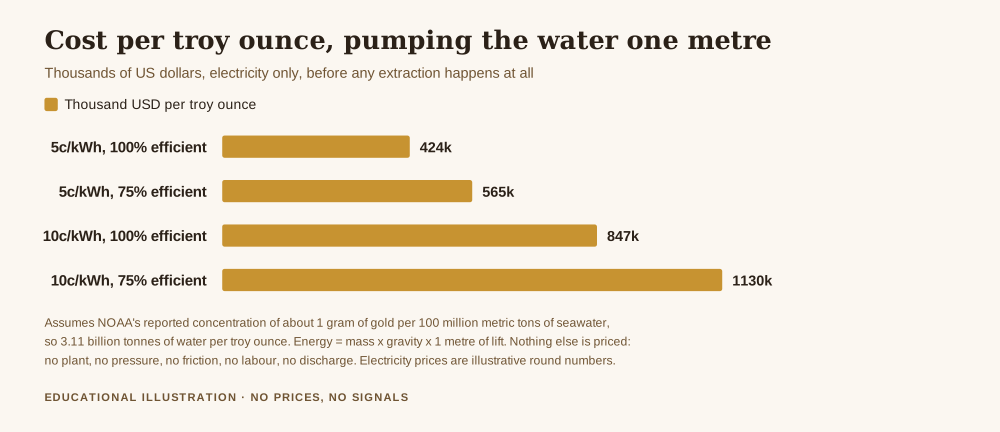
Read that chart carefully, because the thing it does not show is the point. There is no bar for the extraction plant, the pumps themselves, the intake screens, the pipework, the land, the labour, the maintenance, or the disposal of 3.11 billion tonnes of processed water. There is no bar for pushing the water through anything. The chart prices one metre of lift and nothing else, and the lowest bar on it already sits in the hundreds of thousands of dollars per ounce.
A real plant does not lift water one metre. It lifts it, moves it horizontally, forces it through a medium at pressure, and discharges it. Each of those multiplies the first bar. The honest conclusion is not that seawater gold is expensive. It is that the floor on the cost is already far above anything the metal could be worth, and the floor was set by a single measured concentration rather than by any failure of engineering.
What the whole ocean actually holds
The other half of the idea is the inventory. If the ocean holds a vast quantity of gold, surely the scale compensates for the dilution. It is worth putting a number on that too.
NOAA, citing its National Geophysical Data Center, puts the volume of the ocean at 1,335,000,000 cubic kilometres. At 1.025 tonnes per cubic metre that is about 1.37 times ten to the eighteenth tonnes of water. Apply the concentration from the first section and the dissolved gold in every ocean on the planet comes to roughly 13,700 tonnes.
Set that against the land. The USGS Mineral Commodity Summaries of February 2026 puts world gold reserves at 66,000 tonnes and estimated 2025 mine production at 3,300 tonnes, up from 3,280 tonnes in 2024. So the entire dissolved gold content of the world ocean is about 20.7 per cent of the reserves already identified on land, and roughly 4.15 years of current mine output.
Then the sentence that ends the discussion. To extract 3,300 tonnes of gold from seawater, one year of what the mining industry already produces, you would have to process 3.3 times ten to the seventeenth tonnes of water, which is about 24 per cent of the entire ocean, every year.
Not 24 per cent of a bay. Not 24 per cent of a current. Roughly a quarter of all the water on Earth's surface, pumped, processed and discharged, annually, to match what a few hundred mines do now. The ocean does not hold a lot of gold spread thinly. It holds a modest amount of gold spread beyond all reach.
Why any of this matters to someone trading XAU/USD
You will never pump the ocean, so the practical value here is not the seawater. It is the shape of the reasoning, and it transfers directly to the thing you do every day.
Gold is priced the way it is partly because new supply is hard, slow and capital intensive. Mine output has been close to flat for years, as I set out in the piece on peak gold, and the published cost of getting an ounce out of the ground keeps climbing, which is the subject of what it costs to mine gold per ounce. Every few years a story arrives promising that some vast new source is about to change that. Seawater is the oldest of them. Asteroids are the newest. Neither one survives contact with a concentration figure and a calculator.
That is worth knowing because the supply side of this market moves slowly and predictably, which means the fast moves in the price are almost never about supply. When gold jumps, it is demand, rates, the dollar or fear doing the work, and treating a supply story as a reason to change your position is a category error. The useful version of this discipline is the one in protecting your capital when gold gets volatile: decide what the number has to be before the story can matter, then go and find the number.
There is a second transfer, and it is the one I would actually keep. In this article the decisive figure was a single line on a government fact page, and it took longer to convert the units than to find it. Most of the stories that cost traders money fall apart just as quickly, and for the same reason. They are quantitative claims being carried by qualitative enthusiasm. Ask what the number would have to be. Then look it up.
What this calculation does not include, and where it could be wrong
I would rather state the weaknesses than have you find them.
The concentration is uncertain, and NOAA says so directly: it is "difficult to say exactly how much" gold the ocean holds. The figure I used is from one study of the Atlantic and north Pacific. Measuring gold at parts per trillion is genuinely hard, contamination of samples has produced wildly higher historical estimates, and some published figures are orders of magnitude apart. If the true average concentration were ten times higher than the figure I used, every cost in this article would fall by a factor of ten, and the pumping floor would still be tens of thousands of dollars per ounce before a single piece of extraction equipment was switched on. The conclusion survives being wrong by an order of magnitude, which is the only reason it is worth publishing.
The ocean mass is approximate, since I converted a volume at a single average density, and real seawater density varies with depth, temperature and salinity. The energy calculation assumes perfect efficiency at the step where it suits the argument least, so it understates the cost rather than overstating it. It ignores pressure, friction and every capital item. The electricity prices are illustrative round numbers, not quotes from any market.
And the seafloor is a separate question from the dissolved metal. Undissolved gold in rock on the ocean floor is a mining problem, not a filtration problem, and nothing in this article prices it. NOAA notes it is a mile or two down and locked in rock that has to be mined through.
Get the free Black Gold Market blueprint, a short document on protecting capital before you try to grow it, including the habit of pricing a claim before you act on it. One email, no spam, unsubscribe anytime.
Get the free blueprint →Frequently asked questions
How much does it cost to extract gold from seawater per ounce?
No commercial operation exists, so there is no market figure to quote. What can be computed is a floor. At NOAA's reported concentration you need 3.11 billion tonnes of water per troy ounce, and raising that water a single metre at perfect efficiency costs about 423,600 dollars in electricity at five cents per kilowatt hour. Every real cost sits on top of that.
How much gold is in the ocean in total?
Using NOAA's concentration and NOAA's figure of 1,335,000,000 cubic kilometres of ocean, the dissolved gold works out at roughly 13,700 tonnes. That is about 20.7 per cent of the 66,000 tonnes of land reserves the USGS reports, or a little over four years of current mine production, spread through every ocean on the planet.
Has anyone ever tried it?
Yes, repeatedly, and the attempts are a century old. They fail on the same arithmetic every time. The concentration, not the technology, is what defeats the idea, which is why no amount of engineering progress has changed the answer.
Could a future technology make it viable?
A technology would have to beat the cost of moving the water, and moving the water is physics rather than invention. The floor in this article assumes the extraction itself is free and instantaneous and still lands in the hundreds of thousands of dollars per ounce. A breakthrough in extraction chemistry does not touch that number.
Does the gold in seawater affect the gold price?
No. It is not recoverable, so it is not supply. Nothing that cannot reach the market can affect the price at which the market clears, and treating it as a latent supply overhang is a mistake.
Where did the numbers in this article come from?
The concentration and the ocean volume are NOAA's, both linked above. World production of 3,300 tonnes for 2025, 3,280 tonnes for 2024, reserves of 66,000 tonnes, and the conversion of 32,150.7 troy ounces per tonne are from the USGS Mineral Commodity Summaries of February 2026, also linked. Everything else, the 3.11 billion tonnes, the 3.03 cubic kilometres, the 1.21 million pools, the 8.47 gigawatt hours, the dollar figures, the 13,700 tonnes, the 20.7 per cent, the 4.15 years and the 24 per cent of the ocean, is my own arithmetic from those published figures, under the assumptions stated in the text.
Where Black Gold Market Fits
Black Gold Market is free to follow. Daily XAU/USD analysis with the level, the context and the risk stated before the trade, losing days included, on Telegram. There is a free blueprint for anyone who wants the capital protection material in one place, and an optional Kit for people who want the full method. Nothing here promises a profit, and nothing here is a signal service.
About the author. Raphael writes Black Gold Market. He works on the part of this business that happens before the entry, the level, the context, and the risk, and he would rather spend an hour converting units than an afternoon believing a story. Nothing in this article is a recommendation to trade, and no entry, stop or target discussed should be treated as a signal.