

Every so often a chart of the gold lease rate turns up in a thread with a caption suggesting that something enormous is about to happen. Almost nobody explains the mechanism underneath it, so here is gold leasing explained from the plumbing upwards: who lends the metal, who borrows it, what changes hands, and what the fee actually comes to when you count it.
The short version is that leasing is a rental market for physical metal. An institution that owns gold and does not need it in its hands this quarter lends it to an institution that does, for a fee. The fee is small, the metal comes back, and the owner's balance sheet barely twitches.
Everything below is either quoted from the IMF's published reserve reporting guidelines, from the World Gold Council's published reserve data, or from interest rates published by the Federal Reserve, with the arithmetic shown where I have done any. There are no gold prices in this article, and nothing here is a view on where the price goes next.
Gold leasing explained, starting with what actually moves
In a gold lease the owner hands over metal for an agreed term and gets the same weight back at the end, plus a fee. The fee is quoted as an annual percentage, called the lease rate, and it is normally paid in metal rather than in cash.
Who lends. Central banks, overwhelmingly. They are the largest holders of idle gold in the world, and the World Gold Council notes that central banks and other official institutions account for around a fifth of all the gold ever mined. That is a vast quantity of metal sitting in vaults doing nothing, held for reasons that have nothing to do with yield.
Who borrows. Bullion banks, refiners, miners and jewellery manufacturers. Each has the same problem in a different shape, which is that they need metal in their possession now and will have it, or will have sold it, later. A refiner that has bought unrefined material needs metal to deliver against sales it has already made. A miner that wants certainty on next year's production can borrow metal, sell it, and repay from what comes out of the ground.
What does not move is ownership of the price. This is the part most explanations skip, and it is the one that matters.
Why the reserve line does not change
If a central bank lends a hundred tonnes, does its published gold reserve fall by a hundred tonnes?
No, and that is not an accounting trick. The IMF's guidelines for the reserves data template define the relevant reserve line, in the template's own words, as "gold (including gold deposits and, if appropriate, gold swapped)". Gold that has been lent out stays inside the reserve figure by design.
The guidelines are specific about why. On gold deposits and gold swaps they state that "the original owner of the gold retains the risks and rewards of changes in the price of the asset". The lender still gains if gold rises and still loses if it falls. What the lender has given up is possession for a term, not exposure.
There is a condition attached. To count as a reserve asset, the guidelines require that gold deposits "must be available upon demand to the monetary authorities and should be of a high quality", which is to say the counterparty has to be good for it. That condition is doing a lot of quiet work, and it is the reason this market is concentrated among a small number of large institutions.
The rate nobody quotes, and the identity that defines it
You will not find the gold lease rate on a retail platform, and there is a reason for that. It is not usually quoted directly at all. It falls out of two other numbers.
Gold can be sold forward, which is to say sold today for delivery and payment at a future date. The forward price embeds a rate, the gold forward rate, which is what it costs to carry metal to that date. The identity the market works with is simple enough to write in one line:
lease rate = dollar interest rate, minus the gold forward rate.
The intuition is a swap of one asset for the other. If you hand over metal for a term, you receive cash you can put on deposit at the dollar rate. The lease rate is whatever is left of that dollar rate after the forward market has taken its share for carrying the metal.
Put real numbers in it. The Federal Reserve's H.15 release of selected interest rates gives a three month Treasury yield of 4.23 per cent for 8 October 2026, with the six month at 4.30 and the one year at 4.44. Hold the dollar rate at 4.23 and the identity does the rest.
| Gold forward rate | Implied lease rate | What it says about the metal |
|---|---|---|
| 4.23 per cent | 0.00 per cent | Nobody will pay to borrow it. Metal is easy to find. |
| 4.00 per cent | 0.23 per cent | An ordinary, quiet market. |
| 3.50 per cent | 0.73 per cent | Borrowers are competing a little. |
| 2.00 per cent | 2.23 per cent | Physical metal is genuinely tight somewhere. |
| Below zero | Above 4.23 per cent | Backwardation. Metal now is worth more than metal later. |
That last row is the threshold worth remembering. Gold goes into backwardation, meaning the forward price sits below the spot price, exactly when the lease rate climbs above the dollar rate. On the numbers above that line sits at 4.23 per cent, and a lease rate that high is a once in a decade event rather than a Tuesday.
What the fee comes to, counted in metal
Lease rates are small, and seeing them in ounces makes that concrete. A tonne is 32,150.75 troy ounces, using the troy ounce's defined weight of 31.1034768 grams. Take a lease of one tonne for one quarter, 91 days, on the money market's actual over 360 convention, with no compounding.
| Lease rate | Fee on one tonne for 91 days | As a share of the tonne |
|---|---|---|
| 0.10 per cent | 8.13 troy ounces, about 253 grams | 0.0253 per cent |
| 0.25 per cent | 20.32 troy ounces, about 632 grams | 0.0632 per cent |
| 1.00 per cent | 81.27 troy ounces, about 2.5 kilograms | 0.2528 per cent |
| 2.00 per cent | 162.54 troy ounces, about 5.1 kilograms | 0.5056 per cent |
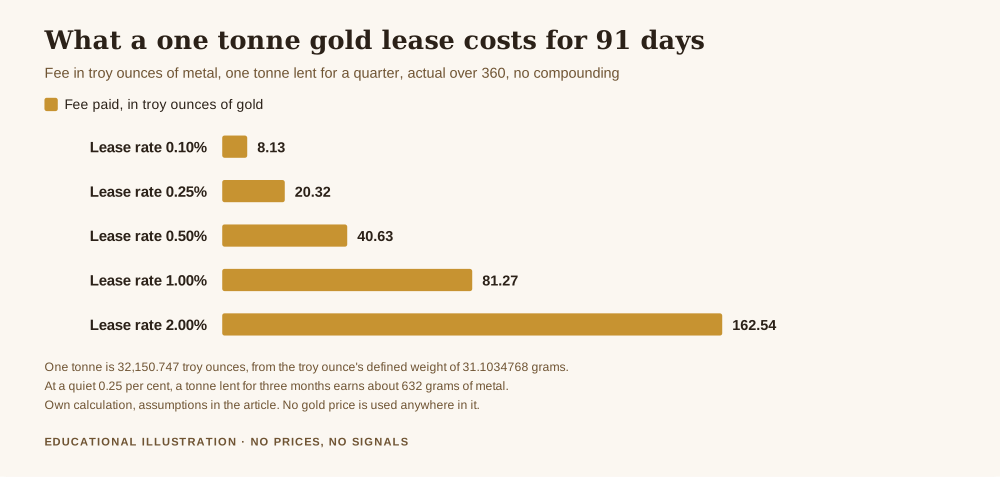
At a typical quiet lease rate of a quarter of a per cent, a central bank lending a tonne for three months earns about two thirds of a kilogram of gold. Lend a hundred tonnes for a full year at that rate and the fee comes to roughly 8,149 troy ounces, a little over 253 kilograms.
Set that against the one year dollar rate of 4.44 per cent in the same H.15 release and the shape of the thing becomes obvious. Leasing is not a yield strategy. It is a modest fee on an asset the owner has decided to keep, and the gap between 0.25 and 4.44 is precisely why the forward market is normally in contango.
When the lease rate spikes, and what it is actually saying
Because the lease rate is the price of borrowing physical metal, it rises when physical metal is hard to borrow. That is a genuinely informative signal, and it is also the most abused chart in the gold commentary business.
What a spike means literally is that somebody needs metal in a specific place at a specific time and is willing to pay to get it. That can come from a refinery backlog, a sudden shift in where bars need to sit, a scramble to deliver against contracts, or a counterparty everyone has quietly stopped lending to. These are real events, and they are worth knowing about.
What a spike does not mean is that the price is about to do anything in particular. The metal tightness and the price are related the way a traffic jam and a destination are related. One tells you about the road, not about where anybody is going. I would put a lease rate spike in the same mental box as a repatriation headline: evidence about institutions, not an input to a position.
What this means for someone trading XAU/USD
Day to day, close to nothing, and I would rather say that plainly than dress it up.
Your spread, your swap and your margin are set by your broker and by the general level of interest rates, not by the lease market. There is no lease rate feed on your platform because there is nothing in it for you to act on. A retail account is trading a cash settled contract on the price, and the plumbing that moves bars between vaults does not touch that contract.
Where it earns its place is in the slower work of understanding what gold is. Leasing explains how a central bank can hold metal and earn on it without selling it. It explains why "the vaults are empty" claims rarely survive contact with the reserve definitions. And it explains why the forward curve usually slopes the way it does. That belongs in the same category as knowing what you actually own when you own gold and what gold reserves are, which is to say it is structural knowledge rather than a trade.
If you want the part of this that does reach the price, it is official sector buying and selling rather than lending, and I covered the mechanism in how central banks affect the price of gold.
What this article does not say
It does not give you a current lease rate. The forward rates that would pin one down are not published on a page I can point you to and verify, and I am not going to quote a number I cannot source. The table above is an identity with illustrative inputs, not a market quote.
It does not say leasing is risk free for the lender. The metal is an unsecured claim on the borrower for the term unless collateral is posted, which is exactly why the IMF guidelines insist the deposit be available on demand and of high quality before it can count as a reserve asset.
And it does not say every tonne of official gold is lent out. The share actually on loan is not disclosed country by country, and anybody who tells you the precise figure is guessing.
Get the free Black Gold Market blueprint, a short document on protecting capital and on checking a claim against the source before you trade on it. One email, no spam, unsubscribe anytime.
Get the free blueprint →Frequently asked questions
What is gold leasing, in one sentence?
It is the rental of physical metal. An owner lends gold for an agreed term, the borrower returns the same weight at the end, and a fee is paid for the use of it, normally in metal rather than cash.
Does gold leasing reduce a country's gold reserves?
No. The IMF's reserves data template defines the line as "gold (including gold deposits and, if appropriate, gold swapped)", so metal that has been lent out still counts. The guidelines also state that the original owner retains the risks and rewards of changes in the price, which is the substantive reason the figure does not move.
Who actually borrows leased gold?
Bullion banks, refiners, miners and manufacturers. The common thread is a timing gap: they need metal in their possession now, and will either have metal later or have already sold what they are producing.
How is the gold lease rate calculated?
It is normally derived rather than quoted, as the dollar interest rate minus the gold forward rate. When the forward rate falls, the implied lease rate rises. When the lease rate climbs above the dollar rate, the forward rate has gone negative and the market is in backwardation.
Is a high gold lease rate bullish for the price?
It is a statement about the availability of physical metal, not about direction. A spike says somebody needs bars in a particular place at a particular time and is paying for the privilege. Treating that as a price forecast is reading a traffic report as a destination.
Does any of this affect my XAU/USD trading?
Not in any way you can act on. Your costs come from your broker's spread and swap and from the general level of interest rates. The lease market moves physical bars between institutions, and a retail contract on the price never touches them.
Where Black Gold Market fits
Black Gold Market is a free journal about reading gold and protecting capital, written for people who would rather check a primary source than be told what to think. Nothing here is sold on a promise of returns and there is no signal service. The free blueprint is a short document on protecting capital and on the unglamorous checks that decide whether an argument holds up. The piece underneath all of it is how to protect your capital when gold gets volatile.
About the author. Raphael writes Black Gold Market. He spent a week trying to find a current gold lease rate he could actually cite, concluded that the honest answer was a definition and an identity rather than a number, and wrote that instead. What matters to him is the level, the context, and the risk, in that order.
This article is educational and is not financial advice. Trading gold and other leveraged products carries a high risk of losing money rapidly, and no entry, stop or target discussed should be treated as a signal. The treatment of gold deposits and gold swaps in official reserves is quoted from the International Monetary Fund's guidelines for the reserves data template, 2013 edition, the share of mined gold held by the official sector is quoted from the World Gold Council, and the dollar interest rates are the US Treasury constant maturity yields published by the Federal Reserve in release H.15 for 8 October 2026, all as linked. The lease fee figures in ounces and grams, the implied lease rates and the backwardation threshold are my own arithmetic from those published inputs, on the assumptions stated in the text. Decide your own risk, and never trade money you cannot afford to lose.