

Every few years a headline announces that another central bank is bringing its gold home, and the story arrives wrapped in a suggestion that somebody no longer trusts somebody else. So it is worth asking plainly why are countries repatriating gold, and then going to the one case where the central bank published its own figures from start to finish. Germany did exactly that. The Bundesbank set out a transfer plan, ran it for five years, and printed the tonnages year by year when it was done.
What those tables show is less dramatic and more useful than the headlines. This was a logistics programme with a target share, not a panic. It finished three years early. And when it was over, almost half of Germany's gold was still sitting abroad, on purpose.
Everything below is either taken from the Bundesbank's published tables or computed by me from them, with the arithmetic shown. There are no prices in this article, and nothing here is a view on where gold goes next.
Why are countries repatriating gold, and what the word actually means
Repatriation is a change of custody, not a change of ownership. A central bank that holds gold at the Federal Reserve Bank of New York already owns that gold. It is recorded as German, or Austrian, or Dutch, and it sits in an allocated account as specific numbered bars. Moving it to Frankfurt does not add an ounce to anyone's reserves and does not remove one from anyone else's. It changes which vault door stands between the owner and the metal.
That distinction matters because it decides what a repatriation story can and cannot mean. If ownership never changed, then the world's stock of central bank gold is exactly the same the day after the convoy arrives as it was the day before. The only thing that moved is jurisdiction and physical control. If you want the related idea of what you actually hold when you hold metal, that is the subject of allocated versus unallocated gold.
So the honest version of the question is not whether countries are reclaiming something they had lost. It is why a country would accept the cost and the risk of moving tonnes of metal across borders in order to change nothing about who owns it.
What the Bundesbank actually moved
In 2013 the Bundesbank announced a storage plan: by 2020 it wanted half of Germany's gold reserves in its own vaults in Frankfurt am Main. Reaching that share required moving roughly 300 tonnes out of New York and about 374 tonnes out of Paris. On 23 August 2017 it published a press release confirming the transfers were complete, with a table of what moved and when.
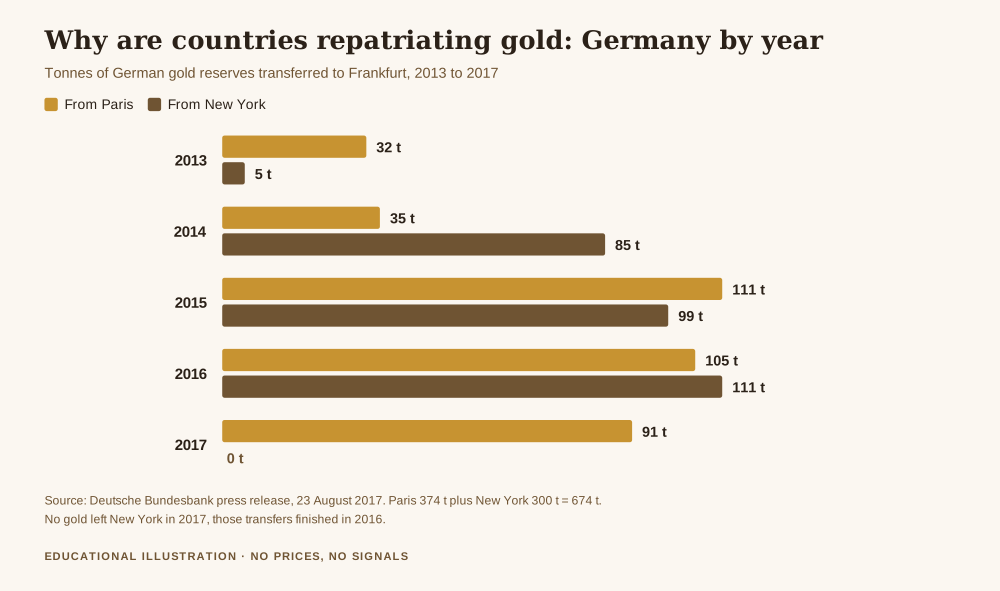
The year by year figures are 37 tonnes in 2013, 120 in 2014, 210 in 2015, 216 in 2016 and 91 in 2017. Paris contributed 32, 35, 111, 105 and 91 tonnes. New York contributed 5, 85, 99 and 111 tonnes, finishing a year earlier. Add the columns and you get 374 tonnes from Paris and 300 from New York, 674 tonnes in total, which is exactly the figure the Bundesbank states in its own text.
I checked that addition rather than trusting it, and I would encourage the habit, because the secondary coverage of this event does not all agree. At least one widely repeated write up puts the total at 743 tonnes. The Bundesbank's own columns sum to 674. When a published table and a summary disagree, the table wins.
A few things stand out from the schedule. The pace was not steady: 2013 moved 37 tonnes and 2016 moved 216, nearly six times as much. The average across the five years works out at about 135 tonnes a year, which is a number that describes no individual year particularly well. And the programme beat its own deadline by three years, finishing in 2017 against a target of 2020.
For a sense of physical scale, a London Good Delivery bar is nominally 400 troy ounces. At 31.1034768 grams to the ounce that is about 12.44 kilograms a bar, so 674 tonnes is roughly 54,000 bars. That is an illustrative figure and I want to flag the assumption: the Good Delivery standard permits anything from 350 to 430 ounces, so the true count could sit anywhere from about 50,000 to about 62,000 bars. Nobody moves a nominal bar. They move actual ones, each weighed individually.
The split before and after
The Bundesbank published where the gold ended up: Frankfurt 1,710 tonnes or 50.6 per cent, New York 1,236 tonnes or 36.6 per cent, London 432 tonnes or 12.8 per cent, from a total of 3,378 tonnes.
It did not publish the starting split in the same table, but that is recoverable. Add back what left each location and you get the position before the programme began. Frankfurt held 1,710 minus 674, which is 1,036 tonnes. New York held 1,236 plus 300, which is 1,536. Paris held the 374 tonnes that all left. London was never part of the programme, so it held 432 throughout. Those four figures sum to 3,378, which is the check that the reconstruction is right.
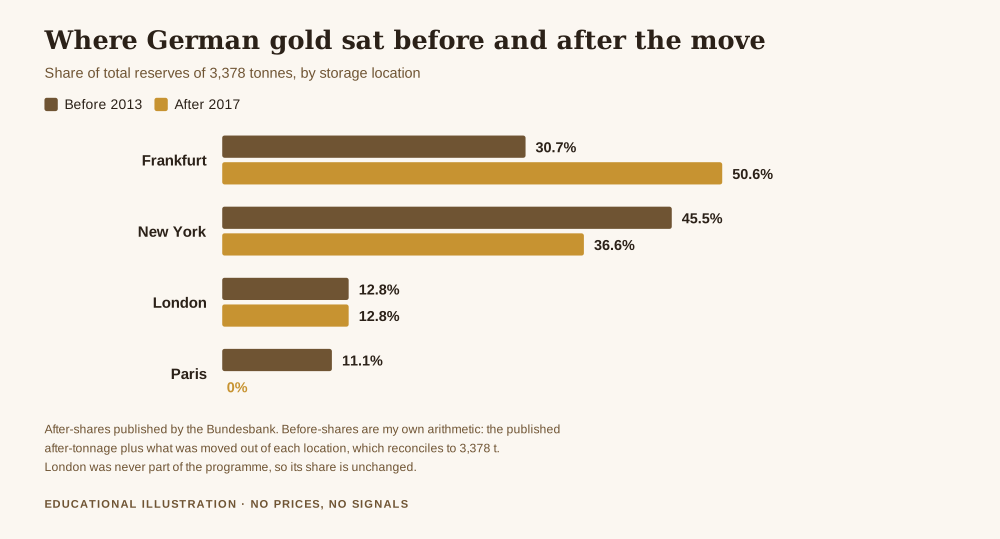
In share terms Frankfurt went from 30.7 per cent to 50.6, New York from 45.5 to 36.6, Paris from 11.1 to nothing, and London stayed at 12.8. The single most telling pair of numbers is the total held outside Germany: 69.3 per cent before, 49.4 per cent after. A programme described in the press as bringing the gold home left just under half of it abroad, and that was the plan from the first announcement, not a shortfall.
Put the other way, the Bundesbank relocated almost exactly a fifth of its reserves, 19.95 per cent, and deliberately left more than twice that much where it was.
Why a country stores gold abroad in the first place
The foreign storage was never an accident, and understanding the reasons for it explains why so much stayed.
The first reason is market access. London and New York are where large gold transactions actually settle. Metal already sitting in a London vault can be sold, lent or used as collateral without being insured, flown and re-assayed first. Gold in Frankfurt is safe, but it is further from the plumbing. A reserve asset you cannot mobilise quickly is doing only half its job.
The second reason is historical. Germany accumulated much of this gold through post war trade surpluses settled abroad, and during the Cold War a divided country with a Soviet army inside its borders had an obvious interest in keeping reserves well to the west. The metal was placed where it was for reasons that made sense at the time and then simply stayed there.
The third reason is diversification of location. Holding everything in one vault concentrates a risk, whatever the vault. Splitting across Frankfurt, New York and London means no single jurisdiction, natural disaster or political decision reaches all of it. Seen that way, the 2013 plan was not a retreat from foreign storage but a rebalancing of it, from one heavily weighted location to a more even spread. Central banks' reasons for holding the metal at all are a separate question, covered in what are gold reserves.
So why bring any of it home
Three motives come through clearly, and none of them require a conspiracy.
The first is domestic accountability. The programme followed sustained public and parliamentary pressure in Germany, including from the Federal Court of Auditors, about reserves that citizens were told existed but that had never been physically inspected by their own central bank. Moving the metal was partly an answer to that political reality.
The second is verification, and this is the part most worth noticing. The Bundesbank states that it had checks in place across the whole chain, from removal at the foreign vault to arrival in Frankfurt, and that every transferred bar was then inspected. Its published conclusion is that no irregularities came to light regarding the authenticity, fineness or weight of the bars. It also committed to publishing an updated bar list. That is the useful outcome of a repatriation: a claim becomes a verified count.
The third is optionality in a crisis. Gold held abroad depends, in the extreme, on the cooperation of the host. That cooperation has effectively always been given, and the Bundesbank's own experience gives no reason to doubt it. But a reserve asset exists for conditions that are not normal, and a share held under direct physical control is the version of the asset that does not require anyone else to agree.
What this does not tell you about the gold price
This is the part where the subject is usually oversold, so let me be blunt about it.
Repatriation moves metal between vaults. It does not create demand, it does not remove supply, and it does not change the total held by central banks by a single gram. The 674 tonnes Germany moved were German before the move and German after it. Anyone presenting a vault transfer as a bullish signal is describing a change in custody as though it were a change in ownership, and those are different things.
What central bank behaviour genuinely can move is net buying and selling, which is a separate series and one the World Gold Council tracks in its reserves by country data. A country that adds to its holdings is taking metal out of the available float. A country that reorganises where its existing holdings sit is not. The mechanics of how official sector activity reaches the price are covered in how central banks affect the price of gold.
The honest summary is that repatriation is interesting as evidence about institutional confidence and public accountability, and close to meaningless as a trading input. Those two statements are not in tension. A thing can matter and still not be tradeable.
What this number does not tell you
Some limits, because a figure quoted without its boundaries turns into folklore.
This is one country. Germany's programme is unusually well documented, which is exactly why I used it, but one well run case does not establish that repatriation generally goes smoothly or that it is a widespread trend. Other episodes have had different motives and different outcomes.
The figures are also rounded, and the Bundesbank marks them as such. The location tonnages are given to the nearest whole tonne and the shares to one decimal place, so small discrepancies in my derived percentages are rounding, not error.
And this is a 2017 position, not today's. Germany's split has not been static since, and the article makes no claim about the current distribution. If you need the present figure, go to the Bundesbank's current reserve reporting rather than relying on a number from a completed programme.
Finally, the physical bar count is mine, not the Bundesbank's, and it rests on the nominal bar weight assumption set out above. Treat it as a sense of scale, not an inventory.
Get the free Black Gold Market blueprint, a short document on protecting capital and on checking a claim against the source before you trade on it. One email, no spam, unsubscribe anytime.
Get the free blueprint →Frequently asked questions
Why are countries repatriating gold if it does not change who owns it?
Because custody and ownership answer different questions. Ownership says whose asset it is on the balance sheet. Custody says who physically controls it and under whose law. Countries repatriate to satisfy domestic accountability, to verify by inspection that the bars are what the records say, and to hold a share that does not depend on another party's cooperation in a crisis. None of that alters the ownership that already existed.
How much gold did Germany actually bring home?
674 tonnes between 2013 and 2017, made up of 374 tonnes from Paris and 300 tonnes from New York. That took Frankfurt's share of the 3,378 tonne total from 30.7 per cent to 50.6 per cent. The programme was completed in 2017 against an original target date of 2020.
Does gold repatriation push the gold price up?
There is no mechanism by which it should. Moving metal between two vaults leaves total central bank holdings unchanged, adds no new buyer and removes no seller. Net official sector purchases can affect the market because they change how much metal is available. A transfer between your own vaults does not.
Why did Germany leave almost half its gold abroad?
Deliberately, for access and for spreading location risk. London and New York are where large gold transactions settle, so metal held there can be mobilised faster than metal in Frankfurt. The stated goal was never to bring everything home, it was to hold half domestically. The result, 49.4 per cent still abroad, met the target as written.
Was any of the German gold found to be missing or fake?
No. The Bundesbank states that every transferred bar was inspected on arrival and that no irregularities emerged concerning authenticity, fineness or weight. That is the single most concrete result of the exercise, and it is the opposite of what the more excitable coverage anticipated.
Where Black Gold Market fits
Black Gold Market is a free journal about reading gold and protecting capital, written for people who would rather check a primary source than be told what to think. There is nothing sold here on a promise of returns and there is no signal service. The free blueprint is a short document on protecting capital and on the unglamorous checks that decide whether an argument holds up. The piece underneath all of it is how to protect your capital when gold gets volatile.
About the author. Raphael writes Black Gold Market. He went looking for the source behind a repatriation headline, found a central bank that had published its own tonnages year by year, and discovered that the published columns disagreed with the number most often repeated about them. What matters to him is the level, the context, and the risk, in that order.
This article is educational and is not financial advice. Trading gold and other leveraged products carries a high risk of losing money rapidly, and no entry, stop or target discussed should be treated as a signal. The tonnages, location shares and completion dates are quoted from the Deutsche Bundesbank's published press release of 23 August 2017, as linked. The before transfer split, the percentage shares derived from it, the five year average and the bar count are my own arithmetic from those published figures, with the assumptions stated in the text. Decide your own risk, and never trade money you cannot afford to lose.