

The best way to ship gold coins is whichever method still protects you on the day something goes wrong, and that is almost never the method with the cheapest postage. Most people compare delivery speed and price, send the parcel, and only read the small print after it fails to arrive. The services you are choosing between carry wildly different promises: one of them stops at 100 USD of cover, one stops at 5,000 USD, and one goes to 50,000 USD. Those three numbers decide everything, so start there and let the postage sort itself out afterwards.
Postage is the cheap part, cover is the expensive part
A parcel of coins is small, light and quiet. It costs very little to move across a country, which is exactly what makes the decision feel trivial. You pick a service, you pay a few dollars, you get a tracking number, and the whole thing feels handled. It is not handled. What you have bought is transport, and transport is the part that almost always works.
The part that occasionally does not work is the part you have to buy separately, and the amount you can buy is capped. Those caps are published, they are not negotiable at the counter, and they do not scale with how valuable your parcel happens to be. A shipment is covered to the cap or it is not covered, and the difference lands on you.
The question is not how to send the coins. It is how much of the loss you are quietly agreeing to carry yourself.
This is the same habit that protects a trading account. You can read the headline number, or you can read the clause underneath that says what happens when the headline number fails. Measured, not assumed, applies to a parcel just as much as it applies to a position.
The best way to ship gold coins begins with the declared value
Before comparing services, write down one figure: what the contents are actually worth, in the currency the carrier will pay a claim in. That figure, the declared value, is the only input that matters, because every cover limit is expressed against it. Not the weight. Not the number of coins. The value.
Once that figure exists, the choice narrows almost on its own. The United States Postal Service publishes the limits plainly. Priority Mail Express, Priority Mail and USPS Ground Advantage each include up to 100 USD of insurance in the price of the service. Standard shipping insurance, bought on top, can be purchased for up to 5,000 USD of indemnity. Registered Mail, bought at a Post Office counter, can be insured for up to 50,000 USD.
Put a declared value against those numbers and the included cover stops looking like cover at all. On a parcel declared at 50,000 USD, the 100 USD that comes free with the service is 0.2 per cent of the shipment. You would be carrying 49,900 USD of the risk yourself while holding a receipt that says the parcel is insured. It is insured. It is insured for almost nothing.
What each service actually covers
Run the same declared value through each option and the gaps become hard to argue with. At a declared value of 10,000 USD, the included cover reaches 1 per cent of the parcel and standard insurance reaches 50 per cent of it. At 25,000 USD, standard insurance reaches 20 per cent. At 50,000 USD, standard insurance reaches 10 per cent, while Registered Mail still reaches all of it.
That is the whole comparison. Below 5,000 USD of declared value you have a genuine choice, because standard insurance covers the parcel completely and costs less trouble than a counter visit. Above 5,000 USD you do not really have a choice any more, you have a decision about how much uninsured value you are willing to put in one box.
There is a second detail worth knowing before you choose. USPS notes that for mail insured for more than 500 USD, the recipient may be required to show acceptable identification before the item is handed over. That is a feature, not an obstacle. A parcel that can only be released to someone who can prove who they are is a parcel that is harder to divert, and it means the person at the other end should be expecting it and able to prove it.
Why splitting a parcel to fit a cap works against you
The obvious workaround, when a declared value sits above the standard cap, is to break the shipment into pieces that each fit underneath it. Five parcels of 5,000 USD instead of one of 25,000 USD. Every piece fully insured, nothing exposed. It sounds disciplined. It is the opposite.
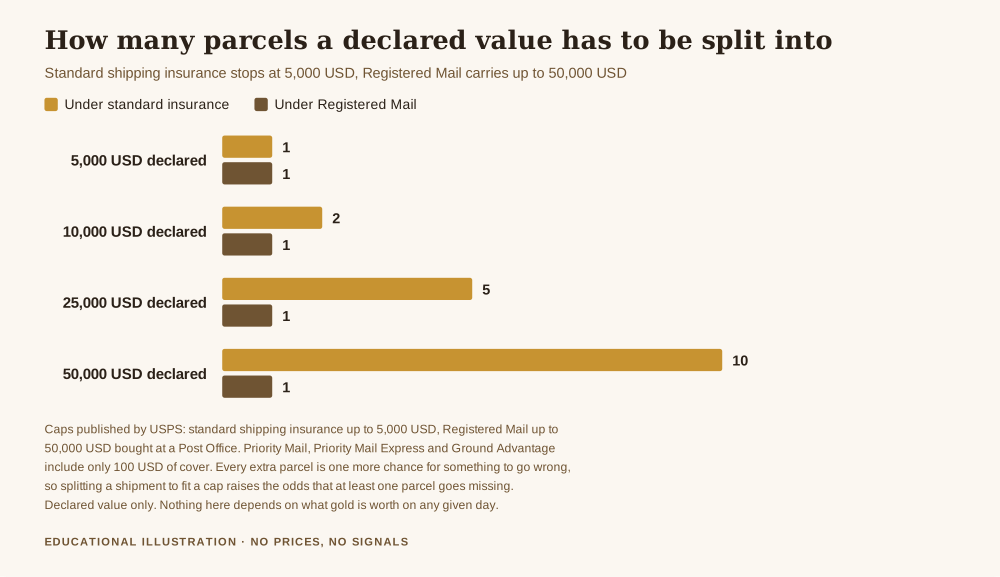
Work it through. Moving a declared value of 50,000 USD while staying under the 5,000 USD standard cap takes ten separate parcels. Registered Mail moves the same value in one. You have not reduced the risk, you have multiplied the number of chances to meet it, because each parcel is its own opportunity for something to go wrong.
The arithmetic is unforgiving. Suppose the chance of any single parcel going missing is one in a thousand. That is a hypothetical figure, not a published postal statistic, used only to show the shape of the thing. Send one parcel and the chance of a loss is 0.1 per cent. Send ten, and the chance that at least one of them goes missing is about 0.996 per cent, roughly ten times worse. Raise the per parcel chance to one in two hundred and ten parcels turn a 0.5 per cent problem into a 4.9 per cent one.
Every one of those claims would be paid, because each parcel sat under the cap. That is not the point. The point is that you have ten times as many conversations with a claims department, ten times as many packages sitting on ten doorsteps, and ten times as many chances to have a very bad week. Fitting the cap is not the same as managing the risk, and the difference between those two ideas is most of what protecting capital when gold gets volatile is about.
The handover is part of the protection
Registered Mail is not simply a higher number. It is a different handling process, and the process is most of what you are paying for. USPS is explicit that regardless of how the service was purchased, Registered Mail items must be presented for mailing to a Postal employee. You do not put it in a box on a corner. You hand it to a person.
From that point the item travels under signature at each stage, which is why the cover can be as high as it is. A chain of custody that records who held the item and when is what makes a claim provable rather than merely sad. The slowest part of the journey is also the part that creates the evidence.
Pack it so that the evidence survives too. Coins should not move or make noise inside the parcel, the outer wrapping should give no clue about the contents, and the packaging should be sealed in a way that shows if it has been opened. Keep the counter receipt, the tracking record and your own note of what went in, because a claim is settled on documentation. If the coins carry certificates or an assay card, photograph both the coins and the paperwork before sealing anything.
What a shipping indemnity will not do for you
It will not pay more than the declared value. Under declaring to save a few dollars on the insurance fee caps your own claim at the number you wrote down. It is the most expensive saving available in this whole process.
It will not cover what you cannot prove. Indemnity pays the actual value of the contents, which means you need evidence of what was in the parcel and what it was worth. A claim is a paperwork exercise, and the paperwork has to exist before the parcel leaves.
It will not survive a prohibited or restricted contents problem. Carriers set their own rules on what may be sent, with limits that differ by service and by destination, and international shipping adds customs declarations on top. Check the rules for the exact service and route before packing, not after.
It is not a substitute for storage. Insurance in transit covers a journey. It says nothing about where the coins live the rest of the time, which is a separate decision covered in where to store gold and in how to insure gold once it is at rest.
And one quiet risk that no carrier covers: the person at the other end. Verify who you are sending to and why, independently of whatever message prompted the shipment. Pressure to send metal quickly to an address you have not confirmed is a pattern worth recognising, and it sits close to the behaviour described in how to spot a gold trading scam.
Get the free Black Gold Market blueprint, the capital protection material in one place, for anyone who would rather check a published limit than take it on trust. One email, no spam, unsubscribe anytime.
Get the free blueprint →Frequently asked questions
What is the best way to ship gold coins domestically?
Start from the declared value. Below 5,000 USD, standard shipping insurance can cover the parcel in full. Above that figure, Registered Mail is the only option listed by USPS that carries the whole value, up to 50,000 USD, in a single insured parcel.
Is the insurance included with Priority Mail enough?
Only for very small shipments. Priority Mail Express, Priority Mail and USPS Ground Advantage include up to 100 USD of insurance. On a parcel declared at 10,000 USD that is 1 per cent of the contents, so the included cover should be treated as a rounding error rather than as protection.
Should I split a valuable shipment into several smaller parcels?
Splitting keeps each parcel under a cap, but it multiplies the number of parcels that can go astray. Moving a 50,000 USD declared value under the 5,000 USD cap takes ten parcels against one by Registered Mail, which raises the chance that at least one of them is lost by roughly a factor of ten.
Why does Registered Mail have to be handed over at a counter?
Because the signature trail is the product. USPS requires Registered Mail items to be presented to a Postal employee, and the recorded chain of custody from that moment onward is what supports indemnity at the higher limit.
Does the recipient need identification?
They may. USPS notes that for mail insured above 500 USD the recipient may be required to show acceptable primary identification before delivery. Tell the person to expect the parcel and to have identification available, otherwise a protected shipment turns into a failed delivery.
What about sending coins abroad?
Treat international shipping as a separate question. Cover limits, prohibited and restricted item rules and customs declarations all change by destination, and the limits quoted here are the domestic United States figures. Check the rules for the specific service and country before you pack.
Where this leaves you
Shipping coins is a small decision that behaves like a large one. The cost difference between the careless version and the careful version is measured in a counter visit and a modest fee. The outcome difference is measured in the entire declared value of the parcel. That asymmetry is the only reason this is worth a thousand words.
So the sequence is short. Write down the declared value. Read it against the published caps of 100, 5,000 and 50,000 USD. Choose the service that covers the whole figure in one parcel rather than the one that forces you to divide it. Hand it over in person, keep every piece of paper, and tell the recipient to expect it.
The foundation under this piece is protecting your capital when gold gets volatile, and the companion pieces are how to insure gold and where to store gold. The same instinct runs through all of them: read what the promise actually says before you rely on it.
Figures in this article come from the United States Postal Service, which publishes its cover limits for insurance and extra services, and from the Domestic Mail Manual section on Registered Mail and other extra services. The split parcel probabilities are arithmetic worked out from a stated hypothetical loss rate and are not postal statistics. Nothing in this article depends on what gold is worth on any particular day.
About the author. Raphael writes Black Gold Market on the principle that capital is protected by reading the clause, not by trusting the headline. He trades XAU/USD and spends more time on what happens when a plan fails than on what happens when it works, because the first case is the one that decides whether there is an account left to trade. Black Gold Market is free to follow, and the blueprint is optional. Nothing here is personal financial advice, no outcome is promised, and no entry, stop or target discussed should be treated as a signal.