
Foundations

You open a trading platform and see "EUR/USD 1.1050" on the screen. It looks like one number, a single price. It is actually a comparison between two currencies at once, and reading it backwards makes every decision after it backwards too.
A trader confused about which currency just got stronger does not need a better strategy. Five minutes with this page fixes that. Every lesson after this one leans on the habit you are about to build.
The idea in plain words
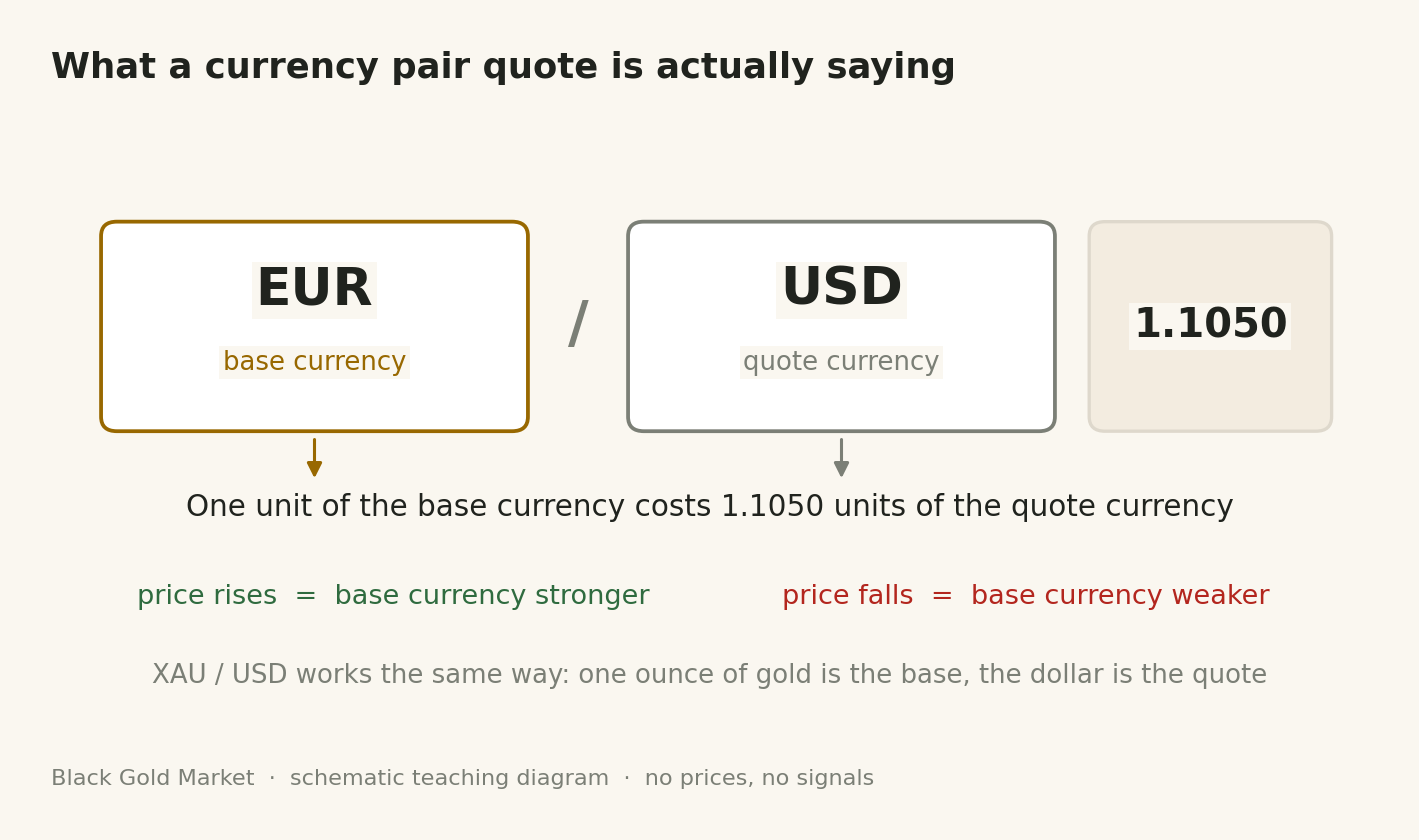
A currency pair always has two parts, written in a fixed order. The first currency is the base currency, the second is the quote currency. In EUR/USD, the euro is the base and the US dollar is the quote. The price you see, 1.1050, tells you how many units of the quote currency it takes to buy one unit of the base currency. Nothing more mysterious than that, one euro costs 1.1050 dollars.
When that price rises, the base currency has become more expensive measured in the quote currency. When the price falls, the base currency buys less. A rising EUR/USD means the euro has strengthened against the dollar, or the dollar has weakened against the euro, both sentences describe the same move.
Every quote is actually two prices standing side by side, a bid and an ask. The bid is what you would receive if you sold the base currency right now, the ask is what you would pay to buy it. The ask sits a touch above the bid, and that gap is the spread, one way your broker earns money on every trade. A later lesson covers spread in full, for now just know it is a real cost, not a rounding error.
Going long a pair means buying the base currency and selling the quote currency in one transaction. Going long EUR/USD means buying euros with dollars, hoping the euro strengthens. Going short reverses it, selling the base and buying the quote, hoping the base weakens instead.
Why a rising USD/JPY means a weaker yen, not a stronger one
This is where new traders trip. In USD/JPY, the dollar is the base and the yen is the quote. A rising USD/JPY price means one dollar buys more yen than before, so each single yen buys less, the yen has weakened. It feels backwards at first because the word "yen" sits right there in the ticker, and your eye wants to attach the rising number to whichever currency it recognizes. Name the base, name the quote, and the direction sorts itself out.
Gold is quoted the same way
XAU/USD, the ticker most gold traders watch, follows the identical rule. XAU stands for one troy ounce of gold and sits in the base position, the US dollar sits in the quote position, same structure as EUR/USD. A rising XAU/USD price means one ounce of gold now costs more dollars. Gold is not special here, it is simply the base currency of its own pair, treated exactly like the euro in EUR/USD.
Reading a symbol on your platform
Open the watchlist on any platform and pick a symbol. Six letters split into two groups of three, the first three name the base, the last three name the quote. Beside the symbol you will usually see two close numbers, the smaller one is the bid, the larger one is the ask. Some platforms hide the two sided quote until you open an order ticket, so if you see only one number, look for separate "buy" and "sell" buttons instead.
A worked example
These numbers are invented for this lesson only, a hypothetical example, not a live quote and not a recommendation.
Say a platform shows EUR/USD with a bid of 1.0999 and an ask of 1.1001. The spread is 1.1001 minus 1.0999, which equals 0.0002. Go long at the ask of 1.1001, and if price rises to 1.1051, the euro gained 0.0050 against the dollar, roughly 0.45 percent, before any cost such as the spread or a commission is subtracted. It is not a 50 percent move, mixing up raw digits with a percentage is a common misreading.
Now flip the pair. USD/JPY shows a bid of 149.20 and an ask of 149.23. Go short at the bid of 149.20, selling dollars and buying yen, and if price falls to 148.70, the dollar weakened by 0.50 against the yen. Your short gained on that move, again before costs. A falling USD/JPY here meant the yen strengthened, the mirror image of the rising example above.
A small table of example quotes
| Pair | Base currency | Quote currency | A rise in the price means |
|---|---|---|---|
| EUR/USD | Euro | US dollar | The euro is buying more dollars, the euro strengthened |
| USD/JPY | US dollar | Japanese yen | The dollar is buying more yen, the yen weakened |
| GBP/USD | British pound | US dollar | The pound is buying more dollars, the pound strengthened |
| XAU/USD | Gold, one troy ounce | US dollar | One ounce of gold now costs more dollars |
Where people go wrong
Assuming the first currency named is always the one moving. A trader sees USD/JPY climb and assumes dollar strength without checking the yen side, missing that a weak yen can push the same pair up for a different reason.
Ignoring the bid and ask when planning an exit. A trader sees price return to the entry level and expects a flat result. You buy at the ask and sell at the bid, so closing at the same displayed price you entered at usually locks in a small loss equal to the spread.
Treating the quote currency as fixed and only watching the base. On a broadly strong dollar day, a trader sees EUR/USD and XAU/USD fall together and assumes both had bad news, when the dollar side of both pairs simply did the moving.
Your turn
- Open a demo platform or a free charting site. Write down the base and quote currency for EUR/USD, USD/JPY and XAU/USD.
- Find the live bid and ask for one of those symbols. Calculate the spread by subtracting the bid from the ask.
- On paper only, decide whether going long USD/JPY today would be a bet on a stronger or weaker yen, and write one sentence explaining why.
Check yourself
In EUR/USD, which currency is the base and which is the quote
The euro is the base currency and the US dollar is the quote currency, the price tells you how many dollars one euro will buy.
If USD/JPY rises from 149.00 to 150.00, has the yen gotten stronger or weaker
Weaker. Each dollar now buys more yen, so each individual yen buys less, meaning the yen has weakened against the dollar.
In XAU/USD, what plays the role of the base currency and what plays the role of the quote currency
One troy ounce of gold is the base currency and the US dollar is the quote currency, so a rising price means gold costs more dollars per ounce.
Once base and quote feel automatic, the next habit is measuring a move properly, in the small units traders actually use rather than in percent. That is the subject of pips, points and lots.