

Someone notices that a fund promising twice the daily move of gold exists, does the obvious mental multiplication, and wonders why anyone would hold the ordinary version. So why leveraged ETFs are bad for that person is worth answering properly, because the honest answer is not that the product is dishonest. It does exactly what its documents say. The trouble is that what it says is narrower than what most buyers hear, and the gap between the two has a size you can calculate.
This belongs under Protect. The expensive version of this lesson arrives as a statement showing a loss on a position whose underlying market ended the month roughly where it started. The cheap version is a few paragraphs of arithmetic, which is what follows.
In my inbox, about 92 messages mention leverage in some form. That is a count of a keyword in messages, not a survey, and it says nothing about who is right. But the shape of the questions is consistent. One reader wrote: "Before that I always held spot. Then I watched a few YouTube videos and thought I could trade with leverage." Another asked, more simply: "I need clarity whether we have to use leverage or not, if so how much." Those are the right questions, and a leveraged fund answers the second one for you, every single day, whether you meant to ask it or not.
Why Leveraged ETFs Are Bad, the Short Answer
A leveraged exchange traded fund aims to deliver a multiple of its underlying's return over one day. Twice, or three times, or minus one, or minus two. To do that it has to rebalance its exposure at the end of each day, so that tomorrow starts again at the same multiple of today's closing value.
That daily reset is the whole story. A multiple of the daily return is not a multiple of the monthly return, or the yearly return, or the return over whatever period you actually hold it for. Over one day the promise is precise. Over many days the result depends on the path the underlying took, not only on where it ended. A market that wanders up and down and finishes flat leaves the ordinary fund flat and leaves the geared fund lower.
So the short answer is this. Leveraged ETFs are not bad as instruments. They are bad as holdings for anyone who expects them to behave like a magnified version of the ordinary fund over weeks or months. That expectation is wrong by construction, and it is wrong in one direction more often than the other.
What a Daily Reset Actually Promises
Consider the smallest possible example, because it contains everything.
The underlying rises 10 per cent on day one. On day two it falls by exactly the amount needed to bring it back to its starting value, which is not 10 per cent. Falling 10 per cent from 110 gives 99, not 100. The fall that returns 110 to 100 is 9.0909 per cent. After two days the underlying is exactly where it began.
Now the 2x product. On day one it rises 20 per cent, twice 10, so 100 becomes 120. On day two it falls twice 9.0909 per cent, which is 18.1818 per cent, so 120 becomes 98.18. The underlying is flat. The geared product is down 1.82 per cent.
Nothing went wrong. Each day, the product delivered exactly twice the underlying's daily return. The loss comes from compounding a magnified series of returns, and it appears whenever the path zigzags. That is why the effect is often called volatility decay, although nothing decays in the sense of being worn away. It is simply what multiplying a sequence of larger ups and larger downs produces.
The Arithmetic, With the Assumptions Written Out
One pair of days is a curiosity. Fifty days is a holding period, and this is where the numbers stop being small.
The assumptions, written out so you can repeat or reject them. The underlying moves up by a fixed amount, then down by the exact amount that returns it to its start, and this pair repeats 25 times, which is 50 trading days. The underlying therefore ends exactly flat every time. The geared product is a 2x daily-reset fund. I include no management fee, no spread, no financing cost and no tracking error, so every number below flatters the product.
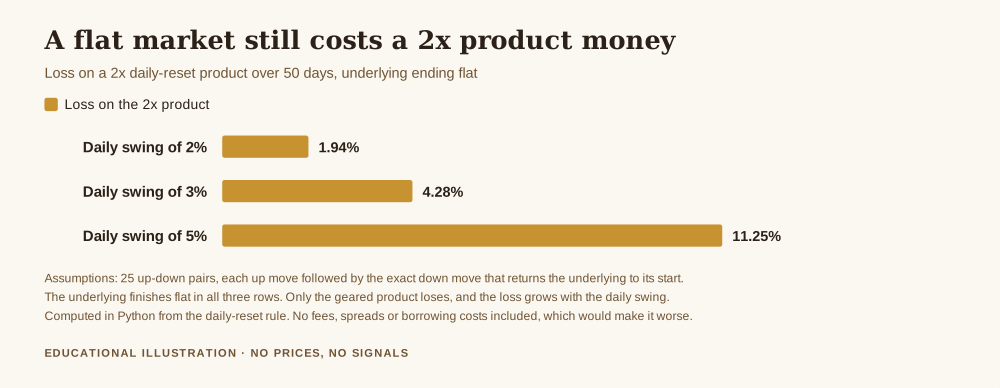
With a daily swing of 2 per cent, the underlying finishes flat and the 2x product finishes down 1.94 per cent. With a swing of 3 per cent it finishes down 4.28 per cent. With a swing of 5 per cent it finishes down 11.25 per cent.
Read the last figure again. The market the fund tracks did nothing over ten weeks. A holder of the geared version lost about a ninth of the money, before costs, without any single day of the product failing to do its job.
There is a second thing in those three rows, and it matters more than the headline. The loss does not rise in proportion to the swing. Going from a 2 per cent swing to a 5 per cent swing is two and a half times the daily movement, and the loss goes from 1.94 to 11.25 per cent, which is almost six times larger. The cost of holding these products grows faster than the volatility that causes it. That is the part that turns a modest inconvenience in a calm market into a serious leak in a loud one.
What the Regulator Says, in Its Own Words
None of this is a private theory. The Financial Industry Regulatory Authority in the United States addressed it directly in Regulatory Notice 09-31. The notice says that most leveraged and inverse ETFs reset daily, and that they typically are unsuitable for retail investors who plan to hold them for longer than one trading session, particularly in volatile markets. It also says that, because of compounding, their performance over longer periods can differ significantly from their stated daily objective.
That is a regulator describing the same arithmetic you have just done by hand. The mathematics behind it has been worked out formally as well. Marco Avellaneda and Stanley Zhang set it out in Path-Dependence of Leveraged ETF Returns, published in the SIAM Journal on Financial Mathematics in 2010. The title is the whole lesson in four words: the return depends on the path.
When a regulator and a mathematics journal arrive at the same sentence from different directions, the sentence is probably worth keeping.
Why the Loss Grows With the Swing
It helps to see why the relationship is not a straight line, because it tells you when to worry.
Each up and down pair costs the geared product a little, and the size of that little depends on the square of the daily move rather than on the move itself. Double the daily swing and the drag per pair roughly quadruples. That is why the 5 per cent row is so much worse than the 2 per cent row, and why the same product can feel harmless for a month and then hurt badly in the next.
The practical reading is simple. The quieter the underlying, the closer the geared fund comes to doing what buyers imagine. The noisier the underlying, the further it drifts from that picture. Gold has calm stretches and violent stretches, and a holder of a geared gold product is effectively making a bet on which kind of stretch is coming, whether or not they think of it that way.
The one path that favours these products is a steady trend with little back and forth, because then the compounding works in the holder's favour. That is a real outcome and it does happen. The problem is that nobody gets to choose the path in advance, and a trend can turn into a range halfway through the holding period without any warning at all.
Where This Meets a Gold Trader
Most people reading Black Gold Market trade gold through a broker rather than through a geared fund. The lesson still transfers, because the same misunderstanding sits underneath both.
A reader once asked me, in a hurry: "If no margin remains, the account will be burned?" Another told me afterwards: "I was too emotional to see a recovery and used excessive margin in this trade." Both are describing what happens when leverage is treated as a way of making a view bigger rather than as a structure with its own rules. A geared fund makes that structure explicit and resets it every day. A leveraged trading account does not reset, but it has its own version of the same trap, which is that the size you chose for a calm market is the size you are still carrying when the market stops being calm.
So the question to ask of any leveraged exposure, fund or account, is not how much it multiplies. It is what happens to it on a path that goes nowhere, and how long you intend to sit on that path.
Get the free Black Gold Market blueprint, a short document on protecting capital before you try to grow it, including how to check what any leveraged product will do to you on a path that goes nowhere. One email, no spam, unsubscribe anytime.
Get the free blueprint →What This Does Not Say
It does not say leveraged ETFs are fraudulent. They are disclosed products that generally deliver their stated daily objective. The problem is a mismatch between that objective and how they are often held.
It does not say they always lose. On a strong, smooth trend a geared fund can return more than its multiple suggests. The arithmetic above shows the cost of a zigzag path, not a guaranteed result on every path.
It does not say anything about where gold is going. Nothing here is a view on direction, and nothing here is a reason to buy, sell or short any product today.
Frequently Asked Questions
Why are leveraged ETFs bad for long term holding?
Because they reset to their target multiple every day, so their return over many days depends on the path the underlying takes. On a path that zigzags and ends flat, a 2x fund ends lower. Over 50 such days with a 5 per cent daily swing, the loss works out to 11.25 per cent before costs.
Does a 2x ETF give twice the return over a year?
Not reliably. It aims for twice the return of each single day. Over a year, compounding those daily returns can produce more than twice, less than twice, or a loss, depending on how much the underlying moved around along the way.
What is volatility decay?
It is the shortfall a daily-reset leveraged product suffers when its underlying moves up and down. The name is a little misleading, because nothing wears away. It is the compounding of magnified ups and downs, which leaves the product lower than a simple multiple of the overall move.
Are inverse ETFs affected in the same way?
Yes. FINRA's Regulatory Notice 09-31 treats leveraged and inverse funds together, because both reset daily and both can drift from their stated objective over longer periods, especially in volatile markets.
Do costs make it worse?
Yes. The figures in this article deliberately leave out management fees, spreads, financing costs and tracking error. Each of those comes on top of the arithmetic drag, never instead of it.
Where did the numbers in this article come from?
The 1.94, 4.28 and 11.25 per cent figures are not quoted from anywhere. I computed them in Python from the daily-reset rule, with every assumption written out above so you can repeat or reject them. The regulatory description is from FINRA Regulatory Notice 09-31, and the formal mathematics is from Avellaneda and Zhang in the SIAM Journal on Financial Mathematics, 2010.
Where Black Gold Market Fits
Black Gold Market is free to follow. Daily XAU/USD analysis with the level, the context and the risk stated before the trade, losing days included, on Telegram. There is a free blueprint for anyone who wants the capital protection material in one place, and an optional Kit for people who want the full method. Nothing here promises a profit, and nothing here is a signal service.
Understanding what a product does on a flat path belongs to Protect. How to protect your capital when gold gets volatile is the pillar this article sits under. What is gold ETF tracking error covers the quieter gap that ordinary gold funds carry, and how gold ETF flows affect the price of gold looks at these funds from the other side, as buyers and sellers in the market itself.
About the author. Raphael writes Black Gold Market. He works on the part of this business that happens before the entry, the level, the context, and the risk, and he would rather run a product through fifty flat days on paper than learn the same thing from a statement. Nothing in this article is a recommendation to trade, and no entry, stop or target discussed should be treated as a signal.
Disclaimer: This article is general educational content about how daily-reset leveraged and inverse exchange traded products behave over time. It is not financial advice, not investment advice and not a recommendation to buy, sell or hold any product, fund or instrument. Product terms, costs and regulatory guidance change over time. Figures computed here rest on the stated assumptions and exclude costs. Trading and investing carry risk of loss. Only commit capital you can afford to lose.