

Why is gold the basis of currency is a question that carries a hidden assumption, and the assumption is out of date by more than half a century. Gold is not the basis of any major currency today. No government will hand you metal in exchange for a banknote, and none has promised to since the summer of 1971. The question is still worth answering properly, because the arrangement that ended left two things behind: a number frozen in American law that has not moved since 1973, and a habit among central banks of holding the metal anyway. Those two leftovers explain more about how gold behaves than any amount of commentary about safe havens.
Everything below is sourced to the Federal Reserve's own material, and the figures are official rates rather than market ones. No absolute gold price appears anywhere in this article, because none is needed. The two prices discussed are set by treaty and by statute, which makes them matters of public record that you can check yourself in a few minutes.
What a gold standard actually promised
A gold standard is not a statement that gold is valuable. It is a promise of convertibility: the issuer will exchange its paper for a fixed quantity of metal on demand, at a rate published in advance. The promise is the whole mechanism. An issuer that prints more paper than it can redeem gets found out, because holders turn up at the window and ask. Discipline does not come from the metal sitting in the vault. It comes from the right of other people to take it away.
That right is also the weakness. A promise to redeem is only as good as the stock of metal behind it, and the stock does not grow when the economy does. The Federal Reserve History account of the gold standard sets out the era and its strains. For a trader the useful part is simply this: under convertibility, the quantity of money was tied to something the authorities could not create at will, and every argument for and against the system follows from that single constraint.
Why is gold the basis of currency in so many explanations, and when did that stop being true
The explanations persist because the arrangement was real, recent, and global. Under the post war settlement, as the Federal Reserve History essay on the end of convertibility records, United States dollars were convertible to gold at a fixed exchange rate of 35 dollars an ounce. Other currencies were fixed to the dollar. So the dollar was anchored to metal and everything else was anchored to the dollar, which is as close to gold being the basis of currency as the modern world ever got.
It ended on a specific evening. On 15 August 1971, the President addressed the nation on a new economic policy, and the first order of business was to close the gold window. The essay puts the consequence in one sentence: foreign governments could no longer exchange their dollars for gold. There was no transition period and no vote. A promise that had organised international finance simply stopped being a promise, and the world has operated without it ever since. You can read the account at Federal Reserve History on the end of gold convertibility.
So the honest answer to the question is in the past tense. Gold was the basis of currency, under a published rate, until a date you can name. What replaced it was not another commodity. It was the judgement of central banks, which is a different kind of anchor and has to be watched in a different way.
The number that never moved
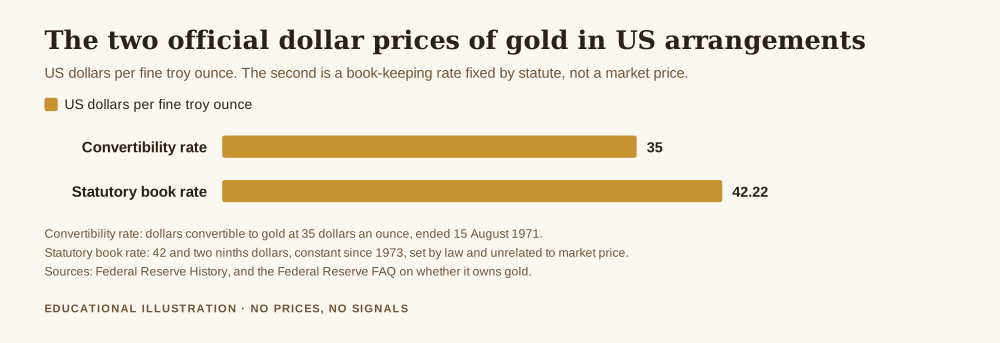
Here is the part that surprises people who assume the old system was swept away completely. The United States still carries gold on its books at a price fixed by law, and that price is not the market price and is not meant to be. The Federal Reserve's own FAQ on whether it owns gold states that the statutory rate "has been constant at 42 2/9, or 42.2222, per fine troy ounce since 1973". Fifty three years, as of this year, without a single revision.
The same page explains the ownership arrangement, which is just as counterintuitive. The Federal Reserve does not own gold. Under the Gold Reserve Act of 1934 it had to transfer ownership of all of its gold to the Department of the Treasury, and in return it received gold certificates. Those certificates are denominated in US dollars, and the FAQ is explicit that they do not give the Federal Reserve any right to redeem the certificates for gold. The source is the Federal Reserve FAQ on whether it owns or holds gold.
Read those two facts together and the shape of the modern arrangement appears. The central bank of the world's reserve currency holds paper claims that cannot be exchanged for metal, valued at a rate set before most traders reading this were born. The 42.2222 figure is a bookkeeping convention, nothing more. It is roughly a fifth above the old 35 dollar convertibility rate and has no relationship whatever to what an ounce changes hands for today. Anyone who quotes it as though it were a market price has misunderstood what they are looking at.
If the link is gone, why do central banks still hold the metal
This is the question that actually matters for anyone trading gold, and it has a practical answer rather than a mystical one. Central banks hold gold because it is the one reserve asset that is nobody else's liability. A foreign bond is a promise from a government that can default, freeze, or inflate. A deposit is a promise from a bank. Metal in a vault is not a promise from anyone, which makes it useless for earning a return and valuable for exactly one purpose: surviving the failure of other people's promises.
The World Gold Council compiles the official sector holdings reported to the International Monetary Fund, published as its monthly central bank statistics. The series is worth following not because any single month tells you much, but because the direction of official buying is one of the few genuinely slow moving forces in this market. If you want the fuller treatment, we have written separately on what gold reserves are and on how central banks affect the price of gold.
It is also where the de dollarisation conversation lives. When reserve managers shift the mix of what they hold, they are not making a statement about the gold standard returning. They are managing counterparty risk across decades. The distinction matters, because the first framing invites you to wait for a monetary revolution and the second invites you to watch a slow and observable trend. We have taken that apart in detail in the de dollarisation trade.
What this changes about how you read gold
Three things follow, and none of them requires a forecast.
The first is that gold has no official price to anchor to. Under convertibility there was a number the authorities defended, so a move away from it meant something specific. Today there is no defended level, which is why arguments that gold is cheap or expensive relative to some official figure are empty. The only figure set by authority is the 42.2222 bookkeeping rate, and it is an accounting entry, not a target.
The second is that the constraint on money creation that convertibility imposed is simply not there any more. Whatever you think that is worth, the practical consequence for a trader is that gold now responds to expectations about policy rather than to a redemption mechanism. That is why rate decisions and inflation data move it, and it is why we treat the macro calendar as part of reading the market rather than as background noise.
The third is the Protect lesson, and it is the one worth keeping. A system that looked permanent ended on a single evening with no notice given to anyone holding a position. The people who were hurt were not the ones who had the wrong view about gold. They were the ones whose arrangements could not survive a rule change they had not budgeted for. That is a risk management point, not a historical one, and it applies to your account in exactly the same way it applied to a foreign treasury in 1971. Size your positions so that a change in the rules is an inconvenience rather than a forced sale.
Reading official figures without being misled by them
Two habits are worth building. The first is to check whether a number you have been handed is a market price, an official rate, or an accounting convention, because those three things get quoted interchangeably by people who should know better. The 35 dollar rate was a real promise while it lasted. The 42.2222 rate is a ledger entry that has outlived the system it belonged to. Neither is a market price, and neither tells you anything about what gold is worth now.
The second is to go to the primary source. Everything in this article comes from two Federal Reserve pages and one World Gold Council data page, all linked above, and the whole check takes about ten minutes. That habit is worth more over a trading career than any individual fact in this article, because the number of confident claims about gold and money that fall apart on contact with the original document is genuinely remarkable.
Get the free Black Gold Market blueprint, a short document on protecting capital and on checking a claim against the source before you trade on it. One email, no spam, unsubscribe anytime.
Get the free blueprint →Frequently asked questions
Is any currency still backed by gold today?
No major currency is. Convertibility of US dollars into gold for foreign governments ended on 15 August 1971, and the fixed rate system that depended on it ended with it. Central banks still hold gold as a reserve asset, which is a different thing from backing a currency with it.
Why is gold the basis of currency in so many textbooks then?
Because it describes a system that really existed and ended within living memory. The gold standard and the post war fixed rate arrangement shaped international finance for decades, so the explanation survives in teaching material and in general conversation long after the mechanism was switched off.
What is the 42.2222 dollar figure?
It is the statutory rate at which the United States values gold for official purposes, constant since 1973 according to the Federal Reserve's own FAQ. It is an accounting convention set by law. It is not a market price, not a floor, and not a target, and it should never be compared with what gold trades at.
Does the Federal Reserve own the United States gold reserve?
No. The Federal Reserve FAQ states plainly that it does not own gold. The Gold Reserve Act of 1934 required it to transfer ownership of all its gold to the Treasury, and it holds gold certificates instead, which carry no right of redemption for metal.
Could a gold standard return?
That is a political question rather than a market one, and nobody trading today should position on an answer to it. What is observable is the direction of official sector holdings, which the World Gold Council publishes monthly from IMF data. Watch the reported figures rather than the arguments about them.
Does any of this help me trade gold?
Indirectly, and usefully. It tells you there is no official price to anchor expectations to, that policy expectations are the live mechanism, and that systems can change by announcement. The last point is a position sizing instruction rather than a view on direction.
Where Black Gold Market fits
Black Gold Market is a free journal about reading gold and protecting capital, written for people who would rather check a primary source than be told what to think. Nothing here is sold on a promise of returns, and there is no signal service. The free blueprint is a short document on protecting capital and on the unglamorous checks that decide whether a claim holds up. The piece underneath all of it is how to protect your capital when gold gets volatile.
About the author. Raphael writes Black Gold Market. He spent an embarrassing stretch of his early twenties repeating a confident claim about gold backing that he had never once traced to a source, and then found the Federal Reserve page that contradicted it in under ten minutes. What matters to him is the level, the context, and the risk, in that order.
Sources and method. The 35 dollar convertibility rate, the date of 15 August 1971 and the closing of the gold window are from the Federal Reserve History essay on the end of gold convertibility. The statutory rate of 42 2/9 dollars per fine troy ounce constant since 1973, the Gold Reserve Act of 1934 transfer, and the fact that gold certificates carry no right of redemption, are from the Federal Reserve FAQ on whether it owns or holds gold. Official sector holdings data is compiled by the World Gold Council from IMF reporting. All sources are linked in the text. The fifty three years the statutory rate has stood, the fifty five years since convertibility ended, and the observation that 42.2222 sits roughly a fifth above 35, are my own arithmetic on those published figures, shown here so you can repeat it.
Disclaimer. This article is educational content about monetary history and official published rates. It is not investment advice, not a recommendation of any product, and not a forecast. Nothing here is personal advice, and no entry, stop or target discussed should be treated as a signal. No absolute gold price appears anywhere in this article, and the two figures quoted are official rates rather than market ones. Official rates and reserve data change, so verify them at the source before acting. Decide your own risk, and never trade money you cannot afford to lose.