

Ask a room of traders why do countries have gold reserves and you will get the same three answers: it is a hedge against inflation, it is money when money fails, and central banks have always done it. None of those are wrong exactly. All of them are the kind of answer that sounds complete and leaves you unable to do anything with it.
There is a better way in, and it does not require guessing at anyone's motives. Central banks publish what they hold. Treasuries publish how they carry it on their books. Those published numbers describe the behaviour precisely, and behaviour is more reliable than stated intent. So rather than argue about why gold feels important, let us read what the official sector actually does with it, and work backwards.
Start with what is on the books, not what is in the speeches
The United States publishes a monthly status report of its government gold reserve. As of 30 September 2026, the reported total was 261,498,926.241 fine troy ounces. Converting at the international troy ounce of 31.1034768 grams, which is the only assumption in that step, gives roughly 8,133.5 tonnes. The figures come from the US Treasury's own gold reserve status report, which is published as line items by facility.
That tonnage is the headline, and it is the least interesting part of the file. The interesting part is how it is split.
Why do countries have gold reserves, answered by where the gold sits
Break the Treasury's line items into categories and a very clear picture appears. Deep storage accounts for 245,262,897 ounces, which is 93.79 per cent of the total. Gold held at the Federal Reserve Bank accounts for 13,452,810 ounces, or 5.14 per cent. Mint working stock, the portion actually available for day to day coin operations, is 2,783,218 ounces. That is 1.06 per cent.
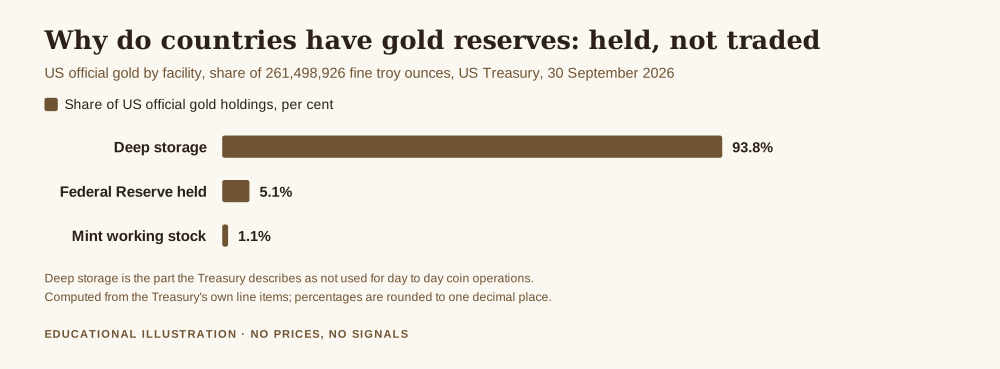
Ninety-four per cent of it is, functionally, not moving. One per cent is doing anything resembling work. A reserve asset in the true sense is not inventory waiting to be sold, and it is not a trading position. It is a holding whose job is to exist, verifiably, in a known quantity, in a known place.
That single ratio answers more of the question than any argument about inflation does. Countries hold gold in order to hold it. The value of the holding lies in the fact that it does not need to be used.
The oddity on the balance sheet that explains the rest
Now the detail that makes most people stop and reread. Against those 261.5 million ounces, the Treasury reports a total book value of 11,041,059,957.90 US dollars. Divide one by the other and the implied carrying rate is about 42.22 dollars an ounce.
That is not a market price, and I want to be unambiguous about it. It is a statutory book rate, a legacy accounting figure fixed in law decades ago, and it has no relationship to what gold trades for. I am not telling you what gold is worth today and I am not going to.
But notice what the accounting implies. A country that intended to treat gold as an investment would mark it to market, because the point of an investment is its current value. Carrying it at a fixed statutory rate says something different. It says this holding is not being managed for return. It is a stock of a thing, counted in ounces, and the ounces are the point.
If you only take one idea from this article, take that one. Official gold is accounted for as a quantity, not as a price. That is a completely different relationship to the metal than the one a trader has.
What central banks say when they are asked directly
Behaviour is the strongest evidence, but stated reasoning is worth something too, provided it is collected properly. The World Gold Council runs an annual survey of central bank reserve managers. The 2026 Central Bank Gold Reserves Survey was published on 16 June 2026 and drew 76 responses, with base sizes varying by question because some questions were voluntary.
Seventy-six is a small sample in absolute terms. It is a large one relative to the number of institutions that exist, which is the right denominator here. The reasons the survey reports clustering around are gold's performance during periods of crisis, its role as a portfolio diversifier, inflation hedging, hedging against geopolitical risk, and deliberate reserve diversification policy.
Put that list beside the storage data and the two agree. Every one of those reasons is a reason to possess a thing rather than to transact in it.
The four motives, stated plainly
Collapsing all of that into usable form, there are four reasons a country ends up with gold on its books, and they overlap.
The first is the absence of counterparty risk. Almost every other reserve asset is somebody's promise. A government bond is a claim on a government, a deposit is a claim on a bank, and a currency holding is a claim on another country's policy choices. Gold is the rare reserve asset that is not anyone's liability. In ordinary times that is an abstraction. In the specific situation reserves exist for, it is the entire feature.
The second is behaviour during crisis, which is the reason the survey respondents cite most consistently. Reserves are not held for normal conditions. They are held for the conditions where normal relationships stop holding, and gold's usefulness is concentrated there.
The third is diversification in the dull, mathematical sense. A reserve portfolio concentrated in a handful of currencies carries the risks of those currencies. Adding an asset that behaves differently reduces the portfolio's dependence on any one of them, and that is true regardless of anyone's view on whether gold is going up.
The fourth is political, and it is the one official statements phrase most carefully. Gold held in your own vaults cannot be frozen by another jurisdiction. This is also why the question of where reserves are physically stored has become more prominent, a subject worth its own treatment.
What this does and does not mean for someone trading gold
Here is where I have to be careful, because this is the point at which macro articles usually overreach.
Central bank demand is real and it is large enough to matter to the supply and demand balance over long horizons. That is a reasonable thing to know. What it is not is a tradeable signal. These institutions operate on multi-year mandates, they report with a lag, and the published figures reach you through the International Monetary Fund's statistics with delays of months. The World Gold Council's own country data notes that holdings are as of June 2026 for most countries and earlier for late reporters, drawn from the IMF's September 2026 statistics edition, as set out on its gold reserves by country page.
Read that again as a trader. The freshest official number available to you is a quarter old, and some of it is older. Anyone presenting central bank activity as a reason to take a position this week is using slow data to justify a fast decision. That is not analysis, it is decoration.
The honest use of this information is narrower and more durable. It tells you that there is a large, patient, price-insensitive holder of gold that does not behave like you, does not share your time horizon, and is not trying to outperform anything. Knowing that should make you more sceptical of explanations that attribute every move to central banks, not less.
There is one more trap worth naming, because it catches careful people. A country adding to its reserves is not expressing a view that gold is cheap. It may be rebalancing a portfolio, reducing exposure to a particular currency, or executing a policy agreed years earlier by people who have since moved on. Reading a purchase as a bullish opinion imports a motive that was never there. The official sector is not a smart money signal, it is a different kind of participant with a different job, and the most common analytical error is to treat its behaviour as a louder version of your own.
The part that actually transfers to your own account
There is one lesson here that is genuinely portable, and it has nothing to do with forecasting.
The official sector separates the part of the holding that is allowed to move from the part that is not, and the untouchable part is ninety-four per cent of it. That is a capital structure decision, made in advance, written down, and insulated from whatever is happening in markets this month.
Most retail accounts have no such separation. Every dollar is available to every idea, which means a bad week can reach all of it. The distinction between reserve capital and working capital is the one piece of central bank practice that an individual can actually copy, and it costs nothing to implement.
Get the free Black Gold Market blueprint, a one-page guide to separating reserve capital from working capital so a single bad stretch cannot reach everything you have. One email, no spam, unsubscribe anytime.
Get the free blueprint →Frequently asked questions
Why do countries have gold reserves rather than only currencies?
Because gold is not anyone's liability. Currency and bond reserves are claims on another government or institution, and in the precise circumstances reserves are held for, those claims can be impaired, frozen, or devalued. Gold carries no such counterparty.
How much gold does the United States report holding?
261,498,926.241 fine troy ounces as of 30 September 2026, which is roughly 8,133.5 tonnes at the standard troy ounce conversion. The Treasury publishes this monthly, broken down by facility.
Why is US gold valued at about 42 dollars an ounce on the books?
That is a statutory book rate set in law, not a market valuation. It exists for accounting continuity. The practical implication is that the reserve is tracked as a quantity of ounces rather than managed for its current value.
Does central bank gold buying predict the gold price?
Not in any way you can trade on. The data arrives with a lag of months, these institutions act on multi-year mandates, and their decisions are largely price-insensitive. It is context for understanding long-run demand, not a timing tool.
What does deep storage mean?
It is the Treasury's own category for the portion of the holding not used for day to day coin operations. It is 93.79 per cent of the US total, which is the clearest single indicator that reserves exist to be held rather than used.
Do all countries hold gold for the same reasons?
Broadly similar ones, with different weightings. The 2026 World Gold Council survey of 76 reserve managers points to crisis performance, diversification, inflation hedging and geopolitical risk, but how heavily each matters depends on a country's currency, trade position and politics.
Where Black Gold Market fits
Black Gold Market is free to follow. Daily XAU/USD analysis with the level, the context and the risk stated before the trade, losing days included, on Telegram. There is a free blueprint for anyone who wants the capital protection material in one place, and an optional Kit for people who want the full method. Nothing here promises a profit, and nothing here is a signal service. The groundwork this article rests on is in protecting your capital when gold gets volatile, the counting and the sources are in what gold reserves are and who holds them, the price mechanism this article deliberately avoided is in how central banks affect the price of gold, and the storage question is picked up in why countries are repatriating gold.
About the author. Raphael writes Black Gold Market. He came to gold through the macro side rather than the chart side, and his standing complaint is that most commentary states a conclusion without ever showing where the number came from. He would rather hand you a smaller claim you can check yourself than a large one you have to trust. Figures here are from the published sources linked above, the calculations state their assumptions so you can repeat them, nothing in this article forecasts the price of gold or is a recommendation to trade or buy any metal, it is not investment advice, and no entry, stop or target discussed should be treated as a signal.