

There is a question that comes up in the channel more often than any other, usually after a bad week, and it is almost always the wrong question. It sounds like this: how do I get my win rate up? So I want to take the long way round to answering it, because the honest answer runs through a different number entirely. What is expectancy in trading, and why does it decide whether an account grows or bleeds, regardless of how often you are right? Once you have the answer to that, the win rate question stops being interesting, and the relief of that is difficult to overstate.
This is a Protect article dressed up as a Master article. The reason to understand expectancy is not that it makes you more money. It is that it stops you from destroying a perfectly good method because you could not tell the difference between a bad process and an ordinary run of bad luck.
What Is Expectancy in Trading, Stated Plainly
Expectancy is the average result you should expect from one trade, taken over many trades, measured in units of the risk you took. That last clause is the part people skip, and it is the part that makes the whole thing work.
Measure everything in R, where 1R is the amount you lose when a trade goes against you and hits your stop. Not the amount you invested, the amount you lose. If a winner pays you twice what a loser costs you, that is a 2R winner. This converts every trade in your record, on any instrument and any size of account, into one comparable unit.
Then the formula is short enough to keep in your head:
Expectancy per trade = (win rate x average winner in R) minus (loss rate x average loser in R)
That is the whole thing. Two inputs you control through your exits, one input you do not fully control at all, and an output that tells you whether the arithmetic of your business is positive or negative. A positive expectancy means the method pays you, slowly, over enough repetitions. A negative expectancy means it takes from you, slowly, over enough repetitions, and no amount of discipline or screen time fixes that, because discipline applied to a losing formula just delivers the losses more reliably.
The Break-Even Win Rate, and Why the Win Rate Argument Dies Here
Set expectancy to exactly zero and solve for the win rate, and you get the win rate you need just to stand still at any given reward-to-risk ratio. The formula is one divided by one plus your reward-to-risk. Here is what that produces, assuming every loser costs exactly 1R:
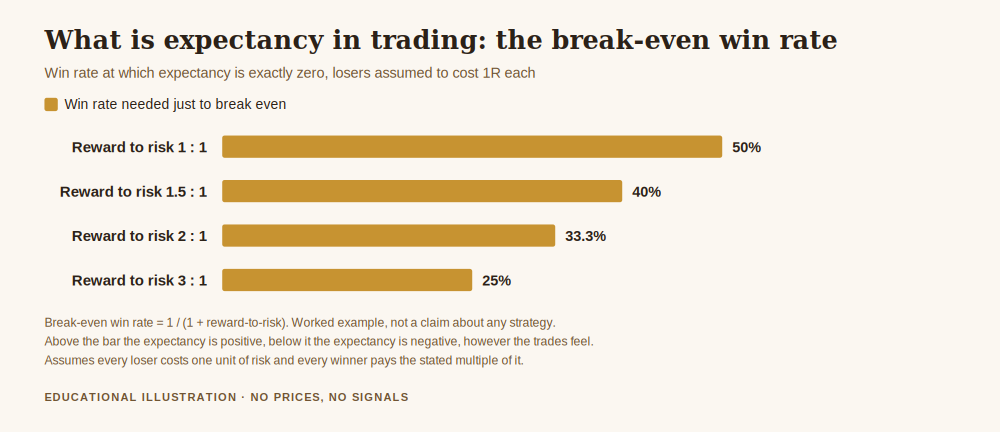
At a reward-to-risk of 1 to 1, you need to be right 50 percent of the time just to break even before costs. At 1.5 to 1 you need 40 percent. At 2 to 1 you need 33.3 percent. At 3 to 1 you need 25 percent, which means you can be wrong three times out of four and still be running a positive business.
Sit with that last one for a moment, because it dismantles something. A trader being wrong three times out of four is not a trader with a problem. It may be a trader with an excellent method who has simply chosen to be paid in fewer, larger increments. Meanwhile a trader who is right seven times out of ten, and who cuts winners at 0.5R while letting losers run to 1.5R, is losing money steadily while feeling correct almost every day. That is the crueller of the two situations, and it is far more common, because being right feels like evidence and it is not evidence.
This is the entire reason the channel states the level, the context and the risk before the trade rather than after it. The reward-to-risk is decided at the entry, in advance, in cold blood. It is the input you have most control over and it does more work in that formula than the win rate ever will.
A Worked Example, With the Assumptions on the Table
Assume a method that wins 40 percent of the time, where winners pay 2R and losers cost 1R. These are assumptions I have chosen to illustrate the arithmetic, not a description of any strategy, mine or anyone else's.
Expectancy = (0.40 x 2R) minus (0.60 x 1R) = 0.80R minus 0.60R = +0.20R per trade.
Twenty percent of one unit of risk, per trade, on average, in the long run. It sounds like almost nothing, and that reaction is worth examining, because it is exactly the reaction that leads people to abandon working methods. Over 100 trades that is 20R. If your unit of risk is a small, fixed, survivable fraction of the account, 20R is a serious year. The number is small per trade and meaningful in aggregate, which is precisely the shape of every durable business ever built.
Notice also what happens if you leave the win rate completely alone and improve only the exit, taking winners at 3R instead of 2R. Expectancy becomes (0.40 x 3) minus 0.60 = +0.60R per trade, three times the edge, with no improvement whatsoever in how often you were right. Now compare that to the alternative route of pushing the win rate from 40 to 50 percent while holding 2R, which gives +0.50R. Both work. Only one of them is under your direct control on the day.
The Number Nobody Wants to Hear
Here is where expectancy stops being a comforting formula and starts being a demand for patience.
Your measured expectancy is an average drawn from a sample, and samples are noisy. Take the example above, 40 percent at 2R with 1R losers. The expectancy is +0.20R, and the standard deviation of a single trade's outcome around that average works out to about 1.47R. That is more than seven times the size of the edge itself. Any individual trade tells you essentially nothing.
Run the standard confidence interval arithmetic on that and you get numbers that should change how you behave:
- You need roughly 208 trades before the 95 percent confidence interval around your measured expectancy is narrower than the edge you are trying to measure.
- You need roughly 830 trades to pin that expectancy down to plus or minus 0.10R.
- To get to plus or minus 0.05R, you need about 3,320 trades.
I computed these from the assumptions stated above, using a 95 percent interval and the standard error of the mean. Change the assumptions and the numbers change, but the order of magnitude does not, and the order of magnitude is the message. If you take two trades a day, 208 trades is around five months of work before your own record can tell you, with any confidence, whether your edge is real.
Which means the trader who changes method after a losing fortnight is not being disciplined or adaptive. They are reading noise as signal, and then acting on it, which is the most expensive thing an amateur does. Twenty trades is not a verdict. It is barely a sentence in the record.
Why This Belongs Under Protect Before It Belongs Under Grow
There is an external number worth putting beside all of this. When the European Securities and Markets Authority introduced its restrictions on contracts for difference, it recorded that "74-89% of retail accounts typically lose money on their investments", and it capped retail leverage on gold at 20:1 partly on the strength of that evidence.
Read as an expectancy statement, that figure says most retail accounts are running a negative number. Not most retail traders lack conviction, not most retail traders are undisciplined. The arithmetic is negative, and everything else is downstream of that.
There are three ways an account arrives at a negative expectancy, and only one of them is about market skill. The first is costs, where spread, commission and swap quietly subtract from every trade until a small positive edge becomes a small negative one. The second is position size, where risk is large enough that a normal losing streak, which the arithmetic above says is guaranteed, ends the account before the edge has room to express itself. The third is the exits, where winners are cut early out of anxiety and losers are held late out of hope, which drags the average winner down and the average loser up simultaneously. That third one destroys more edges than bad analysis does, and it is why taking profit too early is worth its own article.
Protect, in this context, means keeping the risk per trade small enough that you survive to trade number 208. That is not a motivational statement. It is the precondition for the measurement being possible at all.
How to Compute Your Own
You need a record. If you do not keep one, this article has given you a formula you cannot use, and the first step is a journal, not a calculation.
With a record in front of you, work through it in this order. Convert every closed trade into R by dividing its result by the risk you had on at entry, using the risk you actually had rather than the risk you meant to have. Separate winners from losers and take the average of each in R. Compute the win rate as winners divided by total trades. Then apply the formula, and write down the number of trades it was drawn from, because that count is as much a part of the result as the result is.
Then, and this is the step that matters, do nothing with it for a while. Log the next fifty trades and recompute. An expectancy that holds its sign across independent chunks of your record is telling you something. An expectancy that swings from positive to negative every twenty trades is telling you that you do not have enough data yet, which is itself useful information, and it is an argument for smaller risk rather than a different method.
What Expectancy Will Not Tell You
It will not tell you when the edge stops working. Markets change, and a formula computed on last year's record describes last year. This is why the recomputation matters more than the original figure.
It will not tell you the path. A positive expectancy is entirely compatible with a drawdown deep enough to end you, and this is the trap that catches people who have understood the maths but not the risk. The average is the destination. The path there includes losing runs that the average does not warn you about, which is why position sizing so no single trade can hurt you is not optional alongside this.
It will not survive dishonest inputs. Excluding the trade you would rather forget, or recording your intended stop instead of the one you actually moved, produces a number that describes a trader who does not exist. The formula is only as good as the record, and the record is only as good as your willingness to write down the ugly ones.
Get the free Black Gold Market blueprint, a short document on protecting capital before the trade rather than after it, including how to keep a record honest enough to compute an expectancy you can trust. One email, no spam, unsubscribe anytime.
Get the free blueprint →Frequently Asked Questions
What is expectancy in trading, in one sentence?
It is the average amount you should expect to win or lose per trade, measured in units of the risk you took, computed as your win rate times your average winner minus your loss rate times your average loser.
What counts as a good expectancy?
Any number reliably above zero, computed from enough trades to trust, is a working business. Chasing a large figure usually means either a very small sample or an exit rule that will not hold up, and I would rather have a small positive number I believe than a large one I cannot reproduce.
Is expectancy the same as risk to reward?
No. Reward-to-risk is one of the inputs. Expectancy combines it with how often you are right to produce the actual result. A 3 to 1 reward-to-risk with a 20 percent win rate has a negative expectancy, since the break-even point at 3 to 1 is 25 percent.
How many trades before I can trust my number?
On the assumptions worked through above, around 208 before the confidence interval is narrower than the edge, and around 830 before you can pin it to a tenth of an R. Fewer than fifty tells you almost nothing.
My expectancy is negative. What do I change first?
The exits, then the costs, then the frequency, and only after that the entries. Most people reach for the entries first because that is the interesting part, and it is usually the part that is least wrong.
Where Black Gold Market Fits
Black Gold Market is free to follow. Daily XAU/USD analysis with the level, the context and the risk stated before the trade, losing days included, plus an optional Kit for people who want the method written down in full. Nothing here promises a profit and nothing here ever will, and an article about expectancy is the clearest possible explanation of why such a promise would be dishonest.
Protect comes first. How to protect your capital when gold gets volatile is the pillar this sits under, because expectancy only pays out to accounts that are still open. Trading is a game of probability is the same idea approached from the other side. How to calculate a risk-reward ratio covers the input that does the heavy lifting in the formula, and how to increase a win rate is worth reading precisely because it explains why that is the smaller lever of the two.
About the author. Raphael writes Black Gold Market. He works on the part of this business that happens before the trade, the level, the context, and the risk, and on the conviction that a method you can follow through a quiet quarter is worth more than a better one you cannot.
Disclaimer: This article is general educational content about a piece of trading arithmetic. It is not financial advice and not a recommendation to trade any instrument or use any method. No trading results of mine or of anyone else are represented anywhere in this article, and no gold price level is quoted. The win rate of 40 percent, the reward-to-risk ratios, the resulting expectancy of +0.20R, the per-trade standard deviation of 1.47R and the sample sizes of 208, 830 and 3,320 trades are worked assumptions that I computed to illustrate the formula, using a 95 percent confidence interval and the standard error of the mean. They describe arithmetic, not a forecast, and they are not a claim about what any strategy will produce. The figure that "74-89% of retail accounts typically lose money on their investments" and the 20:1 retail leverage cap on gold are taken from the European Securities and Markets Authority announcement of 27 March 2018 and describe retail CFD accounts across the European Union at that time, not gold trading specifically and not the present day. Trading gold, CFDs and leveraged products carries a high risk of losing money rapidly, and no entry, stop or target discussed should be treated as a signal. Readers should consider their own circumstances and speak to a licensed professional in their jurisdiction.