

Gold sits in a vault doing nothing, and somebody eventually asks whether it could be earning its keep. The answer the London market gives is a lease, so the question worth asking carefully is what is a gold lease, and the honest version of that question is who is paying whom, for what, and what the lender gives up in exchange.
This belongs under Protect, because the interesting part is not the yield. It is the swap you make when you lend metal: a specific set of bars becomes a claim on a counterparty. That is a trade of certainty for income, and it is the same trade, in a different costume, that retail traders make without noticing every time they hold a leveraged position overnight.
What is a gold lease, in one paragraph
A gold lease, which the London market also calls a gold deposit, is the lending of metal for a set period at an agreed rate. The LBMA's own guide to the loco London market puts it plainly: lenders of metals are seeking a return on their investment. Interest is calculated on the gold principal. The principal is usually returned in gold, and the interest is often settled in currency instead of metal. The rate on that loan is the gold lease rate, and it is a genuine interest rate on a genuine loan, not a fee for storage.
The crucial sentence in that guide is the one about credit. The lender holds exposure to the borrower on the full principal for the whole term. The loan can be rolled at maturity, the guide notes, depending on credit considerations. That clause is the whole risk of the arrangement compressed into three words.
Allocated gold stops being allocated
Here is the part I would want anyone to understand before anything about rates. Allocated gold cannot be lent as such. Once it is lent, it becomes unallocated. The borrower returns different bars, usually of slightly different weight.
Think about what that means. Allocated metal is specific: those bars, those serial numbers, your property sitting in a vault. Unallocated metal is a claim on a bank's bullion account. Lending converts the first into the second for the duration of the term, and converts it back afterwards, into different bars. The guide notes that central bank gold held at the Bank of England is the main example of allocated gold, and that all gold there is allocated. So when a central bank lends, it is deliberately stepping out of that category for a while in order to earn a few basis points.
If you have read allocated versus unallocated gold, this is that distinction doing real work with real money attached, rather than as a definition to memorise.
The swap, and why the forward price sits above spot
The second structure is the swap. One leg exchanges gold for currency at spot, and the reverse leg unwinds it at a forward date. Gold forward prices, the guide explains, are quoted as the net of the currency interest rate and the metal interest rate. So the swap rate is the currency rate minus the gold lending rate.
The guide's illustration: a 10 per cent dollar rate and a 3 per cent gold rate give a 7 per cent swap. The day count is actual over 360, so a positive swap rate puts the forward above spot. Gold is, in the guide's words, almost invariably in contango, and a backwardation occurs when the swap rate is negative.
That single subtraction is the engine. The dollar earns more than the gold does, so whoever holds the metal and lends the dollars comes out ahead over the term, and the forward price has to reflect it. This is also why gold tends to care about interest rates at all, a mechanism covered from the price side in how interest rates affect the price of gold.
What happens to the forward as the lease rate climbs
Because the swap rate is a subtraction, you can watch the forward premium disappear by moving one input. I held the currency rate at 4.00 per cent, a figure I chose for the illustration rather than quoted from anywhere, and raised the gold lease rate.
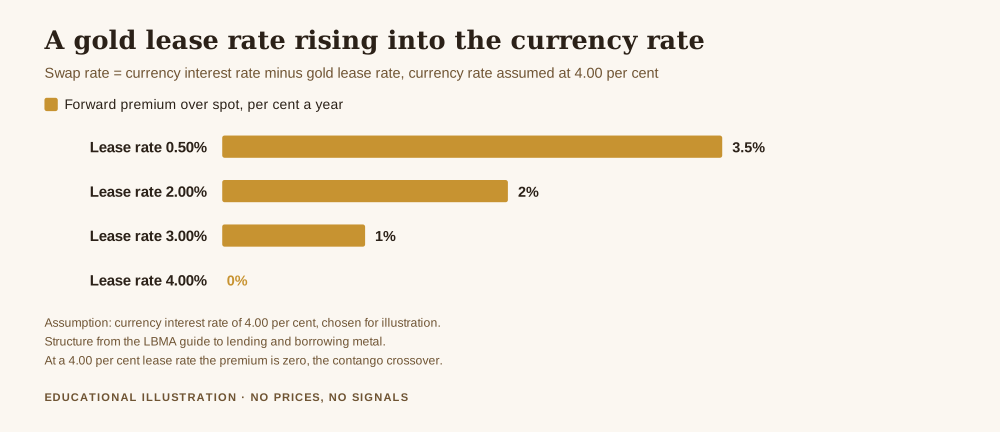
At a 0.50 per cent lease rate the swap is 3.50 per cent, which over 365 days on an actual over 360 basis works out to a forward premium of about 3.549 per cent of spot. At 2.00 per cent the swap is 2.00 per cent. At 3.00 per cent it is 1.00 per cent. At 4.00 per cent the swap is exactly zero and the forward sits flat against spot. Push the lease rate above the currency rate and the subtraction goes negative, which is the backwardation the guide describes, and in gold that is the unusual state rather than the normal one.
Those figures are my own arithmetic on an assumed currency rate, not a quotation of any market level. The structure is what matters: the forward premium you pay is the gap between two interest rates, one of which almost nobody quotes publicly any more.
The arithmetic on an actual deposit
The LBMA guide works an example I recomputed to check I had the day count right. A central bank lends about two tonnes of gold, 64,123.432 ounces, for 183 days at 0.50 per cent. On an actual over 360 basis the interest is 162.980 ounces, so the total returned is 64,286.412 ounces. For scale, one metric tonne is 32,150.7466 troy ounces, which makes that principal 1.994 tonnes.
Scale it up and lengthen it: 100,000 ounces at 0.50 per cent for 365 days earns 506.944 ounces. That is the shape of the business. Half a per cent on a very large pile, which is why it is central banks and not individuals doing it, and why the minimum size is institutional. The guide notes that market makers quote gold swaps against US dollars for at least 50,000 fine ounces, and 50,000 ounces is about 1.555 tonnes.
Half a per cent is also small enough that the credit question deserves more attention than the yield does. You are lending something that cannot default to a counterparty that can.
Nobody sets this rate, and since 2015 fewer people publish it
Gold rates are set by supply and demand, not by monetary authorities. There is no central bank of gold deciding the lease rate, and the guide is blunt about the consequence: there is no lender of last resort, so customers should not depend on overnight borrowing being available.
Transparency has gone backwards. The benchmark used to be GOFO, the Gold Forward Offered Rate, built from quotes contributed by market making members. The LBMA announced on 3 December 2014 that the GOFO dataset would be discontinued and no longer published after 30 January 2015, and pointed participants with open gold interest rate swap trades toward a compression cycle to wind them down. Since the lease rate was conventionally derived as the dollar rate minus GOFO, retiring GOFO removed the public leg of that subtraction.
So the honest answer to "what is the gold lease rate right now" is that it is an over the counter number quoted by bullion banks, varying between them, and no longer published as a single public benchmark. Anyone quoting you a precise live figure is quoting a dealer, not a benchmark.
Who lends, who borrows, and why it mattered historically
On the lending side: central banks, placing metal on deposit from their accounts, and market makers quoting swaps. On the borrowing side: commercial banks, and producers hedging future output.
The World Gold Council's own commentary on the lending market, published on 2 October 2020, fills in why this was once a much bigger story. From the 1980s until September 1999 the market was bearish, central bank sales and uncertainty about future sales weighed on expectations, and producers increased forward selling of production. The commentary describes a circle in which producer hedging, central bank lending and falling spot prices fed each other, and says the Central Bank Gold Agreement signed in 1999 put a halt to it. After 1999 central banks became net buyers more often than sellers, and lent less because lease rates were low.
That is the useful history. Lease rates are a pressure gauge on borrowed gold. When borrowers want metal badly and lenders are not supplying it, the rate rises. When the market is oversupplied relative to demand for loans, it falls.
What this has to do with a retail account
Directly, nothing. You are not going to lease gold, and nobody is going to lease it from you.
Indirectly, three things. First, the forward curve you trade against is built from this subtraction, so the overnight financing on a leveraged gold position traces back to the same two interest rates, which is the mechanism underneath swap charges in forex. Second, it explains why gold is normally in contango and what it would mean if that flipped. Third, and this is the one I actually care about, it is a clean demonstration that holding an asset and having a claim on an asset are different positions with different risks, and that institutions get paid a documented rate to move from the first to the second.
Most retail accounts make that same move for free and without being told. Unallocated metal, a CFD, a pooled account: each one is a claim rather than a holding. The lease market at least prices the difference honestly.
What this article is not
It is not a quotation of current rates. The 0.50, 2.00, 3.00, 4.00 and 10 per cent figures are either the LBMA guide's own illustrative examples or assumptions I have labelled as mine, and the guide describes its worked numbers as illustrative and off market.
It is not a recommendation to lend, borrow or hold anything. It is a description of a wholesale market that exists above the level most of us operate at, written because the mechanism explains costs we all pay.
It is not complete. Gold interest rate swaps, forward forwards and the accounting treatment of swaps against loans all sit behind this and all have their own rules.
Get the free Black Gold Market blueprint, a short document on protecting capital before you try to grow it, including the habit of knowing whether you hold an asset or a claim on one before you commit. One email, no spam, unsubscribe anytime.
Get the free blueprint →Frequently asked questions
What is a gold lease, in one line?
The lending of gold for a set period at an agreed rate, with interest calculated on the gold principal, the principal usually returned in metal and the interest often settled in currency. The lender carries credit exposure to the borrower on the full principal for the whole term.
Is a gold lease the same as a gold swap?
No. A lease or deposit lends metal and earns a rate on it. A swap exchanges gold for currency at spot and reverses the exchange at a forward date. They are linked, because the swap rate is the currency interest rate minus the gold lending rate.
What is the gold lease rate today?
There is no single published answer any more. Rates are quoted over the counter by bullion banks and vary between them. The public benchmark leg, GOFO, was discontinued after 30 January 2015, so a precise live figure can only come from a dealer rather than a benchmark.
Why would a central bank lend its gold?
To earn a return on a reserve asset that otherwise yields nothing. The trade off is that allocated gold becomes unallocated for the term and the bank takes credit exposure to the borrower, which is why the rate matters less than the counterparty.
Does the lease rate explain why gold forwards trade above spot?
Yes, mechanically. The forward premium is the currency rate minus the lease rate, on an actual over 360 basis. Because the currency rate is normally the larger of the two, gold is almost invariably in contango, and the premium shrinks to zero as the lease rate rises to meet the currency rate.
Where did these numbers come from?
The mechanics, the actual over 360 day count, the contango and backwardation definitions, the 50,000 fine ounce minimum swap size, the absence of a lender of last resort, the allocated to unallocated point and the worked examples of 64,123.432 ounces earning 162.980 ounces over 183 days and 100,000 ounces earning 506.944 ounces over 365 days are from the LBMA's guide to lending and borrowing metal. The GOFO discontinuation, announced 3 December 2014 and effective after 30 January 2015, is from the LBMA notice. The lending market history, the 1999 Central Bank Gold Agreement and the 1980s to September 1999 bearish period are from the World Gold Council's commentary on the gold lending market, dated 2 October 2020. The 4.00 per cent currency rate, the resulting 3.50, 2.00, 1.00 and zero per cent swap rates, the 3.549 per cent forward premium, the 1.994 and 1.555 tonne conversions and the 32,150.7466 ounces per tonne constant are my own arithmetic on stated assumptions. All three sources were read on 31 October 2026.
Where Black Gold Market fits
Black Gold Market is free to follow. Daily XAU/USD analysis with the level, the context and the risk stated before the trade, losing days included, on Telegram. There is a free blueprint for anyone who wants the capital protection material in one place, and an optional Kit for people who want the full method. Nothing here promises a profit, and nothing here is a signal service. The groundwork this article rests on is in protecting your capital when gold gets volatile, the ownership distinction is in allocated versus unallocated gold, and the cost you actually pay for it is in swap charges in forex.
About the author. Raphael writes Black Gold Market. He works on the part of this business that happens before the entry, the level, the context, and the risk, and he has yet to find a yield small enough to justify not asking who is on the other side of it. Nothing in this article is a recommendation to trade, to lend or to buy any metal, it is not investment advice, and no entry, stop or target discussed should be treated as a signal.