

A reader wrote to me last week with a question that sounds like paperwork and is not. He asked, plainly, is forex trading CFD or spread betting, because he had opened an account, funded it, traded gold on it for four months, and had just realised he did not know what the account actually did. He was not confused about charts. He was confused about what he owned.
That is a Protect question, and it is a better one than most people ask in their first year. The answer matters because the wrapper around your position decides your leverage, decides how much of a price move separates you from a forced exit, and decides whether you can lose more than you deposited. None of that is visible on a chart. All of it is written in a document you probably clicked past. So let us go through it properly. No gold price appears in this article, no entry, and no promise of any kind.
Is Forex Trading CFD or Spread Betting: The Short Answer
For most retail traders, outside a handful of jurisdictions, it is one of the two, and almost never actual foreign exchange.
When you click buy on XAU/USD at a retail broker, in the overwhelming majority of cases no gold moves, no dollars are exchanged, and no bank transfers anything on your behalf. You enter a contract with the broker. The contract says that when you close, the difference between the opening price and the closing price is settled in cash, multiplied by your position size. That instrument is a contract for difference, a CFD. If your account is a spread betting account, usually a UK arrangement, the same economic exposure is expressed as a stake per point of movement rather than as a quantity of an asset, and it is legally structured as a bet rather than as an investment contract.
There is a third possibility worth naming so the picture is complete. Some accounts, particularly in the United States, are genuine retail foreign exchange or futures accounts governed by a different regime entirely. And some people trade gold through exchange traded funds or futures inside a normal brokerage account, which is a different thing again. But if you opened an account online, deposited a modest sum, and were offered leverage on gold within minutes, you are almost certainly holding a CFD or a spread bet.
Here is the part I want you to sit with. Both of them give you the same price exposure. Neither of them gives you the asset.
What You Actually Own Is a Contract, Not a Currency
This distinction is not academic, and it shows up in four places that touch your money.
The first is counterparty. Your profit is owed to you by the broker, not by a market. If the broker fails, your position and your balance are claims against a failed firm, which is why the register check matters more than the spread. The second is cost structure. You are paying a spread, sometimes a commission, and an overnight financing charge for the leverage you are using, which is a rent on a position you do not own. I have written separately about commission against spread, and the arithmetic there applies directly here.
The third is leverage, which we will come to in detail, because it is the single most consequential number in the whole arrangement. The fourth is the set of protections that exist, or do not exist, depending on where the firm is regulated. That last one is the reason the 2018 European intervention is worth reading even if you have never traded in Europe.
What ESMA Restricted, and Why Gold Sits at 20 to 1
In March 2018 the European Securities and Markets Authority announced product intervention measures on CFDs and binary options sold to retail clients. It is a short document and it is worth reading in the original, because the reasoning is stated rather than implied.
The measures ESMA agreed were these. Binary options were prohibited outright for retail clients. CFDs were not prohibited, they were restricted, and the restriction had five parts: leverage limits on opening a position, a margin close out rule applied per account, negative balance protection applied per account, a ban on the use of incentives by CFD providers, and a firm specific risk warning delivered in a standardised way.
The leverage limits vary by how volatile the underlying is. ESMA set them from 30 to 1 down to 2 to 1: 30 to 1 for major currency pairs, 20 to 1 for non major currency pairs, gold and major indices, 10 to 1 for commodities other than gold and non major equity indices, and tighter still below that.
Notice where gold landed. Not with the major currency pairs at 30 to 1, and not with the other commodities at 10 to 1. Gold was given its own line, grouped with major stock indices at 20 to 1. A regulator looking at the volatility of the thing you and I trade every day decided it warranted a middle band of its own.
The same announcement contains the figure most people quote and few people read in context. Analyses by national regulators across EU jurisdictions showed that 74 to 89 percent of retail accounts typically lose money on their investments, with average losses per client ranging from 1,600 to 29,000 euros. That is not a claim about your ability. It is a description of a population, and it is the reason the standardised risk warning exists at all.
The Leverage Cap Is a Distance, Not a Brake
Most people read a leverage limit as a restriction on ambition. It is more useful to read it as a measurement of distance, and the arithmetic is simple enough to do in your head once you have seen it.
If your leverage is L times, then your margin is one over L of the position value. A price move against you of x percent costs you x percent of the position value, which is x times L percent of your margin. So the move that consumes your entire margin is one over L. That is the whole formula, and the account size cancels out completely.
| Leverage | Margin, as share of position | Move that consumes all margin | Move that reaches a 50% close out |
|---|---|---|---|
| 2 to 1 | 50.00% | 50.00% | 25.00% |
| 10 to 1 | 10.00% | 10.00% | 5.00% |
| 20 to 1, the gold cap | 5.00% | 5.00% | 2.50% |
| 30 to 1 | 3.33% | 3.33% | 1.67% |
| 100 to 1 | 1.00% | 1.00% | 0.50% |
| 500 to 1 | 0.20% | 0.20% | 0.10% |
| 1000 to 1 | 0.10% | 0.10% | 0.05% |
My arithmetic, and the assumptions are stated: margin equals one over leverage of the position value, the close out column assumes the position is closed when equity falls to half the initial required margin, which is the rule ESMA applied, and the whole table ignores spread, commission and financing, all of which make the real distances slightly shorter rather than longer.
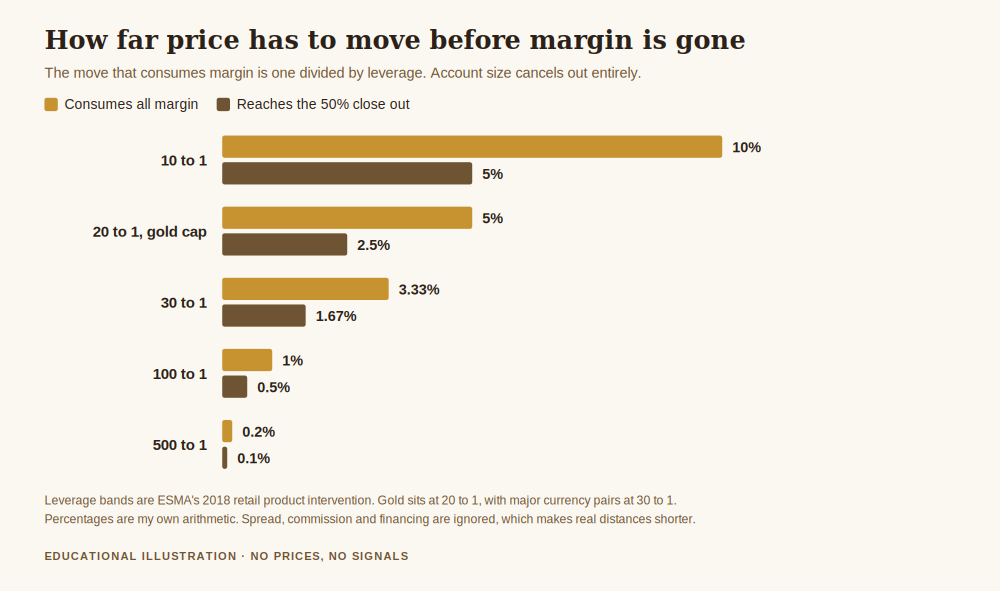
Read the gold row against the offshore row. At the 20 to 1 cap, a 5 percent adverse move consumes the margin behind the position, and a 2.5 percent move reaches the close out. At 500 to 1, the numbers are 0.2 percent and 0.1 percent. The ratio between them is 25 times. A trader on the capped account can absorb twenty five times as much adverse movement before the same thing happens to him.
That is what the cap actually buys. Not safety, and not a better method. Distance. It moves the forced exit further away from ordinary market noise, so that the thing which closes your position is more likely to be your own decision than an automatic rule firing during a busy hour. This is the same argument I made in position sizing so one trade cannot hurt you, arriving from the regulatory side instead of the personal one.
And note the direction of the incentive. High advertised leverage is presented as generosity. On this arithmetic it is the opposite: it is the setting at which the smallest amount of ordinary movement is sufficient to end your position.
Spread Betting Is the Same Exposure in a Different Wrapper
If your account is a spread betting account, most of what I have written still applies, with the differences sitting in structure rather than in economics.
You are not quoted a position size in ounces or lots. You are quoted a stake per point, so a position is expressed as an amount of money per unit of price movement. The profit and loss arithmetic is the same, and the leverage arithmetic above is the same, because a stake per point is just a position size wearing different clothes.
The legal form is a bet, which is why it exists as a separate category in the first place, and it is a regulated financial product in the United Kingdom rather than an unregulated one. The tax treatment of spread betting differs from the tax treatment of CFDs, and it differs by jurisdiction and by personal circumstance. I am not going to put a number on that, because the honest answer is that it depends on where you are resident and what else you do, and it is a question for a qualified professional in your own country rather than for a trading journal.
What I will say is the thing that matters for capital protection: choosing a wrapper for its tax treatment while ignoring its leverage setting is optimising the small number and neglecting the large one.
Three Checks That Tell You Which One You Are Trading
You can settle this for your own account in about fifteen minutes, and none of it costs anything.
Read the key information document. Every regulated provider has to give you one, and it names the product. It will say contract for difference, or spread bet, or rolling spot forex. It also states the leverage, the margin requirement and the close out level. If you cannot find this document, that is itself an answer.
Check the firm on the register, not on its own website. The Financial Conduct Authority register is free and public for UK firms, and most jurisdictions run an equivalent. In the United States the Commodity Futures Trading Commission tells you to verify registration status and disciplinary history before you research anything about the trade itself. The ordering in that instruction is deliberate. I covered the full procedure in how to check a forex broker licence.
Find the close out rule and the negative balance clause in writing. Ask two questions and get the answers in text, not on a call. At what equity level does the firm close my positions, and can I end up owing more than I deposited? Under the ESMA regime the answers are set: close out per account, and negative balance protection per account. Outside it, they are whatever the contract says. What negative balance protection means goes through the mechanics.
If the answers to those three come back clean, you have not found a good broker. You have found a broker that is not obviously a problem, which is a lower bar and the right one to clear first.
Get the free Black Gold Market blueprint, a short document on protecting capital before the trade rather than after it, including the account checks in this article written out as a list you can work through. One email, no spam, unsubscribe anytime.
Get the free blueprint →Frequently Asked Questions
Is forex trading CFD or spread betting, in one sentence?
For most retail traders it is one of the two rather than actual currency dealing, a CFD in most of the world and a spread bet in the United Kingdom arrangement, and both give you the same price exposure through a contract with your broker instead of ownership of the asset.
Does it change how I should size a position?
Not in principle, because the arithmetic of risk per trade is identical. It changes the maximum size available to you, and it changes how far an adverse move has to travel before an automatic rule closes you out. At 20 to 1 that distance is 5 percent of the position value, at 500 to 1 it is 0.2 percent.
Is a higher leverage account better because I can control more with less?
The arithmetic points the other way. Higher leverage reduces the margin you must post and, by exactly the same factor, reduces the price movement needed to consume it. Nothing about the method improves. Only the distance to a forced exit shrinks.
Am I protected from losing more than I deposited?
Under the ESMA measures, negative balance protection applies per account for retail clients, so the deposit is the limit. Outside that regime it depends entirely on the contract you signed, which is why the clause is worth locating in writing before it matters rather than after.
Are these products banned anywhere?
Binary options were prohibited for retail clients under the same 2018 ESMA intervention. CFDs were restricted rather than prohibited. Rules differ by jurisdiction and change over time, so check the current position with your own regulator rather than trusting an article, including this one.
Where did the figures in this article come from?
The leverage bands, the five restriction measures, the 74 to 89 percent retail loss range and the 1,600 to 29,000 euro average loss range are quoted from ESMA's own announcement of 27 March 2018, linked above. Every number in the leverage table is my own arithmetic from the stated formula, margin equals one over leverage, and it is not a measurement of any market or any broker.
Where Black Gold Market Fits
Black Gold Market is free to follow. Daily XAU/USD analysis with the level, the context and the risk stated before the trade, losing days included, plus an optional Kit for people who want the method written down in one place. There is no promise of profit here, because nobody can honestly make one.
Protect comes first, and knowing what your account actually is belongs at the very start of that. How to protect your capital when gold gets volatile is the pillar this article sits under. What a margin call is and how to avoid one is the close out rule seen from the inside, commission against spread covers what the wrapper costs you to hold, and how to spot a gold trading scam is the harder edged version of the register check above.
About the author. Raphael writes Black Gold Market. He works on the part of this business that happens before the trade, the level, the context, and the risk, and on the conviction that a method you can follow through a quiet quarter is worth more than a better one you cannot.
Disclaimer: This article is general educational content about the legal and structural form of retail trading accounts, and about the arithmetic of leverage and margin. It is not financial advice, not tax advice, not legal or regulatory advice, not a recommendation to buy or sell any asset, and not a solicitation to trade. It does not endorse or assess any specific broker or firm. The leverage bands, the restriction measures and the retail loss figures are quoted from the European Securities and Markets Authority announcement of 27 March 2018; the register is operated by the Financial Conduct Authority and the verification instruction by the CFTC. Rules differ by jurisdiction and change over time. Every figure in the leverage table is my own arithmetic on the stated assumptions. No gold price appears in this article. Trading gold, CFDs and leveraged products carries a high risk of losing money rapidly, and no entry, stop or target discussed should be treated as a signal. Readers should consider their own circumstances and speak to a licensed professional in their jurisdiction.