


What is negative balance protection in forex, and why does a rule almost nobody reads decide how bad your worst day can get? Because without it, the floor under a leveraged account is not zero. There is no floor. You can lose the deposit and then keep losing, and what is left is a debt owed to your broker.
Most people meet this rule as a line in a terms document and skip it. I want to do the opposite: take the arithmetic seriously, then check it against how far gold has actually moved on its worst days over the last decade. The two together answer the question properly, and the answer is more uncomfortable than the marketing version.
What Is Negative Balance Protection in Forex, in Plain Terms
Negative balance protection is a commitment that your account cannot go below zero. If the market moves so fast that closing your position leaves your balance in deficit, the broker absorbs the shortfall instead of billing you for it. Worst case, your deposit is gone. It does not become money you owe.
It exists because leverage separates the size of the position from the size of the money backing it. When you trade with 20 times leverage, a 5 percent move in the underlying is a 100 percent move in your equity. Push the leverage higher and that ratio gets worse in a way that most people do not carry in their head.
In the European Union it is not optional. In its product intervention measures agreed on 23 March 2018 and announced on 27 March, ESMA required negative balance protection on a per account basis for retail clients trading contracts for difference, alongside leverage caps and a standardised close out rule. ESMA's own words for what this achieves are worth quoting exactly: the measures "ensure that investors cannot lose more money than they put in".
Note the phrase "per account". It applies to the whole account, not to each position separately, which matters when several positions are open at once.
The Two Rules That Are Supposed to Stop You Before Zero
Negative balance protection is the last of three layers, and it only matters when the first two fail. Understanding the other two is what makes the third one real rather than abstract.
The leverage cap. In the same ESMA measures, retail leverage on opening a position is limited by the volatility of the underlying: 30 to 1 for major currency pairs, 20 to 1 for non major currency pairs, gold and major indices, 10 to 1 for commodities other than gold and non major equity indices, 5 to 1 for individual equities, and 2 to 1 for cryptocurrencies. Gold sits at 20 to 1, so the margin posted for a fully committed gold position is 5 percent of what that position is actually worth.
The margin close out rule. ESMA standardised the level at 50 percent of minimum required margin, on a per account basis. Your broker is required to start closing positions when account equity falls to half the margin the positions require. At 20 to 1, that trigger sits 2.5 percent of the position's value away from where you started.
Read as a sequence, those two rules describe a fully committed gold account at the retail cap: an adverse move of 2.5 percent forces the close out, and an adverse move of 5.0 percent takes the equity to zero. Everything below that line is where negative balance protection starts working.
Why the Close Out Rule Is Not Enough On Its Own
A close out at 50 percent of required margin sounds like a solid backstop, and on an ordinary day it is. It has one assumption inside it, and the assumption is the entire problem: it assumes the market trades at that level on the way down.
Markets do not always do that. Price can leave one level and reappear at another with nothing in between, over a weekend, around an unexpected event, or in the seconds after a headline. The close out is a request to trade at a price. When there is no price there, the request fills wherever the market next exists.
How Far Gold Has Actually Moved in One Session
I took the published LBMA gold benchmark, afternoon fix, from 4 January 2016 to 14 August 2026. That is 2,663 published sessions and 2,662 moves from one published price to the next. Because the benchmark is a once a day auction, each move is the distance between two fixings rather than the intraday path, which makes this a conservative measurement rather than a dramatic one.
The median absolute move was 0.4998 percent. Almost every session is small. The point is not the median.
Moves of 2.5 percent or more, the distance that triggers the close out on a fully committed account at the gold cap, happened 80 times, 3.01 percent of sessions. Moves of 5 percent or more, the distance that takes that same account to zero, happened 7 times. Counting falls only, there were 6, which is 0.23 percent of sessions. And once in this sample the benchmark fell 7.83 percent in a single session, on 30 January 2026.
Run down the largest single session falls and the shape of the tail is clear: 7.83 percent, then 5.54, 5.36, 5.27, 5.13, 5.02, 4.97 and 4.81 percent. Stretch the window and it gets worse. The worst two consecutive sessions in the sample fell 12.77 percent together, the worst five fell 12.02 percent, and the worst ten fell 15.28 percent.
Turn the largest of those into a leverage number and the result is blunt. A 7.83 percent fall takes a fully committed account to zero at anything above 12.8 to 1. That is below the 20 to 1 legal maximum for retail gold in the European Union. In other words, the single worst session in this sample was large enough to wipe out an account operating fully committed at the highest leverage a retail client is permitted, and then push it past zero.
What That One Session Would Have Cost, By Leverage
Here is the same session applied across leverage levels. The figure shown is what the account would owe after losing everything, expressed as a multiple of the original deposit, if nothing stopped the loss at zero.
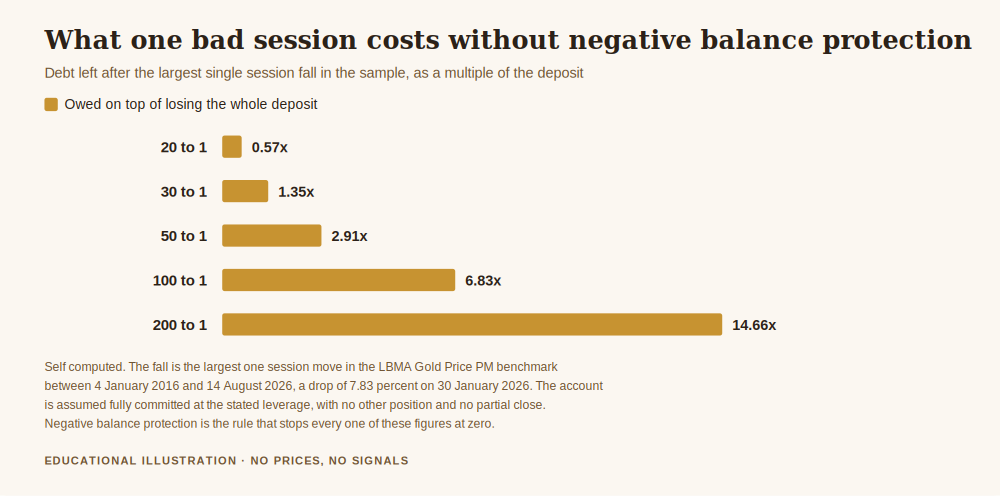
At 20 to 1, the account owes 0.57 times the deposit. At 30 to 1, 1.35 times. At 50 to 1, 2.91 times. At 100 to 1, 6.83 times. At 200 to 1, 14.66 times. At 500 to 1, the kind of number that appears in offshore advertising, 38.14 times the original deposit.
Every one of those figures becomes zero with negative balance protection in place. That is what the rule is worth on the worst day in this particular decade of this particular market. Not a comfort, exactly. A cap.
The same arithmetic works for a hypothetical rather than a historical move. A 10 percent adverse jump against a fully committed account leaves a debt of 1.00 times the deposit at 20 to 1, 4.00 times at 50 to 1, 9.00 times at 100 to 1 and 49.00 times at 500 to 1. The pattern is worth internalising: the debt does not rise gently with leverage, it rises with leverage minus one, so the last few notches of leverage carry almost all of the exposure.
What Negative Balance Protection Does Not Do
This is the section that matters more than the reassuring part, and it is the section that gets left out.
It does not stop you losing everything. It caps the loss at 100 percent of the account. A rule that guarantees you cannot lose more than all of your money is a real protection and a very low bar.
It is not universal. The ESMA requirement covers retail clients in the European Union, and similar rules exist in the United Kingdom and Australia. Many jurisdictions have no such requirement, and offshore entities advertising leverage far above the caps above are usually outside all of them. If a broker offers 500 to 1, the leverage cap is not applying to you, and there is no reason to assume the negative balance rule is either.
It does not apply to professional clients. The retail protections come with retail status. Accepting an upgrade to professional in exchange for higher leverage means signing away exactly the protection this article is about.
It works per account, not per position. Several correlated positions do not each get their own floor. They add up first, and the protection applies to the total.
It is a promise from a company. In an extreme event, the broker absorbing the shortfall has to be solvent enough to absorb it. That is one more reason the question of who holds your money is worth more of your time than the question of which entry to take.
What This Should Change About Position Size
The useful conclusion is not "check that your broker offers negative balance protection", although you should. It is that the rule tells you exactly where the arithmetic stops being survivable, and that line is closer than it looks.
A fully committed account at the gold cap is one 5 percent session from zero, and this market produced 6 such falls in ten and a half years. That is rare. It is not hypothetical, and a thing that happens 0.23 percent of the time happens roughly once every two years.
The protection against that is not a rule written by a regulator. It is not committing the account. Leverage is a limit on what you are allowed to do, never an instruction, and the distance between the leverage you are offered and the leverage you use is the only part of this you control. Position sizing so one trade cannot hurt you is the mechanical version of that argument, and what a margin call is and how to avoid one covers the layer immediately above this one.
ESMA's own justification for the whole package is worth ending on. Its analysis found that 74 to 89 percent of retail accounts typically lose money on these products, with average losses per client ranging from 1,600 to 29,000 euros. The rules exist because of what the data showed, not because regulators dislike traders.
Get the free Black Gold Market blueprint, a short document for setting the leverage you actually use before the market sets it for you. One email, no spam, unsubscribe anytime.
Get the free blueprint →Frequently Asked Questions
Can I really end up owing my broker money?
Without negative balance protection, yes. The arithmetic above is not exotic: at 100 to 1 leverage on a fully committed account, the largest single session fall in this ten year sample of the gold benchmark would have left a debt of 6.83 times the deposit. With the protection in place, the same session costs the deposit and nothing more.
Does every broker offer negative balance protection?
No. It is required for retail clients in the European Union under the ESMA measures, and comparable rules apply in some other jurisdictions, but plenty of firms operate outside all of them. The reliable signal is not the marketing page, it is which regulator the entity you are actually contracting with answers to, and that entity is often not the one whose name is on the website.
If I have negative balance protection, is high leverage safe?
No, and this is the most expensive misreading of the rule. It caps your loss at everything you deposited. High leverage makes reaching that cap far more likely, since a fully committed account at 100 to 1 needs only a 1 percent adverse move to be wiped, and moves of 1 percent or more occurred on 23.67 percent of the sessions in this sample.
What is the difference between a margin call and negative balance protection?
A margin call, and the automatic close out that follows it, is meant to end your position while there is still equity left, at 50 percent of required margin under the ESMA rule. Negative balance protection handles the case where that close out could not be executed in time because the market jumped past the level. One is a warning, the other is a floor.
Does negative balance protection apply per trade or per account?
Per account, under the ESMA measures. Losses across your open positions are netted against your total equity first, so several correlated positions are effectively one exposure for this purpose.
How often do the moves that matter here actually happen?
In this sample, gold moved 2.5 percent or more in a single session 3.01 percent of the time, and 5 percent or more 0.26 percent of the time. Rare, and unevenly distributed: four of the eight largest falls fell inside 2026, and three others inside 2020.
Where This Leaves You
Negative balance protection is a good rule and a low ceiling. It is the difference between a bad outcome and an unbounded one, and it is worth confirming that you have it before it is worth anything else about your broker.
But the number to take away is not the rule. It is 12.8 to 1, the leverage at which one real session in this sample took a fully committed account to zero. That figure sits below the highest leverage a European retail client is legally allowed to use, which tells you what the legal maximum is: a limit set by a regulator on the size of the mistake available to you, not a recommendation about how much of it to use.
The habit that survives all of this is the same one as always. Decide the size before the story, keep the account far enough from its own cliff that a rare session is an inconvenience rather than an ending, and treat every protective rule as the last line rather than the first. How to protect your capital when gold gets volatile is where that habit is written out in full, and how to trade gold safely during geopolitical shocks covers the kind of session that produces the moves measured above.
About the author. Raphael writes Black Gold Market. He works on the part of this business that happens before the trade, the level, the context, and the risk, and on the conviction that a method you can follow through a quiet quarter is worth more than a better one you cannot.
Disclaimer: This article is general educational content about a regulatory protection and the arithmetic of leverage. It is not financial advice, not a recommendation of any broker, and not a suggestion to open any particular position. Trading gold, CFDs and leveraged products carries a high risk of losing money rapidly. No entry, stop or target discussed should be treated as a signal. The leverage caps, the 50 percent close out level, the negative balance protection requirement and the client loss statistics are taken from the ESMA product intervention announcement of 27 March 2018, and apply to retail clients in the European Union; your jurisdiction, your broker's regulator and your client classification may all differ, and you should confirm your own terms directly. Every frequency and every move above was computed by me from the published LBMA gold benchmark, afternoon fix, across the 2,663 published sessions from 4 January 2016 to 14 August 2026, and the leverage figures follow from those moves by arithmetic under the stated assumption of an account fully committed to a single position with no partial close. No gold price is quoted anywhere in this article and no trading results are represented. Past behaviour of a public benchmark is not a prediction.