
Someone in the group asked me a question I have been asked in one form or another for years, and this time I decided to answer it properly instead of in three lines. He wanted to know how to find a trading mentor who was worth paying, because he had been offered three different programmes in one week and every one of them looked convincing. He was not asking me to pick one. He was asking me how a person is supposed to tell.
This is a Protect article, and it is going to be an unusual one, because the honest answer involves a piece of arithmetic that most people selling mentorship would prefer you never did. I am going to work through that arithmetic in the open. Then I am going to give you the two checks that actually filter a list, both of which are free and take minutes. No promise of profit appears in this piece, no win rate, and no gold price.
How to Find a Trading Mentor: Start With the Check That Costs Nothing
Before you evaluate anybody's method, evaluate whether they are who they say they are. This is not the interesting part of the question and it is the part almost everyone skips.
The United States Commodity Futures Trading Commission publishes a page for exactly this purpose. Its instruction is blunt, and I am quoting it because the ordering matters: verify the registration status and disciplinary history of the person or firm selling a product or strategy before researching the risks or potential returns of the trade itself. Before. Not after you have watched their videos and decided you like them. The same page says plainly that while registration and a clean record will not protect you from fraud, most scams involve unregistered entities, people, and products.
The database is called BASIC, it is run by the National Futures Association on the CFTC's behalf, and it is free and public. You type a name. It returns registration status, disciplinary or regulatory history, and financial information. That is a few minutes of work per candidate.
Now, an obvious objection, and it is a fair one. Not every teacher in the world falls under a United States regulator, and plenty of readers of this journal are nowhere near one. That is true. The point is not that BASIC is a universal registry. The point is that a free public record exists, that a large share of people who solicit money from traders are covered by one somewhere, and that the cost of looking is close to zero. If you shortlist twenty names and only a quarter of them turn out to be registered anywhere at all, you have removed fifteen candidates for free, before spending a single evening on anyone's curriculum. That is the cheapest filtering you will ever get. Look up your own jurisdiction's equivalent register and run the same pass.
The Law Already Has a Name for Someone Who Advises You for Money
There is a definition worth internalising here, because it reframes the whole conversation. The CFTC's official glossary defines a Commodity Trading Advisor as, and I quote, "a person who, for pay, regularly engages in the business of advising others as to the value of commodity futures or options or the advisability of trading in commodity futures or options, or issues analyses or reports concerning commodity futures or options."
Read that again with a mentorship advertisement in mind. For pay. Regularly. Advising others as to the advisability of trading. Issues analyses or reports. A great many people who describe themselves as mentors, coaches or educators are describing, word for word, an activity that has a regulatory category and a registration requirement attached to it. The CFTC's own page lists the intermediary types that generally must register, and Commodity Trading Advisors are on that list alongside Introducing Brokers, Commodity Pool Operators and Retail Foreign Exchange Dealers.
Why registration is worth anything at all is also stated there rather than left to inference. It indicates that principals and associated persons have completed background checks, that the firm meets certain financial requirements, that addresses and contact details are verified and accessible to customers, that the firm submits to examinations and regulatory supervision, and that associated persons have passed required proficiency tests. None of that makes anyone a good teacher. All of it makes them a findable person with something to lose, which is a different and more useful property than charisma.
What a Mentor Costs, Measured in R Instead of Money
Now the arithmetic. The reason mentorship fees are hard to judge is that they are quoted in currency, while your trading is measured in risk. Convert the fee into the same unit as everything else you do and the comparison becomes obvious.
Call R the amount you risk on one trade. If you risk one percent of equity per trade and a programme costs ten percent of your equity, that programme costs ten R. The arithmetic is just the fee percentage divided by the risk percentage, and note what falls out of it: the size of your account cancels completely. A fee of ten percent of equity is ten R whether the account holds a hundred dollars or a hundred thousand.
| Fee, as share of equity | At 0.5% risk | At 1% risk | At 2% risk |
|---|---|---|---|
| 5 percent | 10.0 R | 5.0 R | 2.5 R |
| 10 percent | 20.0 R | 10.0 R | 5.0 R |
| 20 percent | 40.0 R | 20.0 R | 10.0 R |
| 30 percent | 60.0 R | 30.0 R | 15.0 R |
| 50 percent | 100.0 R | 50.0 R | 25.0 R |
My arithmetic, and the assumption is stated: the fee is expressed as a share of account equity, and risk per trade is a fixed share of equity. Look at the bottom left cell. A conservative trader risking half a percent per trade, paying a fee worth half the account, has paid one hundred R for the education. That is one hundred losing trades' worth of risk, spent in a single transaction, before the first lesson.
Then ask the repayment question. Suppose the teaching works, and permanently improves your expectancy by some amount per trade. At one percent risk, a ten percent fee costs ten R. If the improvement is a genuine and lasting plus 0.05 R per trade, repayment takes two hundred trades. At two trades a week that is close to two years before the education has paid for itself, and that is under the most generous assumption available, which is that the improvement is real, immediate and permanent.
The Part Nobody Advertises: You Cannot Prove It Worked
Here is where it gets genuinely uncomfortable, and it is the single most useful thing in this article.
Suppose you want to establish, honestly, that the mentorship improved your expectancy. That is a comparison of two samples, your trades before and your trades after. The sample size required for a two-sample comparison at ninety-five percent confidence and eighty percent power is roughly two times 2.80 squared, times the per-trade standard deviation squared, divided by the square of the difference you are trying to detect.
Put realistic figures in. Per-trade results in a risk-defined system scatter with a standard deviation somewhere around 1.5 R. Say the mentorship genuinely improves your expectancy by 0.10 R per trade, which would be a substantial improvement. The arithmetic asks for about 3,532 trades before and 3,532 trades after. Seven thousand trades in total. At two trades a week, that is sixty-eight years. At five trades a week it is twenty-seven years. Even at twenty trades a week, an intensity most people cannot sustain without damaging their process, it is nearly seven years.
Sit with the implication. Inside the lifetime of any normal mentorship, and inside the lifetime of most trading careers, the question "did this teacher improve my results" is not answerable from results. The evidence you would need does not exist and will not exist in time to be useful to you. Anyone who tells you their students' outcomes prove their teaching works is either unaware of this or hoping you are.
Which leads to the only conclusion the numbers support. If outcome cannot be your test, then process and identity have to be. You judge a prospective mentor on whether they are a findable, accountable person, and on whether what they teach is coherent, stated in advance, and falsifiable. Not on what their account did last quarter.
Why a Screenshot of a Winning Month Is Close to a Coin Flip
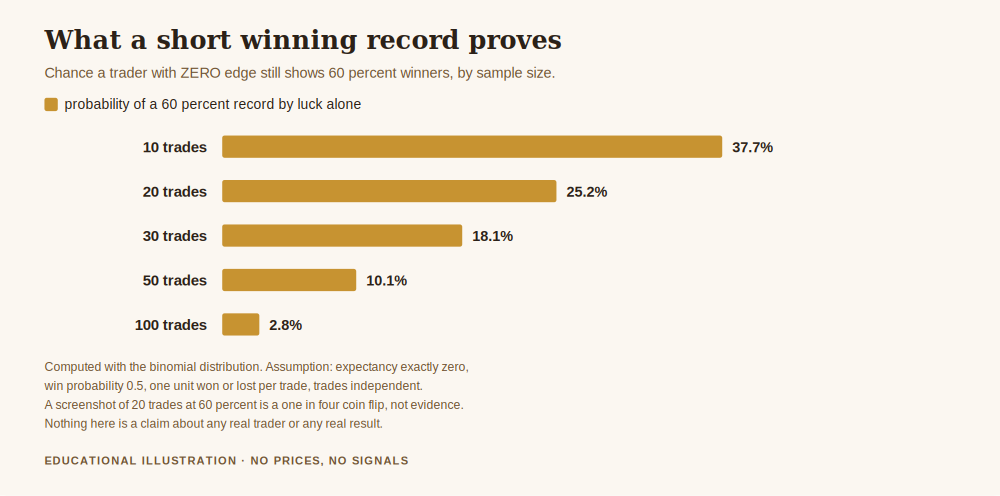
The chart above is the same point from the other direction, and it is worth stating precisely. Assume a trader with exactly zero edge, a fifty percent win probability, one unit won or lost per trade, trades independent. Run the binomial arithmetic on how often pure luck alone produces a sixty percent win rate.
Over ten trades it happens 37.7 percent of the time. Over twenty trades, 25.2 percent. Over thirty, 18.1 percent. You need to reach a hundred trades before the figure drops to 2.8 percent.
So a screenshot showing twenty trades at sixty percent winners is, on these assumptions, roughly a one in four event for somebody with no skill whatsoever. It is not a lie and it is not evidence. It is a coin landing the way coins sometimes land. When a marketing page shows you a month, it is showing you something a person with nothing could have produced by accident one time in four. That is the whole informational content of the exhibit.
The regulatory backdrop is worth keeping in view while you look at any such exhibit. The European Securities and Markets Authority found, in the analysis behind its 2018 product intervention, that 74 to 89 percent of retail accounts typically lose money, with average losses per client ranging from 1,600 to 29,000 euros. In a population where most accounts lose, a displayed winner tells you almost nothing about the process that produced it, because a large population generates impressive-looking streaks by arithmetic alone.
The Questions That Actually Filter a Shortlist
Given all of the above, here is what I would ask, in order. None of these questions is about performance.
Are you registered anywhere, and under what name? A person teaching for pay who cannot name a register, or who becomes irritated at the question, has answered it. Then go and check the name yourself rather than accepting the answer.
What, specifically, will I be able to do at the end that I cannot do now? A real answer sounds like a capability. Size a position from a stop distance. Read a session's structure before the session opens. Keep a record that survives a bad month. A non-answer sounds like an outcome, and outcomes are not teachable.
Show me your method being wrong. This is the question I would refuse to skip. Anyone with a genuine repeatable process can describe the conditions under which it fails, because they have met those conditions. Someone who cannot produce a failure mode is either very new or is selling a story. As I have written before, the best trades are often the ones you do not take, and a teacher who has never articulated a reason to stand aside has not finished thinking.
What happens to my money if I stop? Refund terms, cancellation, whether an ongoing subscription auto-renews. Boring, and the single most common place people get hurt.
Who else can I talk to who finished and did not continue? Testimonials from current students are marketing. A teacher confident enough to point you at someone who left is telling you something real.
Get the free Black Gold Market blueprint, a short document on protecting capital before the trade rather than after it, including the checks to run on anyone who asks you for money in this industry. One email, no spam, unsubscribe anytime.
Get the free blueprint →Frequently Asked Questions
How to find a trading mentor, in one sentence?
Check the free public registers first and remove everyone who is not findable, then judge the survivors on whether they teach a coherent, falsifiable process, because the arithmetic shows you will never be able to judge them on your own results in time for it to matter.
Does a mentor need to be registered with a regulator?
It depends on what they do and where they and you are. The CFTC's definition of a Commodity Trading Advisor covers people who, for pay, regularly advise others on the advisability of trading commodity futures or options, and its own guidance says intermediaries generally must register. Whether a specific person falls inside a specific regime is a question for that regulator, not for me. What is certain is that checking costs nothing.
Is an expensive mentor better than a cheap one?
Nothing in the arithmetic supports that. Price sets how many R you have spent before you begin. It carries no information about teaching quality. A fee worth half your equity at half a percent risk per trade is a hundred R, and a hundred R is a very large hole to teach your way out of.
Why can't I just judge a mentor by whether I make money afterwards?
Because the sample size is not achievable. Detecting a genuine 0.10 R improvement against a per-trade standard deviation of 1.5 R needs roughly 3,532 trades on each side of the change, about seven thousand trades in total. At two trades a week that is close to seventy years. This is arithmetic, not opinion, and the assumptions are stated in the article.
What about free mentors?
The registration check still applies, because unpaid influence is still influence, and the risk simply moves from your wallet to your method. What changes is the R cost, which is zero, so the whole fee calculation above drops out and only the process questions remain.
Where did the figures in this article come from?
The registration guidance and the ordering instruction are quoted from the CFTC's own check page, the Commodity Trading Advisor definition from the CFTC glossary, the BASIC database from the National Futures Association, and the retail loss range from ESMA's 2018 product intervention announcement. Every R figure, every repayment count, the sample size calculation and the binomial probabilities are my own arithmetic, computed in Python with the assumptions written into the text.
Where Black Gold Market Fits
Black Gold Market is free to follow. Daily XAU/USD analysis with the level, the context and the risk stated before the trade, losing days included, plus an optional Kit for people who want the method written down in one place. There is no promise of profit here, because nobody can honestly make one, and that includes anyone offering to teach you.
Protect comes first. How to protect your capital when gold gets volatile is the pillar this article sits under. How to spot a gold trading scam is the harder-edged version of the same check, how to stop depending on trading signals is what a good mentorship should be moving you away from rather than towards, and what is expectancy in trading explains the R unit this article measures fees in. If you want the broker version of the same registration check, how to check a forex broker licence covers it.
About the author. Raphael writes Black Gold Market. He works on the part of this business that happens before the trade, the level, the context, and the risk, and on the conviction that a method you can follow through a quiet quarter is worth more than a better one you cannot.
Disclaimer: This article is general educational content about how to evaluate someone offering trading education, and about the arithmetic of fees and sample sizes. It is not financial advice, not a recommendation to buy or sell any asset, not legal or regulatory advice, and not a solicitation to trade. It does not endorse, accuse or assess any specific person or firm. The registration guidance and the Commodity Trading Advisor definition are quoted from the CFTC and its official glossary, the BASIC database is operated by the National Futures Association, and the retail loss range is from ESMA. Whether any particular person or activity requires registration in any particular jurisdiction is a matter for that regulator. Every R conversion, repayment count, sample size and probability is my own arithmetic on stated assumptions and is not a measurement of any market, any teacher, or anyone's results. No gold price appears in this article. Trading gold, CFDs and leveraged products carries a high risk of losing money rapidly, and no entry, stop or target discussed should be treated as a signal. Readers should consider their own circumstances and speak to a licensed professional in their jurisdiction.