

The 3am Message
There's a message I get more than any other, and it usually lands late at night. It reads something like this: "Raphael, are we buying or selling right now? I don't know what to do." No chart attached. No reasoning. Just a person, staring at gold moving on a screen, completely frozen until somebody else makes the call for them.
I understand that message, because I remember being the person sending it. And I want to say something that might sound strange coming from someone who posts trade ideas for a living: if you cannot open a position until another person tells you to, you do not have a trading process. You are renting one. And the day that person goes quiet, logs off, changes their approach, or simply gets a bad week, you are left holding an account and no idea what to do with it.
This is the quiet trap of living on signals. It feels like a shortcut. Somebody who knows more than you hands you an entry, and you follow it. When it works, you feel clever. When it doesn't, you feel cheated. Either way, you learned nothing you can use tomorrow. You are exactly as helpless as you were the day before.
So let me be honest about what this article is trying to do. It is not trying to make you a better follower. It is trying to make you a trader who does not need to follow anyone, including me.
Why Signal Dependency Quietly Keeps You Stuck
Here is the part that took me an embarrassingly long time to see. Depending on signals doesn't just fail to help you. It actively holds you in place.
Think about what happens when you copy an entry without understanding it. Price moves against you by twenty points. Now what? You have no idea whether the setup is broken or whether this is normal noise, because you never understood why the trade existed in the first place. So you do the only thing a person with no map can do, you panic. You close too early and miss the move, or you freeze and let a small loss become a large one. Neither of those is a strategy. Both of them are just fear filling the space where understanding should have been.
And it compounds in a worse way. Every time you outsource the decision, you teach yourself that you can't make it. You build a quiet belief that trading is something other people are able to do and you are not. That belief is more expensive than any single losing trade, because it keeps you paying for the next signal, and the next, forever, a subscriber for life, never an owner.
I'm not against learning from someone further down the road. That's how everyone starts, myself included. The problem isn't following an idea. The problem is following it blindly, taking the entry and skipping the education that was supposed to come with it.
What "Trading on Your Own" Actually Means
Let me clear up a misunderstanding, because I hear it a lot. When people imagine trading independently, they picture a lone genius who never asks anyone anything, some solitary figure reading the charts by instinct, right every time. That image is wrong, and chasing it will only make you feel like a failure.
Trading on your own does not mean trading in isolation. It doesn't mean you never learn from a mentor or a community again. It means something much simpler: you understand the reasoning behind a decision well enough that you could make the same decision yourself if nobody were around.
Here's the test I use. When you look at a setup, can you answer three questions in your own words? Why here? Why is this a place worth acting, and not the thousand other places price passed through today. Why now? What changed to make this the moment. And where am I wrong? The exact level that tells you the idea has failed and it's time to step out.
If you can answer those three, you're not following a signal anymore. You're understanding a trade that happens to line up with one. That's the whole shift. The entry might look identical on the chart, but one version leaves you helpless the moment the market moves, and the other leaves you calm, because you knew the map before you set out.
That's what mastery means in the middle pillar of everything I do. Not predicting the future. Understanding the present well enough to act without asking permission.
The Bridge: From Copying to Understanding
So how do you actually cross from one to the other? Not overnight, and not by force. You build a bridge, one plank at a time, using the very signals you're trying to outgrow. Here is the routine I give anyone who tells me they're tired of feeling helpless.
Before you copy anything, write down why
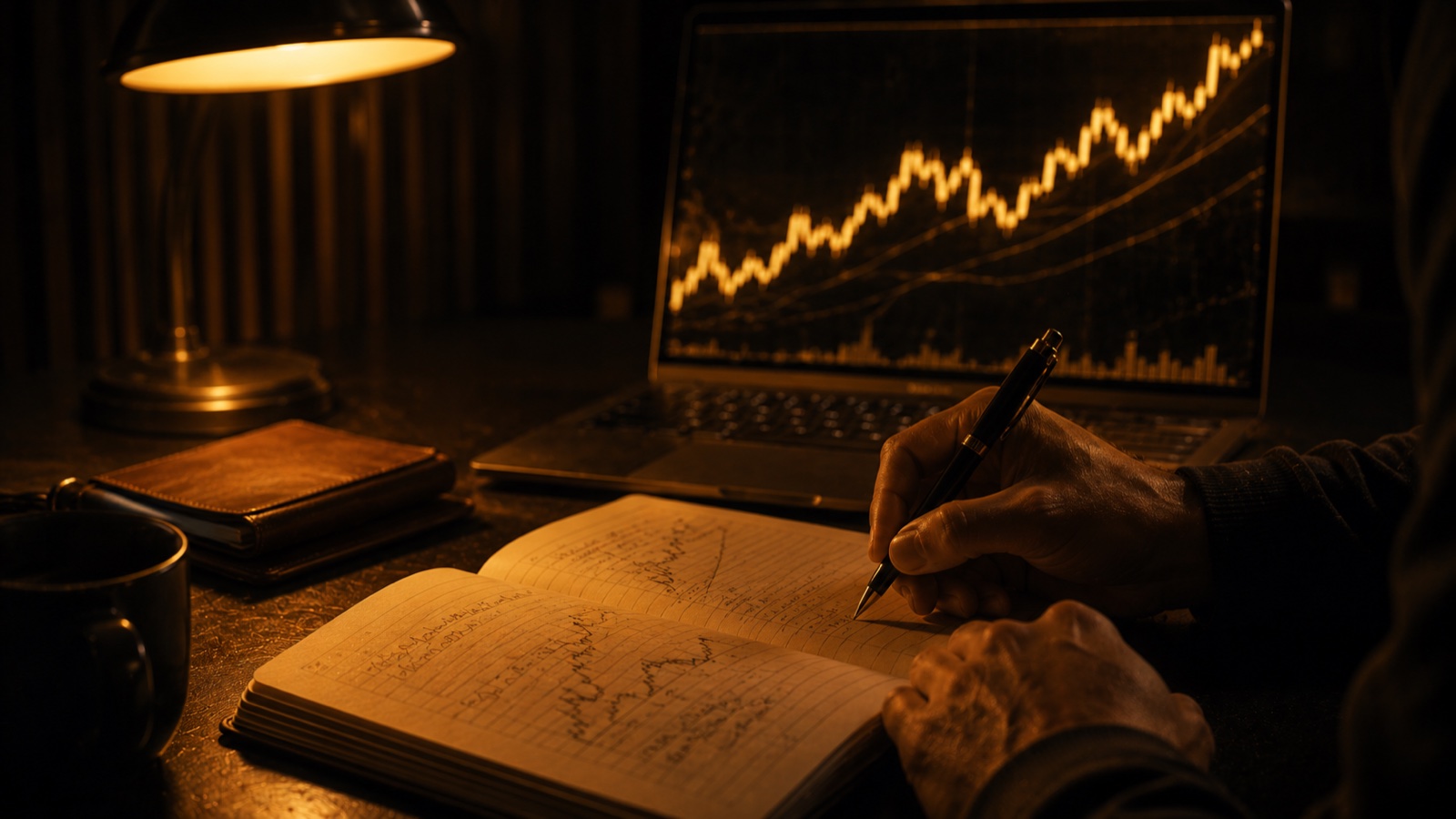
When you see a trade idea, don't just take it. Pause and write, in one sentence, why you think it exists, what the level is, which direction, and what would prove it wrong. You'll be bad at this at first. That's the point. You're building the muscle you've been letting someone else use for you.
Predict before you're told
Each session, mark the levels you'd watch and the direction you'd lean, before any idea gets posted. Then compare. Where you matched, your read is growing. Where you didn't, you have a specific gap to study. This turns every signal into a graded test of your own thinking, instead of a crutch.
Keep a "why" journal, not a "what" journal
Most people record what they traded. Record why. Over weeks the pages stop being a list of wins and losses and start being a mirror of your reasoning, showing you which of your ideas actually hold up and which ones you keep talking yourself into. You can't refine a process you never wrote down.
Size understanding ahead of size
Don't add risk because you had a good week. Add it only when your own reads have been landing, on their own, for a stretch. Let your position size follow your understanding, never the other way round. Confidence you can defend is earned slowly; confidence you borrowed evaporates the first bad day.
Notice what this routine does. It doesn't ask you to abandon signals cold turkey and flail on your own. It uses them as training wheels while you learn to balance, until one day you realise you've been riding without holding on for a while now.
And notice what it protects. Every plank of that bridge sits on top of the first pillar: protect your capital before you chase anything. You're allowed to be wrong while you learn, but only in small, survivable amounts. The trader who blows the account trying to "learn independence" learned nothing except how to start over. Trading gold carries real risk, and most retail traders lose money; the point of small size while you're learning is to make sure your education doesn't cost you the ability to keep learning.
Why I Want You to Eventually Trade Without Me
Here's something that probably sounds backwards for a person who runs a trading channel to say out loud. My goal is to help you get to the point where you don't need me.
Most channels want the opposite. Their whole model depends on you never learning, on you staying just capable enough to keep subscribing and never capable enough to leave. The wall of green screenshots, the "buy now" with no reasoning attached, the mystery kept deliberately mysterious: that isn't an accident. A dependent follower pays forever. An educated one might walk away. So they make sure you stay dependent.
I decided a long time ago that I didn't want to run that kind of room. Not because I'm nobler than anyone, but because I've been the dependent follower, and I know exactly how it ends. It ends with a blown account and a person convinced they were never cut out for this, when the truth is they were just never taught.
So with the roughly 8,900 traders who follow along, I share my analysis and the reasoning behind every idea, the level, the entry, the stop, and why. No idea is a guaranteed win, and I'll never pretend one is. I post the setups so you won't just copy the entry, you'll take the reasoning. If you read enough of my "why," you eventually stop needing my "what." And on the day you message me to say you saw the setup before I posted it, that's not me losing a subscriber. That's the whole job, done.

Get the free Black Gold Market blueprint, a short, practical guide to defending your account through the kind of markets this article describes. One email, no spam, unsubscribe anytime.
Get the free blueprint →Frequently Asked Questions
Is it wrong to use trading signals at all?
No, as long as you use them to learn, not to lean. A signal you study, question, and could explain to a beginner is a teaching tool. A signal you copy blindly because you're afraid to decide is a crutch. Same entry, completely different outcome for you as a trader. The test is simple: could you defend this trade if the person who gave it to you vanished tomorrow?
How long does it take to trade independently?
Longer than a course promises, and it's measured in understanding, not weeks. Some traders start reading setups on their own within a few months of honest journaling; others take much longer. There's no date I can give you, and anyone who guarantees one is selling a shortcut that doesn't exist. Focus on whether your own reads are improving, not on a calendar.
What's the first habit to build if I feel completely dependent?
Before you take any idea, write one sentence explaining why it exists and where it would be wrong. That single act forces you to think instead of react. Do it for a month and you'll notice the panic starts to fade, because you finally understand the trades you're in, instead of just holding them and hoping.
A Word on Risk, and Your Next Step
Let me be plain, because you deserve plain. Trading gold and CFDs carries substantial risk. The leverage that makes a good trade feel big is the same leverage that empties accounts, and most retail traders lose money. Learning to trade independently does not remove that risk, it just means that when a loss comes, you understand it instead of being blindsided by it. Nothing here is a promise of profit, and anyone offering you one is selling the exact dependence I've spent this whole article asking you to walk away from.
Here's everything, cut to the bone. If you can't trade without being told, you don't own a process, you rent one. Signal dependency doesn't just fail to help; it quietly convinces you that you can't do this. Trading on your own isn't isolation, it's understanding the reasoning well enough to answer why here, why now, where am I wrong. You build that understanding by writing down your reasons, predicting before you're told, journaling your why, and letting size follow skill. And the goal isn't to follow me better. It's to not need me at all.
If that's the trader you want to become, I built you somewhere to start. It's called The Sustainable Trader's Blueprint, a simple daily routine plus the rules that keep an account protected while you learn to stand on your own. It won't hand you entries. It'll hand you the thinking behind them. It's free, and there's no timer on it.
Grab the Blueprint here, then trade your next setup by its reasoning instead of someone else's say-so.
Protect. Master. Grow. One trade at a time.

About the Author
Raphael, founder of Black Gold Market
Raphael runs a XAU/USD channel built on one idea: protect your capital, master your emotions, and grow your account sustainably. For roughly 8,900 traders, he posts daily gold analysis and trade ideas, the level, entry, stop, and the reasoning behind each, so you learn to judge a setup for yourself. He's been the helpless follower himself, so his whole aim is the opposite of most channels: to teach the reasoning until you no longer need to be told. The channel is free to follow, with an optional Sustainable Trader's Kit; he doesn't promise returns. His approach is the long game, a trader who can eventually trade without him.
Risk disclaimer: This article is for educational purposes only and is not financial advice. Trading gold, CFDs and other leveraged instruments carries a substantial risk of loss, and most retail traders lose money. Nothing here promises profit or independence by any date. Past performance does not guarantee future results. Only trade with capital you can afford to lose.