

A bullion dealer will tell you, correctly and cheerfully, that they do not set the gold price. The price comes from a market far larger than them and they simply pass it on. Both halves of that are true, and neither of them answers the question. How do bullion dealers make money has an answer that sits entirely in the space between the price you see quoted and the two different prices you are actually offered, and once you can see that space you can measure it before you hand over any money.
How do bullion dealers make money, the three places the margin sits
There are three, and they are different businesses wearing the same shopfront. The first is fabrication, turning wholesale metal into retail objects. The second is the spread, the gap between the price they sell at and the price they buy back at. The third is volume and turnover, which is what makes small margins into a living.
Protect comes before master and grow for a reason, and here the protecting is simply arithmetic. None of these three margins is hidden. All of them are visible before you buy, if you know to look for them.
The first margin, turning a wholesale bar into something you can carry
Start with what the wholesale market actually trades, because almost nobody buying their first coin realises how far from it they are standing.
The London market settles in Good Delivery bars, and the LBMA specification for a gold bar is approximately 400 troy ounces. The LBMA owns and manages the Good Delivery Lists, the register of refiners accredited to supply bars into that market. That is the unit the professional market moves, holds and settles against.
You, meanwhile, want one ounce. Possibly a tenth of an ounce. Somebody has to melt, refine, roll, cut, strike, assay, package and distribute the difference, and that work is real work with real cost. The dealer either does it or pays someone who does, and the price of the object you buy carries that cost.
This is the honest part of the margin and it is worth saying so clearly. A premium over the metal content is not a trick. It is the price of converting a 400 ounce institutional bar into a coin that fits in a hand, with a recognised stamp on it so the next person will accept it without testing. The context for that market is in what LBMA gold actually means.
The second margin, which is the one that costs you
The second margin is the spread, and it is where almost all of the money you will ever lose to a dealer gets lost.
A dealer quotes two prices, not one. They sell to you above the metal value and they buy back from you below it. Both quotes are perfectly legitimate, both are published, and the distance between them is the dealer's gross margin on the round trip. The mistake buyers make is reading only the first number, because the first number is the one on the website.
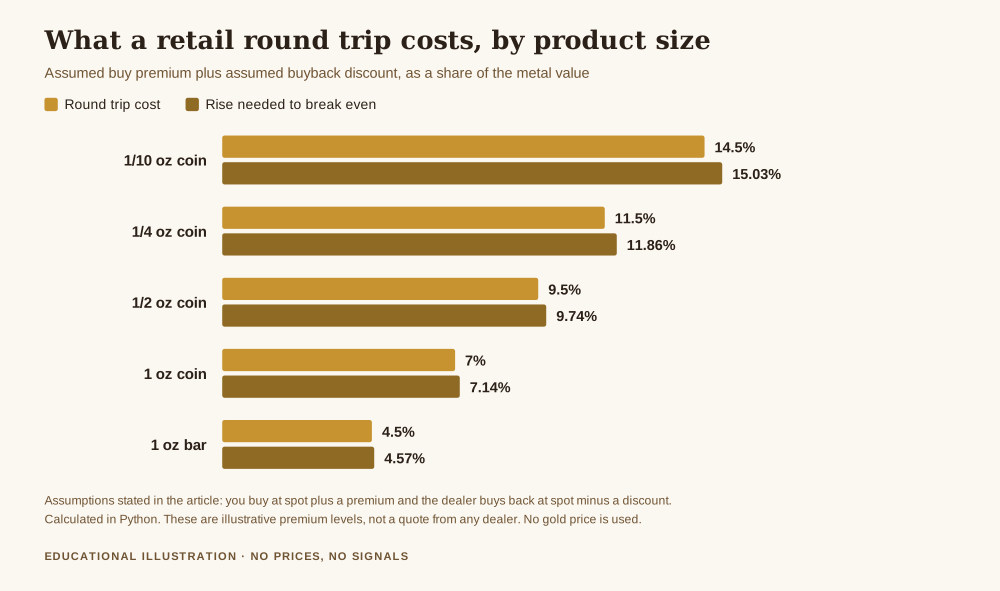
Work it through with stated assumptions. Suppose you buy a one ounce coin at the metal value plus a 5 per cent premium, and the dealer will buy it back at the metal value minus 2 per cent. The round trip costs 7 per cent of the metal value. To get back to where you started, the metal itself must rise by 7.14 per cent, because you are buying at 1.05 and selling at 0.98 of a moving number.
Those premium levels are illustrative figures chosen to show the mechanism, not a quote from any dealer. The mechanism is what matters, and it is identical whatever the actual numbers turn out to be on the day.
Why the small coins cost so much more
Now run the same arithmetic across product sizes and a pattern appears immediately.
On a one ounce bar, assume a 3 per cent buy premium and a 1.5 per cent buyback discount. The round trip is 4.5 per cent and the metal needs to rise 4.57 per cent before you are level. On a one ounce coin at 5 and 2 per cent, the round trip is 7 per cent and you need 7.14 per cent. On a half ounce coin at 7 and 2.5, the round trip is 9.5 per cent and you need 9.74. On a quarter ounce at 8.5 and 3, it is 11.5 per cent and 11.86. On a tenth of an ounce at 11 and 3.5, the round trip is 14.5 per cent and the metal must rise 15.03 per cent before you have broken even.
The fabrication cost of striking a coin does not fall in proportion to its weight. A tenth ounce coin takes nearly as much handling as a one ounce coin and contains a tenth of the metal, so the same handling cost lands on ten times less gold. The buyer of small denominations is paying for convenience at a rate most of them have never calculated.
Spread that 7.14 per cent break even over time and it stops looking like a one off. If you hold for a year, the metal must rise 7.14 per cent in that year just to leave you level. Over three years it is 2.33 per cent a year, over five it is 1.39, over ten it is 0.69. The cost does not disappear, it just gets divided by your patience. That is a strong argument for holding a long time and a very poor one for trading physical metal in and out. The related selling costs are set out in what it costs to sell gold, and the size question itself in gold coins versus gold bars.
The third margin, volume
A few per cent does not sound like a business until you see how much metal moves through the retail channel.
The World Gold Council's Gold Demand Trends for the third quarter of 2026, published on 3 November 2026, put total gold demand at 1,369 tonnes, with bar and coin investment at 268 tonnes, down 19 per cent on the same quarter a year earlier. Total demand value for the quarter was 188 billion US dollars.
Convert the bar and coin figure and the scale becomes concrete. At 32,150.7466 troy ounces to the tonne, 268 tonnes is 8,616,400 troy ounces in a single quarter. That is 19.6 per cent of all gold demand, and it is the equivalent of 21,541 Good Delivery bars of about 400 ounces each, broken down into coins and small bars and sold on. Assume 63 trading days in the quarter and that is roughly 136,768 ounces a day, about 342 wholesale bars daily, being converted into retail units somewhere in the world.
Apply a few per cent to a flow that size and the answer to how dealers make money stops being mysterious. They are not hoping the gold price rises. They are a processing and distribution business that gets paid on throughput, which is also why a good dealer would rather you came back than that they squeezed you once.
What to actually check before you buy
Four things, and all four are knowable in advance.
Ask for the buyback price at the same moment you ask for the sale price. A dealer who publishes both is telling you the size of the round trip without being asked. A dealer who will not quote a buyback is a dealer whose margin you cannot measure, and an unmeasurable cost should be assumed to be a large one.
Work out the round trip as a percentage rather than as a cash figure, because the percentage is the thing that compares across products and the cash figure is the thing that hides inside a large purchase.
Prefer size when your purpose is holding metal, and accept the higher cost of small denominations only when divisibility is genuinely the point. Paying 15 per cent for the ability to sell a tenth of an ounce at a time is a reasonable trade only if you can state why you need that ability.
And check accreditation on the refiner rather than the retailer's own assurances, because the Good Delivery Lists exist precisely so that the question of whether a bar is what it says it is does not depend on trusting the person selling it to you. Protecting capital is the first pillar, and it is covered in full in protecting your capital when gold gets volatile.
Get the free Black Gold Market blueprint, a one page guide to protecting capital before trying to grow it, including how to price a round trip before you commit to it. One email, no spam, unsubscribe anytime.
Get the free blueprint →Frequently asked questions
How do bullion dealers make money in one sentence?
They buy metal wholesale, pay to turn it into retail sized objects, sell those above the metal value and buy them back below it, and they repeat that on a large enough volume that a few per cent becomes a business.
Is the premium over spot a rip-off?
Not in itself. Part of it pays for genuine fabrication, assay, distribution and the recognisability that lets the next buyer accept the piece without testing it. The question is not whether a premium exists but how large it is, and how large the buyback discount is alongside it, because those two together are what you actually pay.
Why is the buyback price always lower than the sale price?
Because the dealer has to hold the piece, carry the price risk while they do, and find the next buyer. That service has a cost like any other. The spread is the compensation for it, and the only thing worth objecting to is a spread you were not shown.
Do bullion dealers profit when the gold price falls?
Largely they are indifferent, which surprises people. Their margin is taken on turnover rather than on direction, so what hurts a dealer is not a falling price but a quiet market. A sharp move in either direction tends to increase the volume passing through them.
Are smaller coins really that much worse value?
On the round trip, yes, and the reason is mechanical rather than predatory. Minting a tenth ounce coin costs nearly what minting a one ounce coin costs, so the same fabrication expense is spread over a tenth as much metal. On the assumed figures in this article, the tenth ounce round trip is 14.5 per cent against 4.5 per cent for a one ounce bar.
How do I compare two dealers properly?
Ask both for the sale price and the buyback price on the same product at the same moment, then express the gap between them as a percentage. That single number is comparable across dealers and across products in a way that headline premiums are not.
Where this leaves you
The plain answer to how do bullion dealers make money is that they make it on the distance between two prices, on the work of turning a 400 ounce wholesale bar into something you can hold, and on doing both many times over. On the assumed figures used here, that distance runs from 4.5 per cent of the metal value on a one ounce bar to 14.5 per cent on a tenth ounce coin, which means the metal itself must rise between 4.57 and 15.03 per cent before the person who bought it is level.
Protect, master, grow, in that order. None of this is an argument against owning physical gold. It is an argument against owning it without knowing the toll on the way in and the way out, because that toll is the one cost of holding metal that is fixed on the day you buy and never recovers by itself. Ask for both prices. The dealer already knows both of them.
The market figures in this article, namely total gold demand of 1,369 tonnes and bar and coin investment of 268 tonnes for the third quarter of 2026, the 19 per cent year on year fall in bar and coin demand and the quarterly demand value of 188 billion US dollars, come from the World Gold Council's Gold Demand Trends published on 3 November 2026 and linked above. The Good Delivery gold bar of approximately 400 troy ounces and the LBMA's management of the Good Delivery Lists come from the LBMA, also linked above. The conversion of 268 tonnes into 8,616,400 troy ounces at 32,150.7466 ounces per tonne, the share of 19.6 per cent, the 21,541 bar equivalent, the daily figures of 136,768 ounces and about 342 bars on an assumed 63 trading day quarter, the round trip costs of 4.5, 7.0, 9.5, 11.5 and 14.5 per cent, the break even moves of 4.57, 7.14, 9.74, 11.86 and 15.03 per cent, and the annualised figures of 7.14, 2.33, 1.39 and 0.69 per cent were all calculated here in Python from the premium and buyback assumptions stated in the text. Those premium levels are illustrative and are not a quote from any dealer. No gold price, entry, stop or target appears anywhere in this article.
Black Gold Market publishes daily gold analysis with the level, the context and the risk written out, and the free blueprint above is the one page version of the capital rules used here. Following along is free, the Kit is optional, and nothing here promises a profit.
About the author. Raphael writes Black Gold Market around three ideas in a fixed order: protect, master, grow. Capital that survives the bad month is the only capital that gets to compound, and the published work shows the level, the context, and the risk so you can judge the reasoning yourself. This is education and not financial advice, your own circumstances decide what any of this means for you, and no entry, stop or target discussed should be treated as a signal.