

Two products are sold to the same people, through the same kind of advertising, using the same words about gold and the dollar and the next ten minutes. They are not the same instrument, and the difference between forex and fixed time trading is not a matter of style or preference. It is a difference in the arithmetic of the payout, and the arithmetic decides the outcome long before anybody's opinion about the market does.
This belongs under Protect, because it is the sort of thing that is obvious once you have seen it written down and completely invisible while you are inside a platform that is designed not to show it to you.
The Difference Between Forex and Fixed Time Trading, Stated Plainly
A forex or gold position, the kind you open in a normal trading terminal, pays you in proportion to what happens. You buy, price rises by some amount, and your result is that amount multiplied by your position size. You close when you decide to close. If the move takes three hours longer than you expected, you are still in it. If it goes further than you expected, you are paid more.
A fixed time trade, often sold under names like fixed time trading, digital options or binary options, pays you a fixed amount if a condition is true at a fixed moment, and nothing if it is not. As the CFTC's advisory on binary options describes it, "when the binary option expires, the option holder will receive either a pre-determined amount of cash or nothing at all."
Those two sentences contain the whole difference. One instrument pays according to how much you were right by and lets you choose when the question is asked. The other pays a flat amount if you were right at a moment chosen in advance, and takes the entire stake if you were not.
People hear that and conclude the fixed time version is simpler, which it is, and then conclude that simpler means safer, which it is not. Simplicity in the payout is exactly what removes your ability to manage the position, and it is also what lets a fixed negative edge be built into the product.
Two Payout Structures, and Only One of Them Scales
Consider what happens when you are right by different amounts.
In a position trade, being right by a small amount pays a small amount, and being right by a large amount pays a large amount. That relationship is the entire basis for the idea of a reward-to-risk ratio: you accept many small losses in exchange for the occasional large win, which is why a 33 per cent win rate can still work if the winners are large enough. The instrument permits asymmetry.
In a fixed time trade, being right by one tick and being right by a hundred ticks pay identically. The payout does not know the difference, because the payout is fixed. That single design decision removes asymmetry from the product entirely. You cannot let a winner run, because there is nothing to run into. You cannot cut a loser short, because the loss is not a function of price, it is a function of the clock striking.
Which means that in a fixed time trade there is exactly one lever left: how often you are right. Everything else that a trader normally works on, exit management, position sizing relative to volatility, letting the good trade pay for the four bad ones, has been removed by the shape of the contract. That is a much narrower path than it sounds, and the next section shows how narrow.
The Break-Even Win Rate, Which Is Where the Argument Ends
Here is the calculation that settles it. A fixed time trade with a stated payout of 80 per cent pays you 0.80 of your stake when you win, and costs you 1.00 of your stake when you lose. So to end level, your win rate must satisfy a simple condition: the wins must pay for the losses.
Solving it gives a break-even win rate of one divided by one plus the payout. At an 80 per cent payout that is 55.56 per cent. Not 50. You must be right 55.56 per cent of the time just to arrive back where you started, before any thought of profit, which is 5.56 percentage points better than a coin flip that you must produce repeatedly, forever, in a market that will not cooperate.
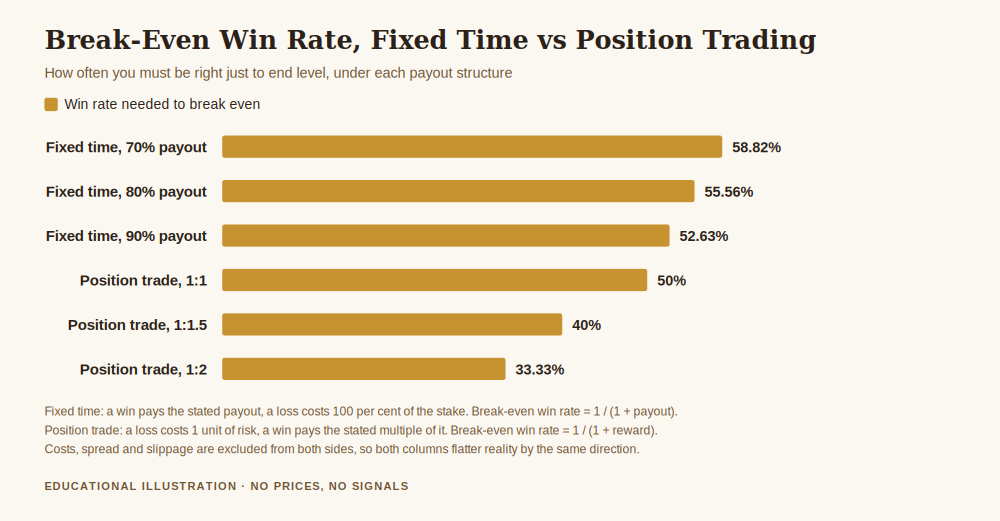
Run it across the payouts these platforms advertise. A 70 per cent payout demands a 58.82 per cent win rate. An 80 per cent payout demands 55.56 per cent. A generous 90 per cent payout still demands 52.63 per cent. The requirement never falls to 50, because it cannot: the payout is always less than the stake at risk, and that gap is the house's margin, stated openly in the product's own terms.
Now compare a symmetric position trade. Risk one unit to make one unit, and the break-even win rate is exactly 50.00 per cent. Risk one to make one and a half, and it falls to 40.00 per cent. Risk one to make two, and it falls to 33.33 per cent. The trader who can only be right a third of the time has a workable structure available to them in one product and no structure at all in the other.
Both columns of that chart exclude spread, commission and slippage, so both flatter reality, and they flatter it in the same direction. Adding real costs raises every bar. It does not change which side of 50 per cent each product sits on, because that is determined by the shape of the payout rather than by the fees.
What a Negative Edge Does Over a Hundred Trades
Suppose you are genuinely good at calling short-term direction, good enough to be right half the time, which most people are not, on a product where the clock is choosing the exit for you. At an 80 per cent payout your expectancy is 0.50 times 0.80, minus 0.50 times 1.00, which is minus 0.100 per unit staked. You lose 10.0 per cent of every amount you stake, on average, forever.
Stake 2 per cent of your capital per trade and take a hundred trades. Holding the stake fixed at 2 per cent of the starting balance, the expected path takes you down 20.0 per cent. Sizing each stake at 2 per cent of the current balance instead, so the stake shrinks as the account does, the expected path is minus 18.14 per cent. Those are arithmetic consequences of the payout structure and the assumed win rate, not forecasts, and the point is that they do not depend on the market doing anything unusual. A flat, unremarkable market with a coin-flip hit rate produces them.
This is what expectancy means when it is negative by construction. It is not bad luck, and it does not get better with practice at reading charts, because the deficit is written into the contract rather than into your skill.
Being Right About Direction Is Not Enough
There is a second, subtler cost, and it catches people who genuinely can read a market.
In a fixed time trade the question is not "will gold go up" but "will gold be above this level at 14:35". Those are different questions, and the second one is far harder, because it requires you to be right about timing to the minute in an instrument whose moves arrive in bursts separated by long periods of nothing. You can have the direction right, watch the move happen twenty minutes after expiry, and lose the entire stake. The market agreed with you and paid you nothing.
In a position trade, being right slowly is still being right. That is not a minor convenience. It is the difference between a process that can absorb the market's ordinary refusal to move on schedule and a process that cannot.
What the Regulators Concluded
Two regulatory facts are worth having, because they are the closest thing to an independent verdict.
The European Securities and Markets Authority announced product intervention measures on 27 March 2018. Binary options were prohibited outright for retail clients. Contracts for difference were restricted rather than prohibited, with leverage limits, a margin close out rule at 50 per cent of required margin, negative balance protection per account, a ban on incentives, and a standardised risk warning. The same announcement notes that 74 to 89 per cent of retail accounts typically lose money on CFDs. One product was banned. The other was left on sale with conditions. That distinction was drawn deliberately.
On the American side, the CFTC advisory linked above is blunt about who is permitted to offer these contracts, stating that "there currently are only three designated contract markets offering binary options in the U.S." It then lists the three categories of complaint it receives about internet-based platforms: "refusal of certain Internet-based binary options trading platforms to credit customer accounts or reimburse funds after accepting customer money", identity theft through collection of "credit card and driver's license data", and "manipulation of the binary options trading software to generate losing trades".
That third one deserves a second read. The complaint is not that customers lost on fair terms. It is that the software itself was alleged to distort prices and payouts. When the venue both sets the payout and reports whether you won, the break-even arithmetic above is the optimistic case.
What This Does Not Mean
It would be dishonest to finish here and let you conclude that the other side of the comparison is safe. It is not.
The 74 to 89 per cent figure ESMA published is about CFDs, the very instrument left on sale. Leverage, spread, swap and your own behaviour will take an ordinary forex or gold account apart perfectly well without any help from an exotic payout structure. The honest summary is narrower than "one is good and one is bad": one structure gives you the tools to build a positive expectancy if you have an edge, and the other removes most of those tools and starts you below zero.
If you are weighing up any platform of either kind, the register check comes before the product argument. Checking a forex broker licence takes a few minutes, and a venue that is not authorised where it claims to be makes every other question about payout structure academic.
Get the free Black Gold Market blueprint, a short document on protecting capital before you try to grow it, including the break-even arithmetic used on this page. One email, no spam, unsubscribe anytime.
Get the free blueprint →Frequently Asked Questions
What is the difference between forex and fixed time trading in one sentence?
A forex position pays in proportion to how far price moves and lets you choose when to close, while a fixed time trade pays a flat amount if a condition is true at a preset moment and takes the whole stake if it is not.
Is fixed time trading the same thing as binary options?
The mechanics are the same: an all-or-nothing payout settled at a fixed expiry. The naming varies by platform and by jurisdiction, and some of that variation exists because the older name attracted regulatory attention. Judge the product by its payout structure rather than by what it is called.
Can anyone be profitable at fixed time trading?
Mathematically it requires sustaining a win rate above the break-even level in the chart above, which at a typical 80 per cent payout means beating 55.56 per cent indefinitely, on questions that include timing as well as direction. This article does not tell you it is impossible, it tells you what the threshold is so you can judge the claim yourself.
Why is the payout always less than 100 per cent?
Because the gap is how the venue is paid. There is nothing hidden about it, it is printed on the trade ticket. What is not printed is the win rate that gap implies you need, which is the calculation this article does for you.
Are CFDs on gold safer, then?
Safer is the wrong word. They have a payout structure that can be worked with, and they still lose money for most retail accounts, on ESMA's own published numbers. A better structure used carelessly is not protection.
Where did the numbers in this article come from?
The break-even win rates are one divided by one plus the payout, computed for payouts of 70, 80 and 90 per cent, and one divided by one plus the reward multiple for position trades. The expectancy figure is 0.50 times 0.80 minus 0.50 times 1.00. The hundred-trade paths assume a 2 per cent stake, fixed against the opening balance in one case and against the current balance in the other. The regulatory wording is quoted from the ESMA and CFTC pages linked in the text, both checked live before publication. None of it is a forecast or a performance claim.
Where Black Gold Market Fits
Black Gold Market is free to follow. Daily XAU/USD analysis with the level, the context and the risk stated before the trade, losing days included, on Telegram. There is a free blueprint for anyone who wants the capital protection material in one place, and an optional Kit for people who want the full method. Nothing here promises a profit, and nothing here is a signal service.
Knowing what you are actually holding belongs to Protect. How to protect your capital when gold gets volatile is the pillar this article sits under, is forex trading a CFD or spread betting takes apart the instrument you are more likely to be using, and how to spot a gold trading scam covers the sales pattern that tends to arrive attached to the product described here. More about who writes this is on the about page.
About the author. Raphael writes Black Gold Market. He works on the part of this business that happens before the entry, the level, the context, and the risk, and he has a long-standing objection to any product whose terms quietly decide the outcome before the market gets a vote. Nothing in this article is a recommendation to trade, and no entry, stop or target discussed should be treated as a signal.
Disclaimer: This article is general educational content about instrument structure, payout arithmetic and regulation in retail trading. It is not financial advice, not investment advice and not a recommendation to buy, sell or use any product, venue or firm. Regulatory wording is quoted from the sources linked in the text and may change, and rules vary by jurisdiction. Trading leveraged products carries a substantial risk of loss and most retail accounts lose money. Figures are illustrative calculations from stated assumptions, not predictions or performance claims.