

A reader wrote to the Black Gold Market group in a bad week. He had deposited, traded for a month, finished ahead, and then found he could not withdraw. Support kept replying with the same word: unverified. He wanted to know how to verify forex account access properly, and underneath that, why a firm that took his money in ninety seconds needed four days and three documents to give any of it back.
The answer is not customer service. It is law, and understanding which law makes the whole process readable rather than infuriating. It also hands you one of the cleanest tests there is for whether a firm is worth your deposit in the first place, which is a Protect question long before it is an administrative one.
How to Verify Forex Account Documents, Step by Step
Every regulated broker runs the same three checks, because they are required to. The industry calls it Know Your Customer, and it has three parts that answer three different questions.
Who are you. A government photo identity document, in date. Passport, national identity card or driving licence depending on the jurisdiction. The name on it has to match the name on the trading account exactly, including middle names and the order they appear in.
Where do you live. A document issued by a third party showing your name and residential address, usually dated within the last three months. A utility bill, a bank statement, a council or municipal tax notice. Mobile phone bills are frequently rejected. A screenshot of an online banking page is frequently rejected. What the firm needs is a document it can treat as issued by someone other than you.
Where did the money come from. This one surprises people and it is the one that causes delays. Above certain thresholds, and for certain jurisdictions, the firm has to form a view on source of funds. Payslips, a tax return, a contract of sale, a bank statement showing the money arriving from an identifiable source. The larger the deposit, the more likely this is asked.
Then a fourth check that is not about documents at all: the payment method. Regulated firms will generally only return funds to the same instrument the money arrived on, and only to an account in your own name. Deposit from a card, and the first tranche of any withdrawal goes back to that card. This is not a policy the firm invented to be difficult, and it is the reason a third party deposit, money sent from a spouse's or a friend's account, will quietly poison a withdrawal months later.
What the Verification Step Is Actually Protecting
It helps to see the size of the problem the rules exist to address. The FBI's Internet Crime Complaint Center publishes an annual count of what United States victims report, and the 2024 edition is blunt reading.
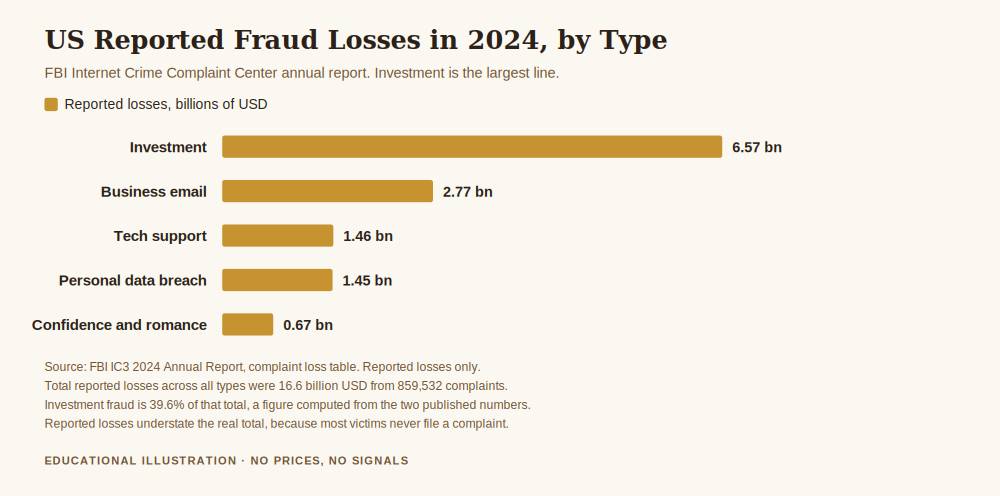
Across all crime types, 859,532 complaints reported 16.6 billion dollars of losses, an average of 19,372 dollars for each complaint that reported a loss. The single largest category was investment fraud at 6.57 billion dollars. Running those two published figures against each other, investment fraud alone accounted for 39.6 percent of every dollar reported lost that year.
Those are reported losses, which means they are the floor rather than the ceiling. Most people who lose money to a fake platform never file anything with anyone.
Now the point. Almost none of that money moved through firms that verify their clients. It moved through platforms that let anyone open an account, deposit instantly, watch a fabricated balance grow, and then discover the withdrawal button was decorative. Identity verification is the friction that makes that business model unworkable, which is exactly why the operations built to take your money do not have it.
The Firm That Does Not Ask Is Telling You Something
This inverts the way most people feel about the upload. If a broker takes a deposit and never asks for a single document, that is not efficiency and it is not a favour. It means one of two things, and both of them are your problem.
Either the firm is outside the regime that would require the check, in which case the protections you assume you have do not exist, or it never intends to process a withdrawal, in which case the verification it never asked for was never going to matter.
The same reasoning applies to the leverage on offer, and here the arithmetic is worth doing once. When ESMA set its product intervention measures on 27 March 2018, it capped retail leverage on gold at 20 to 1, citing that 74 to 89 percent of retail accounts typically lose money, with average losses running from 1,600 to 29,000 euros.
Twenty to one means the margin behind a position is 5.00 percent of its notional value. A 5.00 percent move against you removes it. At the 100 to 1 an offshore venue will happily offer, the margin is 1.00 percent, so a 1.00 percent move does the same job. At the 500 to 1 you will see advertised at unregulated venues, the margin is 0.20 percent, and a move of one fifth of one percent erases the entire deposit standing behind the trade. That is not a better deal with more freedom attached. It is the same account with the survival margin removed, offered by the same class of firm that also does not check who you are.
Get the free Black Gold Market blueprint, a short document on protecting capital before the trade rather than after it, including the checks worth running on a firm before the first deposit. One email, no spam, unsubscribe anytime.
Get the free blueprint →The Five Ways Verification Actually Goes Wrong
Almost every rejection I have seen described comes down to one of five things, and all five are avoidable before you start.
The name does not match. The account was opened as a shortened first name and the passport carries the full one, or a married name sits on one document and a maiden name on the other. Open the account in the exact name printed on the identity document, and if your name has legitimately changed, send the document that proves the change at the same time rather than waiting to be asked.
The address document is too old, or is not really third party. Three months is the usual window and it is measured from the issue date printed on the document, not the day you downloaded it. A statement you generated yourself from a portal often fails where the same statement, downloaded as the bank's own dated PDF, passes.
The image is unusable. Corners cropped, glare across the photograph, a screen photographed rather than the document. Every edge of the document must be inside the frame. This single issue accounts for a large share of the delay people blame on the firm.
The deposit came from someone else. A third party payment cannot be returned to you, and cannot usually be returned at all without an investigation. If the money is genuinely a gift or a loan from family, it needs to reach your own bank account first and travel to the broker from there.
Verification was left until the withdrawal. This is the expensive one, and it is the reader I opened with. A firm can hold a withdrawal while it completes checks it is required to complete, and the clock only starts when you send the last document. Doing it on day one costs twenty minutes and nothing else. Doing it with a balance waiting on the other side costs days, at the exact moment you want the money.
Frequently Asked Questions
How do I verify a forex account, in short?
Send an in date government photo identity document, a third party proof of address issued within about three months, and, if asked, evidence of where the funds came from. Make sure the account name matches the identity document exactly, and fund the account from a payment method in your own name.
How long does verification take?
Commonly one to three business days at a regulated firm once every document is legible and matching, and considerably longer when something has to be resubmitted. The delay is almost always a rejected document rather than a queue, which is why the quality of the first upload decides the timeline.
Is it safe to send my passport to a broker?
It is a normal requirement at any regulated firm, and refusing to send it means you cannot use one. The judgement is not whether to send documents, it is who you send them to. Confirm the firm's registration with the regulator directly, using the register on the regulator's own website rather than a link or a licence number supplied by the firm.
Why does a broker need to know where my money came from?
Anti money laundering obligations require firms to form a view on source of funds, particularly above certain deposit thresholds. It is not a judgement about you, it is a record the firm has to be able to produce. Firms that never ask are usually firms that never expect to be asked.
Can I withdraw to a different account from the one I deposited from?
Generally no, and this catches people out. Regulated firms return funds along the route they arrived, to an account in the same name. Plan the deposit route with the eventual withdrawal in mind, because the decision you make at funding is the one that governs the exit.
Where did the numbers in this article come from?
The loss figures are published by the FBI's Internet Crime Complaint Center in its 2024 annual report, linked below. The 39.6 percent share is my own arithmetic on two figures from that report, 6.57 billion against 16.6 billion. The leverage and margin percentages are arithmetic on the leverage ratios themselves, and the retail loss range is ESMA's own. No gold price appears anywhere in this article.
Where Black Gold Market Fits
Black Gold Market is free to follow. Daily XAU/USD analysis with the level, the context and the risk stated before the trade, losing days included, plus an optional Kit for people who want the method written down in one place. There is no promise of profit here, because nobody can honestly make one.
Protect comes first, and knowing who is holding the money sits ahead of anything you do with a chart. How to protect your capital when gold gets volatile is the pillar this article belongs under. How to check a forex broker's licence is the check you run on the firm before this one, how to spot a gold trading scam covers the operations these rules exist to keep out, and what negative balance protection is covers another safeguard that only exists inside the regulated perimeter.
About the author. Raphael writes Black Gold Market. He works on the part of this business that happens before the trade, the level, the context, and the risk, and on the conviction that a method you can follow through a quiet quarter is worth more than a better one you cannot.
Disclaimer: This article is general educational content about account verification requirements and what they exist to prevent. It is not financial advice, not legal or compliance advice, not a recommendation of any broker or platform, and not a solicitation to trade. Verification requirements, document standards and withdrawal rules differ by firm and by jurisdiction and change without notice, so confirm what applies to you with the firm and with your own regulator. The fraud loss figures are published by the FBI's Internet Crime Complaint Center in its 2024 annual report and cover reported losses in the United States only; the 39.6 percent share is my own arithmetic on two figures from that report. The retail loss range and the leverage caps are from ESMA's product intervention measures of 27 March 2018 and apply to particular jurisdictions and account types. The margin percentages are arithmetic on the leverage ratios and are not quotes from any firm. No gold price appears in this article. Trading gold, CFDs and leveraged products carries a high risk of losing money rapidly, and no entry, stop or target discussed should be treated as a signal. Readers should consider their own circumstances and speak to a licensed professional in their jurisdiction.