

Everyone who asks how to develop patience in trading describes the same experience first. The screen is open, nothing qualifies, and sitting there doing nothing feels like negligence. So a trade gets taken that would not have been taken an hour earlier, and it is rarely one of the good ones.
I want to reframe the problem, because patience is usually discussed as a character trait, something you either possess or must somehow summon. Treated that way it is unfixable, and every attempt to fix it becomes an argument with yourself that you lose at the worst possible moment. Treated as a measurement problem it becomes ordinary, and ordinary problems have solutions.
The Thing Patience Is Actually Competing With
Waiting does not feel neutral. It feels like a cost, because the alternative is visible and the benefit is not. You can see the trade you did not take. You cannot see the loss you did not take, because it never happened, and nothing in the platform will ever show it to you.
That asymmetry is the whole difficulty. Your journal records every action and no restraint. Over a few months the record builds a picture of a person who acts, and the discipline that kept the account intact leaves no trace in it at all.
So the first move is to give the waiting a number, and to put that number somewhere you will see it.
Where a Decade of Movement Actually Happened
I went to the published LBMA gold benchmark for the ten years from 2016 to 2025. That is 2,506 fixings, and therefore 2,505 comparisons from one session to the next. Across that decade the benchmark changed by 303.6%.
Then I removed sessions, strongest first, and recompounded what was left.
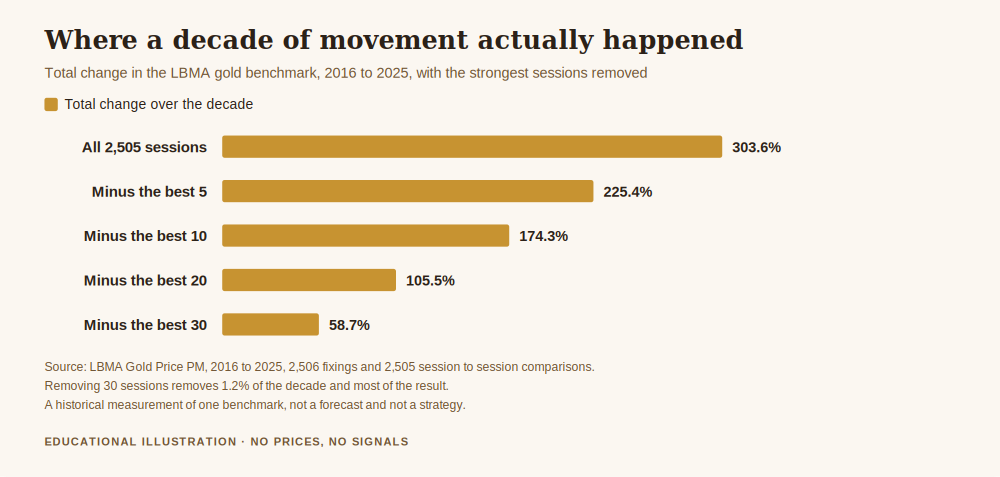
Remove the five strongest sessions and 303.6% becomes 225.4%. Remove ten and it becomes 174.3%. Remove twenty and it becomes 105.5%. Remove thirty, which is 1.2% of the decade, and what remains is 58.7%.
Thirty sessions out of 2,505. Less than one and a half sessions in a hundred carried the majority of ten years of movement.
I want to be precise about what this does and does not show, because this statistic gets misused. It measures the benchmark, not a trading strategy, and it is not an argument for holding anything. It is a statement about the shape of the market you are working in: movement is not spread evenly across time, it clusters, and the great majority of sessions contribute very little to what the decade eventually did.
If that is true of the instrument, then a method that requires you to act every session is asking you to pay attention costs on roughly 2,475 occasions in order to be present for thirty.
How to Develop Patience in Trading Starts With Knowing the Odds of Today
Concentration explains why waiting matters. The next question is more practical: how long should waiting actually feel?
Across the same decade, the median absolute move from one session to the next was 0.48%. Sessions that moved at least 1% happened 542 times, which is 21.64% of them, about one session in five. Sessions that moved at least 2% happened 109 times, 4.35%, roughly one in twenty three.
Now the number that changes how the waiting feels. Between sessions that moved 1% or more, the median gap was 3 sessions, and the longest gap in the decade was 60 sessions. Between sessions that moved 2% or more, the median gap was 9 sessions, and the longest was 379.
Read that last figure again. If your method needs a genuinely large move to work, the historical record contains a stretch of 379 consecutive sessions, well over a year, without one. Not because you were doing anything wrong. Because that is what the instrument did.
A trader who does not know this interprets a quiet fortnight as evidence that their method has stopped working, and goes looking for a new one. A trader who does know it recognises a quiet fortnight as the median case, which is a very different feeling for exactly the same experience.
Four Practices That Make Waiting Possible
Knowing the numbers is not the same as being able to sit still. These are the four things that turn the knowledge into behaviour.
Write the condition down before the session, not during it
Patience fails at the point of decision because that is when the pressure is highest. Moving the decision earlier removes the pressure from it. Before the session opens, write what would have to be true for you to act. During the session your only job is comparison, which is a much smaller task than judgement, and one you can perform honestly while restless.
Record the trades you did not take
This is the direct fix for the asymmetry described above. Keep a short log of the setups you passed on and what happened next. Some of them will have worked, and it is important that you see those too, because a log that only records vindication teaches nothing. What builds over weeks is evidence that your filter has a real effect, and evidence is what patience actually runs on. Not willpower.
Give the waiting a job
An idle screen is the highest risk state in this business. Waiting with nothing to do becomes watching, watching becomes looking for reasons, and looking for reasons reliably finds them. Attach specific work to the quiet periods, reviewing closed trades, checking your expectancy, updating your levels for the week. The market is not the only thing that needs attention, and the quiet sessions are when everything else can get it.
Set a floor on activity, not just a ceiling
Most rules cap how much you may do. Consider one that also states how little is acceptable, because the fear of doing too little is what breaks patience. If your plan explicitly says that zero trades in a week is a legitimate outcome, then a week with zero trades stops being a failure that needs correcting and becomes an anticipated result. The rule that gives you permission is doing as much work as the rule that restrains you.
Protect, Master, Grow
The protective reading is straightforward. The trades taken out of restlessness are not a random sample of your trades, they are drawn from the worse end of your judgement, because they were taken at the moment your standards were lowest.
Mastery is knowing your own numbers rather than mine. The figures above describe the benchmark over one decade. Your method has its own frequency, and until you have measured how often it genuinely qualifies, you will keep judging your patience against a standard that came from nowhere.
Growth follows almost mechanically. Nothing compounds through a stream of marginal trades, and the account that is still intact after a quiet quarter is the one still able to act when the concentrated sessions arrive. Surviving the wait is a precondition of the result, not an alternative to it.
Get the free Black Gold Market blueprint, a short document for writing down your condition before the session so that waiting becomes a comparison rather than an argument with yourself. One email, no spam, unsubscribe anytime.
Get the free blueprint →Frequently Asked Questions
How long does it take to develop patience in trading?
Longer if you treat it as willpower and shorter if you treat it as evidence. The log of trades you passed on is what changes the feeling, because after a few weeks you are no longer asking yourself to trust an instruction, you are reading your own record. Most people report the shift when the log is long enough to argue back.
Is patience just trading less often?
No, and the difference matters. Trading less often is a number. Patience is applying the same standard at hour six of a quiet session as at hour one. A trader who takes very few trades but takes them at their weakest moments has low frequency and no patience at all.
Does the disappearing decade figure mean I should buy and hold instead?
It does not, and it is not intended as an argument for any strategy. It measures how the benchmark moved, and it shows that the movement was concentrated in very few sessions. That is a fact about the instrument which is relevant to anyone deciding how often to act. It is not a recommendation to hold, to trade, or to do anything in particular.
What if my method genuinely needs frequent trades?
Then frequency is correct for you, and the question becomes whether your edge per trade covers what each trade costs. That is arithmetic rather than temperament, and it is a different discipline from this one. The patience problem described here is specific to traders whose method qualifies rarely and who act anyway.
How do I know if I am being patient or just avoiding the market?
By whether your condition is written down. Patience is declining trades that fail a stated test. Avoidance is declining trades that pass it. Without the condition on paper before the session, the two are genuinely indistinguishable from the inside, which is why the writing matters more than the intention.
Do these numbers apply to instruments other than gold?
The specific figures are gold, computed from one benchmark over one decade, and other instruments will differ. The pattern of movement clustering in time rather than spreading evenly is not unique to gold, but if you trade something else you should measure it there rather than borrow these numbers.
Does waiting mean I miss the move?
Sometimes, and that cost is real rather than imagined. The relevant comparison is not against the trades you missed, it is against the full set of trades you would have taken had your standard been lower, including the ones that would have gone badly. Counting only the missed winners is the same accounting error that made patience feel expensive in the first place.
Where This Leaves You
Patience is not a virtue you are waiting to acquire. It is a filter with a measurable effect, and the effect can be recorded the same way you record everything else in this business.
Write the condition before the session. Log what you passed on. Give the quiet hours a job. Then look at your own record after a month and let it tell you whether the filter is worth keeping. That process asks nothing of your character, and it survives the days when your character is not available.
If you want the wider framework this sits inside, that is how to protect your capital when gold gets volatile. The companion argument about which trades deserve to pass the filter is why the best trades are the ones you don't take, and the measurement discipline behind all of it is in how to increase win rate in trading.
About the author. Raphael writes Black Gold Market. He works on the part of this business that happens before the trade, the level, the context, and the risk, and on the conviction that a method you can follow through a quiet quarter is worth more than a better one you cannot.
Disclaimer: This article is general educational content about trade selection and waiting. It is not financial advice and it is not a recommendation of any strategy, instrument or holding period. Trading gold, CFDs and leveraged products carries a high risk of losing money rapidly. No entry, stop or target discussed should be treated as a signal. All movement, gap and concentration figures are computed from the published LBMA daily gold benchmark over 2016 to 2025 using the method stated in the article, with costs excluded, and the source is linked so you can check it. Removing the strongest sessions from a historical series is an illustration of how movement was distributed in the past, not a strategy and not a forecast. Results measured on one instrument over one decade describe the past only. No price levels are quoted anywhere in this article.