

If you are searching for how to check forex broker license in india, you are already doing the right thing, and you are probably about to do it in the wrong order. The usual version of this check is to look up the broker, find a licence number from some overseas authority, decide it looks official enough, and fund the account. That sequence has a hole in it. For a person resident in India, the first question is not whether the broker is licensed somewhere. It is whether you are permitted to send that broker money at all.
This one sits under Protect, and it sits there for a plain reason. Everything else in this journal is about surviving the market. This is about surviving the paperwork, which can take an account apart faster than any drawdown, and which no amount of good trading will fix afterwards.
What follows is what the published rules say, with the sources linked so you can read them yourself. It is not legal advice, and the stakes here are high enough that a qualified professional is worth the fee.
How to Check Forex Broker License in India, the Four Checks in Order
The Reserve Bank of India is the authority that matters for foreign exchange, and it publishes what you need in four separate places. Doing all four takes about ten minutes. Doing three of them and skipping the fourth is how people end up in trouble.
One, the authorised persons list. Dealing in foreign exchange in India is a licensed activity. The RBI publishes the list of entities it has authorised to deal in forex, and an entity that is not on it is not authorised to deal with you, whatever it says about itself.
Two, the authorised electronic trading platforms list. Running a platform where forex transactions happen is a separate authorisation from being allowed to deal. The RBI publishes that list too. A firm can be authorised for one thing and not the other.
Three, the Alert List. In a press release dated 7 September 2022, the RBI said it had placed on its website an Alert List of entities that are neither authorised to deal in forex under the Foreign Exchange Management Act nor authorised to operate electronic trading platforms for forex transactions. The list has been updated since, and a February 2023 revision widened it to include platforms and websites that promote unauthorised operators, including through advertising and through claimed training or advisory services.
Four, the exchange route. The same press release sets out where permitted electronic forex transactions may actually be carried out: on RBI authorised electronic trading platforms, or on recognised stock exchanges. It names three of those, the National Stock Exchange of India, BSE Limited, and the Metropolitan Stock Exchange of India. Three venues, named in a central bank press release. If a platform is not an authorised ETP and is not one of those three, it is not a permitted venue.
The Caveat the RBI Puts on Its Own List
This is the part that catches careful people, so it is worth quoting rather than paraphrasing. The RBI's own wording is that "An entity not appearing in the Alert List should not be assumed to be authorised by the RBI."
Read that twice. The Alert List is not a blacklist you can clear a broker against. It is a list of operators the RBI has got around to naming, and the RBI says plainly that it is not exhaustive. The check that proves something is the authorised list, which is a short list of names that are permitted. The Alert List only ever proves a negative.
That asymmetry is the whole skill here. A positive finding on the authorised list tells you something. An absence from the Alert List tells you nothing at all, and treating it as a clean bill of health is the single most common way this check fails.
The Question That Comes Before the Licence
Now the part that reorders everything above. Suppose you do all four checks on an offshore broker and conclude it holds a real licence from a real authority in its own country. You still have to get money to it, and that is where the Liberalised Remittance Scheme comes in.
Under the LRS, a resident individual may remit up to USD 2,50,000 per financial year, April to March, for permitted current and capital account transactions. The scheme began on 4 February 2004 with a limit of USD 25,000, so the allowance is ten times what it was, over about twenty two years, which works out to roughly 10.95 per cent a year compounded. A generous allowance, by most standards.
Then read what the scheme does not cover. The RBI's own FAQ on the Liberalised Remittance Scheme lists the prohibited items, and two of them are the ones that matter here. Item two: "Remittance from India for margins or margin calls to overseas exchanges / overseas counterparty." Item four: "Remittance for trading in foreign exchange abroad."
So the arithmetic on that generous allowance comes out as follows. Of the USD 2,50,000 a resident individual may remit in a financial year, the proportion that may lawfully be sent abroad to fund forex margin is zero per cent. Not a smaller number, not a number subject to conditions. The purpose is on the prohibited list, so the size of the limit never enters into it.
This is why the ordering matters. The licence question asks whether the broker is allowed to take money from people. The remittance question asks whether you are allowed to send it. A yes to the first does nothing for the second, and it is the second that governs what you are about to do.
What Section 13 Actually Exposes You To
The consequence is written into the Act, and the RBI reproduces it in its master direction on compounding of contraventions. Section 13(1) of FEMA provides that a person who contravenes the Act, or any rule, regulation, notification, direction or order issued under it, "shall, upon adjudication, be liable to a penalty up to thrice the sum involved in such contravention where the amount is quantifiable or up to Rupees Two lakh, where the amount is not quantifiable and where the contravention is a continuing one, further penalty which may extend to Rupees Five thousand for every day after the first day during which the contravention continues."
Three clauses, and each one is worth putting a number against. The assumptions below are only the published ceilings applied to round deposit sizes, which is arithmetic rather than prediction, and the real figure in any case is whatever adjudication decides.
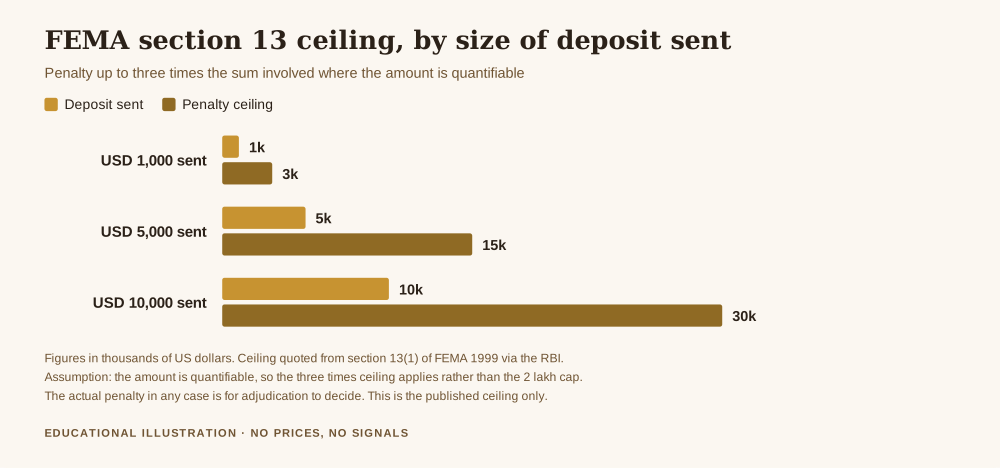
At a deposit of USD 1,000, the ceiling is a penalty of up to USD 3,000. At USD 5,000, up to USD 15,000. At USD 10,000, up to USD 30,000. And since the deposit itself is usually the thing you were hoping to get back, the worst case is the deposit plus the penalty, which is four times the money you sent, at every one of those sizes.
The continuing contravention clause is the one people miss. Rupees Five thousand for every day after the first works out to Rupees 18,25,000 over a year of continuation, which is roughly nine times the Rupees Two lakh ceiling that applies when the amount is not quantifiable. An open position left open is not a static situation in this framework.
Put those together and the risk profile of an unauthorised offshore account is not what a trader usually models. The ordinary trading loss is capped at what you deposited. This exposure is a multiple of it, it is unrelated to whether your trades were any good, and a winning month does not reduce it.
Why a Foreign Licence Does Not Travel
It is worth being clear about what an overseas licence is and is not, because the marketing deliberately blurs it.
A licence from an authority in another country means that authority supervises the firm's conduct in its own jurisdiction, under its own rules, for the clients it is permitted to serve. It is a statement about the firm. It is not a permission granted to you, and no foreign regulator can authorise an Indian resident to make a remittance that Indian rules prohibit. The two questions live in different legal systems and neither answers the other.
This is also why you can find entities on the RBI's Alert List that genuinely hold a licence somewhere. There is no contradiction. The Alert List is about authorisation to deal in forex in India and to operate a forex ETP in India. A firm can be perfectly legitimate at home and still be on it.
Where This Check Goes Wrong
Four failure modes, in rough order of how often they show up.
A regulated badge on the website. A logo and a number in a footer is a claim, not a verification. The claim has to be checked on the regulator's own register, and the register that governs your remittance is the RBI's, not the one in the footer.
Absence from the Alert List read as approval. Covered above, and worth repeating because it is the most confident sort of mistake. The RBI says in terms that absence is not approval.
A rupee payment option read as a domestic entity. Accepting rupees, or routing through a local payment processor, says nothing about where the counterparty sits or whether it is authorised. Convenience at the deposit screen is not a regulatory fact.
A friend's working account read as evidence. That a deposit went through, and that a withdrawal came back once, establishes only that the plumbing worked that time. Enforcement and platform failure both arrive late, which is precisely what makes them dangerous to reason about from a small sample of good outcomes.
What This Leaves, and What to Do With It
The permitted path is narrow and it is published. Exchange traded currency derivatives on a recognised stock exchange, through a SEBI registered intermediary, is a route that exists inside the rules, and SEBI maintains the register of intermediaries so you can check a broker there in the same ten minutes. If something goes wrong with a registered intermediary, SEBI also runs a complaints portal, which is a real avenue that simply does not exist for an unauthorised offshore account.
That last point deserves more weight than it usually gets. The practical difference between an authorised counterparty and an unauthorised one is not the spread or the leverage. It is that one of them comes with somewhere to complain. With the other, a frozen withdrawal is the end of the story, and you will find that the people who could have helped you are the same people who would have told you not to be there.
If you want gold exposure specifically, and that is usually what brings people to this journal, the honest answer is that the instrument question and the jurisdiction question have to be settled before the chart question. Which instruments are available to you inside the rules is a matter for a professional who knows your situation. What this article can tell you is that the order runs jurisdiction, then counterparty, then instrument, then method. Most people run it backwards and discover the first item last.
What This Article Does Not Say
It does not say that offshore brokers are all frauds. Some are substantial regulated businesses. The point is orthogonal to their quality, which is what makes it easy to miss.
It does not quote a number for how many Indian residents trade on unauthorised platforms, because no primary source publishes a figure I could verify, and an invented one would be worse than none.
It is not legal advice, and it is not a complete statement of Indian exchange control law. It is four checks, two prohibited items and one penalty clause, each quoted from the authority that publishes it, with links so you can read the originals. Rules change, and the editions quoted here are the ones live at the time of writing.
Get the free Black Gold Market blueprint, a short document on protecting capital before you try to grow it, including the counterparty checks that belong before the first deposit rather than after the first problem. One email, no spam, unsubscribe anytime.
Get the free blueprint →Frequently Asked Questions
How do I check forex broker license in India in the fastest way?
Look the entity up on the RBI's list of authorised persons and its list of authorised electronic trading platforms. Those are the lists that permit. Then check the Alert List, remembering that absence from it proves nothing. If you are looking at an exchange route instead, check the broker on SEBI's register of intermediaries.
My broker is regulated in another country. Is that enough?
No, because it answers a different question. A foreign licence describes how that firm is supervised at home. It does not give you permission to make a remittance that Indian rules prohibit, and the RBI's Alert List contains entities that hold licences elsewhere.
Can I use my USD 2,50,000 LRS allowance to fund a forex account abroad?
Not for that purpose. The RBI's LRS FAQ lists among its prohibited items "Remittance from India for margins or margin calls to overseas exchanges / overseas counterparty" and "Remittance for trading in foreign exchange abroad." The limit governs how much may be remitted for permitted purposes, and this is not one of them.
What is the penalty if I get this wrong?
Section 13(1) of FEMA provides for a penalty upon adjudication of up to three times the sum involved where the amount is quantifiable, or up to Rupees Two lakh where it is not, plus up to Rupees Five thousand a day after the first day for a continuing contravention. On a USD 5,000 deposit the ceiling is USD 15,000, so the worst case including the deposit is four times what was sent. The actual figure in any case is for adjudication to decide, and compounding is a separate process under Section 15.
The broker is not on the Alert List, so it is fine, correct?
That is the inference the RBI specifically warns against. Its wording is that an entity not appearing in the Alert List should not be assumed to be authorised by the RBI. The list is not exhaustive.
Where can I complain if an authorised intermediary treats me badly?
SEBI runs a complaints portal for registered intermediaries. That avenue is one of the concrete differences between an authorised counterparty and an unauthorised one, because with the latter there is usually nobody with jurisdiction to help.
Where did the numbers in this article come from?
The remittance limit, the prohibited items and the Alert List wording are from the RBI pages linked below. The Section 13 text is quoted from the RBI's master direction on compounding. The percentages and the multiples, the zero per cent, the ten times over twenty two years, the 10.95 per cent a year, the three and four times multiples and the Rupees 18,25,000, are not quoted anywhere. They are arithmetic on those published figures, with the assumptions written out so you can repeat them or discard them.
Where Black Gold Market Fits
Black Gold Market is free to follow. Daily XAU/USD analysis with the level, the context and the risk stated before the trade, losing days included, on Telegram. There is a free blueprint for anyone who wants the capital protection material in one place, and an optional Kit for people who want the full method. Nothing here promises a profit, and nothing here is a signal service.
Checking the counterparty is the first item under Protect. How to protect your capital when gold gets volatile is the pillar this article sits under, how to check forex broker license covers the general register check that this one localises, what is a regulated broker explains what the licence is supposed to buy you, and how to spot a gold trading scam deals with the operators these lists exist to name. The sources used here are the RBI's Liberalised Remittance Scheme FAQ, its press release introducing the Alert List, its master direction on compounding of contraventions under FEMA, and SEBI's register of intermediaries and complaints portal.
About the author. Raphael writes Black Gold Market. He works on the part of this business that happens before the entry, the level, the context, and the risk, and he would rather spend ten minutes on a register than a year on an adjudication. Nothing in this article is a recommendation to trade, and no entry, stop or target discussed should be treated as a signal.
Disclaimer: This article is general educational content about published Indian exchange control rules and regulatory registers. It is not legal advice, not financial advice, not tax advice and not a recommendation to buy, sell or use any product, venue, dealer or firm. Rules and published lists change, and the sources quoted here refer to the editions live at the date of writing. Anyone making decisions in this area should take advice from a qualified professional who knows their circumstances. Trading and investing carry risk of loss. Only commit capital you can afford to lose.