

Every trader I know has a list. Mine used to have four things on it, and the top one was moving a stop when price came close to it. I knew it was costing me. I could describe it accurately. I had promised myself, in writing, more than once, that I would stop. None of that changed anything, and it took me an embarrassingly long time to work out why. If you have gone looking for how to break bad trading habits, you have probably already tried the thing that does not work, which is deciding to be different next time.
What follows is the approach that did work, with the arithmetic written out. Everything numerical here is my own calculation from assumptions I state as I go, apart from one published effect size that I have sourced. There are no gold price levels anywhere in this article, and nothing here is a recommendation to trade.
Why willpower is the wrong tool for how to break bad trading habits
A habit is not a decision you keep getting wrong. It is an action that has become attached to a situation, so that the situation produces the action without a decision happening at all. That distinction sounds academic until you notice its practical consequence: you cannot beat it at the moment it fires, because by the time you notice, it has already fired. The psychology literature on this is old and settled, and Wendy Wood and David Neal's framing of habits as cue driven responses rather than goal driven choices is the clearest statement of it I have read.
Willpower, in other words, is being asked to intervene in the one part of the process where it is not present. That is why the promise fails, and it is why the failure feels like a character problem rather than a design problem. It is a design problem.
Name the cue, not the flaw
The first practical move is to stop describing the habit as a trait and start describing it as a sequence. "I am undisciplined" is not actionable. "When price comes within a few points of my stop and the candle is still open, I move the stop" is actionable, because it names a specific situation that can be altered.
Go through the last thirty or forty trades in your journal and write down, for each occurrence, what was on the screen and what you had just felt in the ten seconds before. You are not looking for a reason. You are looking for the repeated situation. In my case the cue was not losing, it was the sound of the candle closing against me while I was still watching the one minute chart. The habit was attached to watching, and watching was the thing I could actually change.
Two numbers are worth writing down while you do this, because everything below depends on them. The first is how often the cue appears, as a fraction of your trades. The second is what the habit costs you when it fires, measured in R, where one R is the loss you had planned for. You can estimate the second from the journal by comparing where your plan said you would exit against where you actually did.
Put a price on the habit
Once you have those two numbers the habit stops being a moral subject and becomes a line item. At 200 trades a year, the cost is simply the trade count multiplied by how often it fires multiplied by what it costs each time.
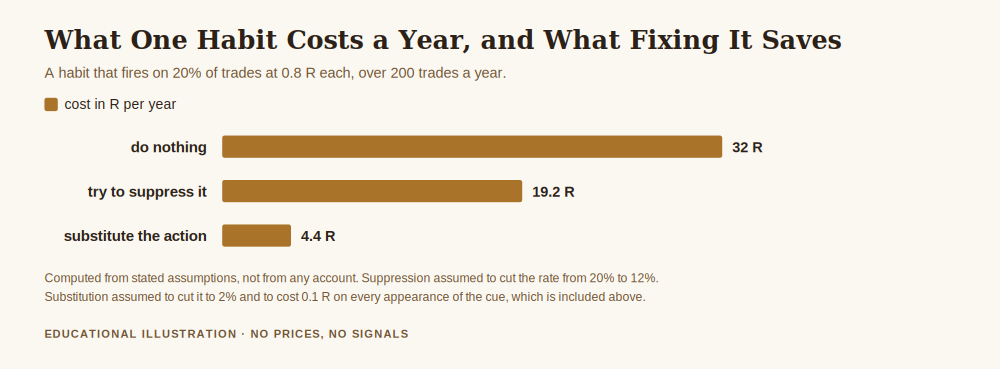
A habit that fires on one trade in five and costs 0.8 R when it does takes 32 R a year out of the account. Move either input and the number moves with it. Firing on half your trades at 1.5 R is 150 R a year, which is not a habit any more, it is the dominant feature of your results. Firing on one trade in twenty at 0.3 R is 3 R a year, which honestly may not be worth the effort of fixing.
That last case matters more than it sounds. Putting a price on the habit tells you which ones to work on and which ones to leave alone. I had four items on my list and only one of them was expensive. The other three were costing me a few R a year between them and a great deal of attention that would have been better spent on the expensive one.
The measurement problem nobody warns you about
Here is where most attempts quietly fall apart. You change something, the next week goes well, and you conclude it worked. It almost certainly did not, and the arithmetic says why.
Suppose the habit fired on 20 per cent of your trades and you want to establish that it now fires on 10 per cent. Testing that properly, at the ordinary standard of a one sided test at 5 per cent with 80 per cent power, needs 82 exposures to the cue. Not 82 trades, 82 occasions on which the cue actually appeared. If the cue turns up on one trade in five and you take four trades a week, that is 0.8 real chances a week, and 82 of them is over two years away.
Read that as encouragement rather than despair, because it has a useful corollary. Large changes prove themselves quickly. Driving the same habit from 20 per cent down to 2 per cent needs only about 22 exposures, because a change that big is hard to mistake for noise. The lesson is not that measurement is pointless. It is that small improvements cannot be verified on any timescale you care about, so you should not spend your effort on them, and "it feels better this week" is not evidence of anything at all.
It also means you should not wait for proof before acting. You should make the change big enough that it does not need much proof.
Substitution beats suppression, and the gap is large
There are two ways to attack a habit. You can try not to do it, which is suppression. Or you can arrange for the cue to produce a different action, which is substitution. They are not equally effective, and you can see the difference without any psychology at all.
Take the same habit, firing on 20 per cent of trades at 0.8 R, costing 32 R a year. Suppose suppression works partially and cuts the rate to 12 per cent. The bill is now 19.2 R a year. Better, and you have spent a year of effort holding the line.
Now suppose that instead you change the setup so the cue rarely produces the action. In my case that meant closing the one minute chart once the trade was placed, because the cue needed me to be watching. Assume it cuts the rate to 2 per cent, and assume the replacement itself is not free, that it costs you 0.1 R every single time the cue appears because occasionally you miss something worth acting on. The bill, including that toll on every appearance, is 4.4 R a year.
Substitution wins by a wide margin even after paying for itself on every occurrence. The reason is structural: suppression attacks the strength of the response and has to win every time, whereas substitution attacks the frequency and only has to be set up once. The 0.1 R toll is the cheapest line in the calculation, and paying it happily is most of the skill.
What the research actually supports
There is one intervention here with a real evidence base behind it, and it is worth being precise about how much it delivers. Writing a plan in the specific form "if situation Y happens, then I will do X" has been tested a great many times. A meta-analysis by Gollwitzer and Sheeran pooled 94 independent tests and found a medium to large effect, d equal to 0.65.
Translated out of academic units, that means a randomly chosen person who wrote the if then plan does better than a randomly chosen person who did not about 68 per cent of the time. Put differently, if a change would otherwise succeed half the time, writing the sentence down lifts that to roughly 74 per cent.
Both halves of that are worth holding onto. It is a real effect and it is free, so write the sentence. It is also not a solution, because a quarter to a third of the benefit simply is not there. Someone who reads that number as "I just need to write my rules down properly" has taken the wrong lesson. The sentence helps you install the substitution. It does not replace it.
Note also what the sentence has to contain. "I will be more disciplined" is not an if then plan, it has no if. "If price comes within ten points of my stop, then I close the platform and go and make coffee" is one, because it names the cue and names the replacement action.
A four week approach that does not depend on feeling motivated
Pulling it together into something you can actually run:
- Week one, measure only. Change nothing. Record every time the habit fires, what was on screen, and what it cost in R. You need the baseline, and you will not get it once you start intervening.
- Week two, price it and pick one. Multiply the three numbers. If a habit is costing less than about 5 R a year, leave it alone and say so out loud, because an unaddressed item on a list is a small ongoing tax on your attention. Work on the expensive one.
- Week three, redesign the situation. Ask what has to be true for the cue to appear at all, then remove it if you can. Close the chart, set an alert instead of watching, move the platform off the second monitor, place the order from a different device. This is the step that does the work, and it is the step everyone skips because it feels like avoiding the problem rather than solving it. Avoiding the problem is solving it.
- Week four, write the if then sentence for what remains. The cue you could not remove gets a named replacement action. One sentence, present tense, specific enough that someone else could follow it.
Then keep counting. Not because you will have proof soon, you will not, but because counting is itself a mild intervention, and because when the count does eventually move you will know it was real rather than a good fortnight.
One caution on the redesign step. If your habit is signal dependence, in the sense of needing someone else to confirm a decision before you make it, the same method applies but the cue is social rather than visual. I have written separately about how that one comes apart, and the mechanism is the same: change what the moment of doubt triggers, rather than trying to feel less doubt.
Get the free Black Gold Market blueprint, a short document on protecting capital before you try to grow it, including how to price a habit before you decide whether it is worth the effort of changing. One email, no spam, unsubscribe anytime.
Get the free blueprint →Frequently asked questions
How long does it take to break a bad trading habit?
Longer than the popular numbers suggest, and the honest answer is that it depends on how often you meet the cue rather than on how many days pass. Habit formation research measures repetition in a stable context, not calendar time, which is the point Lally and colleagues make in their work on habit formation in everyday settings. If your cue appears on one trade in five and you take four trades a week, a month of calendar time is about three real repetitions. That is why redesigning the situation beats waiting it out.
Is it better to fix one habit at a time or several?
One, and pick it by cost rather than by how much it annoys you. The measurement section explains why: you cannot tell whether any individual change worked for a long time, and running three at once means that when something does improve you will not know which change did it.
What if I cannot remove the cue?
Then you substitute rather than remove. The cue still appears, but it now triggers a named harmless action instead of the expensive one. Expect this to work less well than removal and to cost something on every appearance, which is exactly what the 0.1 R toll in the calculation above represents.
Does a trading journal actually help with this?
It helps with the two things the method depends on, which are identifying the cue and getting a baseline number. It does not itself change behaviour. A journal that records outcomes but not what was on screen beforehand will not give you the cue, so record the situation as well as the result.
Where did the 32 R and 4.4 R figures come from?
From arithmetic on stated assumptions, not from any account of mine or anyone else's. 32 R is 200 trades multiplied by a 20 per cent firing rate multiplied by 0.8 R. The 4.4 R figure assumes substitution cuts the rate to 2 per cent and costs 0.1 R on all 40 appearances of the cue. Change any assumption and the number changes, which is the intended use of it.
Is willpower useless then?
No, it is just badly deployed at the moment of temptation. Willpower is useful in advance, for doing the measurement week honestly and for building the setup that makes the cue rare. Spending it there rather than in the heat of the trade is the whole reframing.
Where Black Gold Market fits
Black Gold Market is a free journal about reading gold and protecting capital, written for traders who would rather understand a mechanism than be handed a conclusion. Everything on the site is free to read and there is nothing to buy to follow along. The optional piece is the Sustainable Trader's Blueprint above, a short document on protecting capital before trying to grow it. We do not promise profits, we do not publish results, and we do not think anyone can tell you what your account will do.
About the author. Raphael writes Black Gold Market. He spent two years treating his own worst habit as a discipline problem before he worked out it was a design problem, and fixed it in a fortnight by closing a chart. Nothing in this article is a recommendation to trade, and no entry, stop or target discussed should be treated as a signal.