

Gold in the Asian session has a reputation: quiet, narrow, not worth sitting up for. Most of that reputation is earned. What almost nobody explains is why those hours are thin, and the real reason is stranger than the one you have probably been told. It is not that Asia does not care about gold. Asia buys more gold than anywhere else on earth. It is that the biggest gold exchange in Asia deliberately keeps most of its own trading hours for the evening, when London and New York are awake.
That single fact reorganises how I think about the overnight hours, and it is checkable in about a minute on the exchange's own website. Everything numerical below is either quoted from a primary source I have linked, or my own arithmetic with the assumptions written out beside it. There are no gold prices in this article, nothing here is a forecast, and no part of it tells you what to do with a position.
What the Asian session actually is, in clock terms
The phrase is looser than it sounds. For a XAU/USD trader, the Asian session is roughly the stretch between the New York close and the London open, which is the window when Tokyo, Hong Kong, Singapore and Shanghai are at their desks and Europe is not. On 7 October 2026, with London on British Summer Time and New York on Eastern Daylight Time, that window sits around 01:00 to 07:00 UTC.
I am giving the clock in UTC on purpose. Session talk goes wrong when people quote local times and forget that three of the four reference cities change their clocks on different weekends. If you want the habit that saves you the most confusion, write your session boundaries in UTC once and convert outward from there, rather than carrying a mental map that quietly breaks twice a year.
Gold in the Asian session is quiet for a reason that is not the obvious one
The obvious explanation is that Asia is a smaller market for gold. That explanation is simply wrong, and the demand figures say so without much room for argument.
The World Gold Council's Gold Demand Trends put total gold demand, including over the counter business, at 1,269 tonnes in the second quarter of 2026. That took demand for the first half of the year to 2,522 tonnes, up 2 per cent year on year, with a record half year value of 380 billion US dollars. China and India are the two consumer markets that dominate those totals, and both of them sit squarely inside the hours we are calling quiet.
So the puzzle is real. The region that consumes the most gold is awake, and the screen barely moves. The answer is not about appetite. It is about where that appetite is expressed.
The exchange that should make the Asian hours busy keeps its own liquidity for the evening
The Shanghai Gold Exchange is the venue through which an enormous share of Chinese physical gold is traded. Look at its published trading hours and you find something that reframes the whole question. The exchange lists a night trading session running from 19:45 to 02:30, and a morning trading session running 09:00 to 11:00. Both times are Beijing time, which is UTC plus eight all year, because China does not observe daylight saving.
Convert those two windows and the picture snaps into focus. The night session, which is 6 hours and 45 minutes long, lands at 11:45 to 18:30 UTC. In London on 7 October that is 12:45 to 19:30, and in New York it is 07:45 to 14:30. In other words, the long session of China's gold exchange is not an Asian session at all by the clock. It sits directly on top of the London afternoon and the New York morning.
The morning session, 09:00 to 11:00 Beijing, converts to 01:00 to 03:00 UTC. That two hour window is the only part that falls inside what a XAU/USD trader calls the Asian session, and it is a little over a quarter of the length of the night session.
I want to be careful about how far I push this, because the exchange's own trading hours page is partly broken. It repeats the line "Morning trading session 9:00-11:00" five times in a row with an identical break row beneath it, which means the table as published cannot be read as a complete schedule. So I am quoting only the two windows that appear unambiguously, and I am deliberately not computing a percentage of total exchange hours from a table I cannot fully trust. That restraint matters more than a tidier number would.
What the two readable windows support is modest and still useful: the venue built for Chinese gold concentrates a long session in its evening, timed to overlap the West, and offers a short one during its own morning. Liquidity follows that design. The hours are thin not because Asia is absent, but because Asia's own price discovery has been scheduled to meet London and New York rather than to precede them.
What the thin hours cost you, with the assumptions on the table
Thin hours are not dangerous because they are boring. They are expensive because the cost of getting in and out rises exactly when there is least movement to pay for it. Here is the arithmetic, and I want to be explicit that the spread numbers below are my illustrative assumptions, not measured data. Your broker's figures are the only ones that matter, and you should replace mine before drawing any conclusion.
Suppose your cost to cross the spread is 0.020 per cent of contract value during the liquid overlap, and 0.040 per cent during the thin hours. That is a doubling, which is not an exotic assumption for an illiquid window. The extra cost is 0.020 per cent of contract value on every single trade. Set that against a plan whose target is 0.50 per cent of contract value, and the widened spread eats 4.0 per cent of the target before the trade has done anything at all.
Now run it across a year. At 200 trades, that extra 0.020 per cent compounds into 4.00 per cent of contract value paid purely for the privilege of trading in the quiet hours. Expressed the way a business would, that is the equivalent of eight trades a year that hit their full target and hand every penny straight back to the cost line.
Push the assumption a little and it gets worse quickly. If the thin spread is 0.060 per cent against 0.025 per cent in liquid hours, the extra is 0.035 per cent per trade, which is 7.0 per cent of a 0.50 per cent target, and 7.00 per cent of contract value over 200 trades, or fourteen full winning trades surrendered. Lower your target instead of raising the spread and the ratio worsens again: against a 0.30 per cent target, that first 0.020 per cent extra is 6.7 per cent of everything you were aiming for.
None of those are predictions. They are what the arithmetic does to any plan, good or bad, once the cost of entry rises and the available movement does not. This is the same mechanism I wrote about in what slippage is in gold trading, arriving from a different direction.
Get the free Black Gold Market blueprint, a short document on protecting capital before you try to grow it, including how to work out what a session actually costs you before you decide to trade it. One email, no spam, unsubscribe anytime.
Get the free blueprint →The range that forms, and what it is actually for
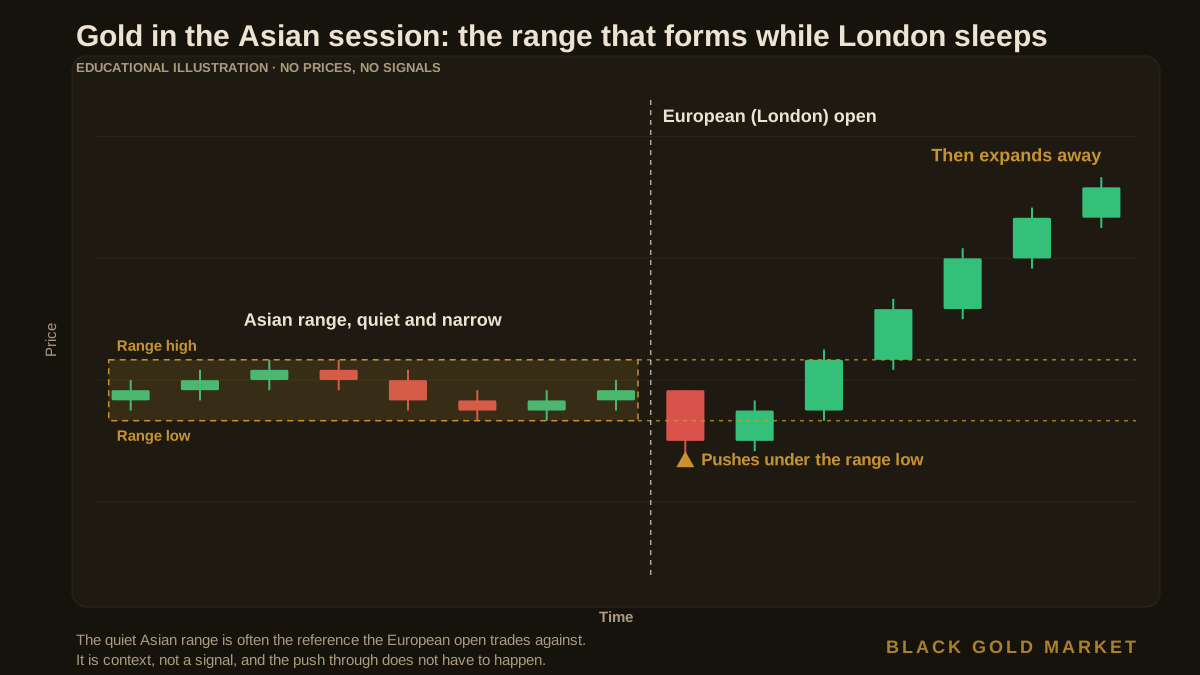
Because the hours are thin, gold in the Asian session often does the one thing thin markets do: it builds a narrow range and sits in it. Traders then treat that range as a reference, which is reasonable, and then treat it as a prediction, which is not.
What the range genuinely gives you is a boundary that a lot of other participants can also see when Europe arrives. What it does not give you is any obligation on price to respect it, break it, or come back to it. The illustration above shows the pattern people talk about, including the push under the range low that so often gets described afterwards as if it were inevitable. It was not inevitable. It is one of several things that can happen, drawn here so you can recognise it, not so you can wait for it.
If you want the companion pieces, I have written about what happens when Europe does arrive in gold in the European session, about the busiest stretch of the day in how gold behaves in the New York session, and about why the day divides this way at all in why gold trades in sessions. This article is the missing third leg of that set.
What this article is not saying
It is not saying the Asian session is untradeable. People trade it successfully, usually with wider stops, smaller size, fewer attempts, and a plan written specifically for a low participation market rather than borrowed from a busier one.
It is not saying the quiet hours are safe because they are slow. Thin markets can move violently on little volume, which is a different risk from the one most people prepare for, not a smaller one.
And it is not giving you a schedule. I have not told you what time to trade, because the honest answer depends on your costs, your strategy, your sleep and your obligations, and I do not know any of those.
What I would actually do with this
Three things, none of which require you to take my word for anything.
First, measure your own spread in the hours you actually trade. Open your platform at 02:00 UTC and again at 14:00 UTC, write both numbers down, and repeat it for a fortnight. That is ten minutes of work and it replaces every assumption in the cost section above with your own data. If the gap is small, the cost argument does not apply to you and you can stop worrying about it.
Second, write your session boundaries in UTC, once, and convert outward. It removes an entire category of error for the price of one note.
Third, if you do trade the quiet hours, size for the fact that you are paying more to participate and that there is less movement available to pay you back. That is the whole of the protect argument here, and it is arithmetic rather than opinion.
Frequently asked questions
What is gold in the Asian session, in one sentence?
It is how XAU/USD behaves between the New York close and the London open, roughly 01:00 to 07:00 UTC, when Asian desks are working and European ones are not.
Why is the Asian session thin if Asia buys the most gold?
Because the venue matters more than the appetite. The Shanghai Gold Exchange publishes a 6 hour 45 minute night session running 19:45 to 02:30 Beijing time, which converts to 11:45 to 18:30 UTC and overlaps London and New York, alongside a 2 hour morning session that sits inside the Asian window.
Does the Asian range predict the direction of the European open?
No. It gives a visible boundary that many participants share, which is useful context. It carries no obligation on price, and treating context as prediction is where most of the damage gets done.
Is it cheaper to trade in the overlap than overnight?
Usually yes on spread, but you have to measure it on your own account rather than assume it. The arithmetic in this article shows why even a small difference matters once you multiply it by a year of trades.
How much does a wider spread actually cost over a year?
On the illustrative assumptions used above, an extra 0.020 per cent of contract value per trade across 200 trades is 4.00 per cent of contract value a year, roughly eight full target trades handed back. Those are assumed figures to show the mechanism, not measured ones.
Should a newer trader avoid the Asian session entirely?
That is a decision about your own costs and your own schedule, and it is not mine to make. What I would say is that a quiet market punishes a plan borrowed from a busy one, so if you trade it, write the plan for it.
Where Black Gold Market fits
Black Gold Market is a free journal about reading gold and protecting capital, written for traders who would rather understand a mechanism than be handed a conclusion. Everything on the site is free to read and there is nothing to buy to follow along. The optional piece is the Sustainable Trader's Blueprint above, a short document on protecting capital before trying to grow it. We do not promise profits, we do not publish results, and we do not think anyone can tell you what your account will do. The piece this one sits underneath is how to protect your capital when gold gets volatile.
About the author. Raphael writes Black Gold Market. He spent a long time assuming the overnight hours were quiet because nobody was interested, and only found out otherwise by reading an exchange timetable, which is a reminder that the explanation you inherit is rarely the one that was checked. He prefers the level, the context and the risk to any story. Nothing in this article is a recommendation to trade, and no entry, stop or target discussed should be treated as a signal.