

A Question Asked in Bad Faith by Everyone
The search box version of this is blunt: trading vs investing which is better. It gets asked most often by someone who has just lost money trading, and it is usually asked hoping for permission to stop. The answer that comes back is almost always the same, and it is almost always delivered with a certainty that the evidence does not support.
I want to take the question seriously instead, and that means measuring both sides rather than praising one. Everything below comes from the published London gold benchmark, whose full record runs back to 1968, and I have stated the method each time so you can repeat it. No entry, stop or target discussed should be treated as a signal.
What "Just Hold It" Left Out
The standard answer is that investing wins, because trading is a casino and holding is patient and sensible. I have some sympathy with the sentiment. I have none at all with the way it is usually presented, because it quietly omits what holding actually asked of the people who did it.
Take the LBMA gold benchmark and measure from each major peak down to the low that followed.
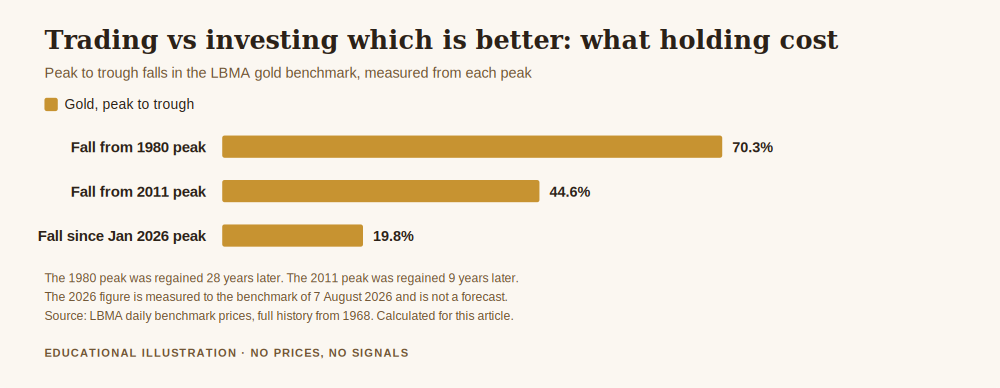
From its 1980 peak the benchmark fell 70.3 percent, and it did not regain that level for 28 years. Someone who bought at the wrong moment and held with perfect discipline was still behind when their children finished school.
The modern example is gentler and still severe. From the peak of September 2011 the benchmark fell 44.6 percent, reaching its low in December 2015. It regained the old level in July 2020, nine years after the peak. In between it spent 2,228 benchmark days below that level. That is nine years of opening a statement and seeing a number lower than the one you started with.
And this is not only history. Measured from the benchmark's peak in January 2026, the price on 7 August 2026 stood 19.8 percent lower. I mention it as a fact about the present rather than a claim about the future, because I have no idea what the future does and neither does anyone telling you otherwise.
So the first correction to the usual answer: holding is not the option without losses. It is the option where the losses are deep, slow, and impossible to do anything about while they are happening.
Trading vs Investing Which Is Better When You Count Decisions
Now the other side, and here is the measurement that reframed the question for me.
Across the ten years from 2016 to 2025, the benchmark was published on 2,506 days. Someone who bought once and held made one decision in that decade. Someone trading once a day had 2,506 opportunities to be wrong.
That ratio, roughly 2,500 to 1, is the actual difference between the two jobs. It is not speed. It is not sophistication. It is the number of times you put your judgment into the market and let it be tested.
This cuts both ways, which is why the honest version of trading vs investing which is better has no single answer. Two and a half thousand decisions is two and a half thousand chances to apply an edge, if you have one. It is also two and a half thousand chances to apply a mistake, and mistakes compound faster than edges because they require no skill to repeat.
The holder's single decision is not obviously superior. It is one bet, made once, with no opportunity to be right again and no opportunity to correct. It concentrates everything into the quality of one judgment and the depth of one person's patience. Whether that is a strength depends entirely on which judgment was made and how long the patience holds.
Two Different Failure Modes
What actually separates the two is not how much can go wrong. It is how it goes wrong, and which kind you are built to survive.
The holder fails slowly and visibly
The holder's failure mode is duration. The loss is unrealised, it is on the statement every month, and nothing you do affects it. There is no action available, which is the part people underestimate. Watching a position sit 44 percent under water for four years while doing nothing is not passive, it is an active exercise in restraint performed daily for years.
Most people who claim they would have held through the 2011 to 2015 decline did not hold, because most people did not. The strategy is simple and the execution is a long test of tolerance, and those are very different things.
The trader fails quickly and repeatedly
The trader's failure mode is frequency. Each individual loss is small by design, which sounds safer and is exactly why it is not. Small losses do not trigger the alarm that a large one does, so they can accumulate for months without ever feeling like an emergency.
Add costs. Every one of those decisions carries a spread, and often a commission, and the cost is charged whether the decision was right or wrong. The holder pays that cost once. The trader pays it 2,506 times, and that difference alone can turn a genuine edge into a slow bleed. This is the ground covered in why trading is a marathon not a sprint, and the exposure side of it in how to reduce drawdown in trading.
The Question That Actually Decides It
Neither approach is safe. One offers a shallow, frequent, controllable kind of pain and charges you for the privilege each time. The other offers a deep, rare, uncontrollable kind and charges almost nothing. Picking between them is not a question of which is better in the abstract. It is a question about you, and it has three parts.
How long can your capital sit still? If the money has a job to do within five years, the record above should worry you. A nine year wait to get back to level is not an unusual event, it is one of the two most recent examples. Capital that might be needed cannot be committed to an approach whose recovery times are measured in that unit.
What do you do when nothing is happening? Some people can leave a position alone for years. Some cannot leave one alone for a week. This is not a character flaw either way, it is a fact about you that determines which failure mode you will actually survive, and it is far better established by honest observation of your own past behaviour than by what you intend to do.
Do you have an edge, and can you prove it? Trading only makes sense as a proposition if the 2,506 decisions are, on average, better than nothing. Most people cannot demonstrate that, and the ones who assume it are the ones the frequency punishes hardest. Holding requires no edge in the same sense. It requires only that you chose a thing worth holding and then genuinely held it.
Notice that none of these three questions is about markets. They are all about your circumstances and your temperament, which is why the answer differs by person and why anyone giving you a universal answer has stopped thinking.
Get the free Black Gold Market blueprint, a short document for writing down your reason and your risk before the trade, so the review afterwards has something honest to work with. One email, no spam, unsubscribe anytime.
Get the free blueprint →Frequently Asked Questions
So trading vs investing which is better, in one sentence?
Neither, and the framing is the problem: they are different jobs with different failure modes, one deep and slow, one shallow and frequent. The useful question is which of those two you can survive given how long your capital can sit still and how you behave when nothing is happening.
Is not holding obviously safer, since you cannot be stopped out?
Not being stopped out is not the same as not losing. The measurements above are of losses that were entirely real to the person holding, sustained for 28 years in one case and nine in another. What holding removes is the mechanism that ends the loss, which cuts both ways.
Does the 44.6 percent figure mean gold is a bad thing to hold?
No, and I would be uncomfortable if that were the takeaway. It means any single asset held through a full cycle can put its holder through a fall of that order, and that the plan has to survive it. The number is a statement about what holding demands, not a verdict on the asset, and nothing here is a recommendation to buy or to avoid anything.
Can I do both at once?
Many people do, and it works when the two pots are genuinely separate, with different money, different time horizons and different rules written down before either starts. It fails when they blur, which usually shows up as a trade that goes wrong being reclassified as a long term investment. That is not a strategy, it is a stop loss being cancelled with better vocabulary.
Why measure decisions rather than returns?
Because returns depend on the period you pick and the decisions do not. The 2,500 to 1 ratio holds across any decade, so it tells you something structural about the two approaches rather than something incidental about one stretch of history. It is also the part you control.
What if I do not know whether I have an edge?
Then you should assume you do not, and size accordingly, because that assumption costs you very little if wrong and saves you a great deal if right. An edge you cannot demonstrate over a reasonable sample is indistinguishable from luck, and the frequency of trading is precisely what turns that distinction into money.
Where This Leaves You
The comfortable answer to this question is that investing is sensible and trading is gambling. The record does not support it. It supports something less satisfying: that both approaches can lose you money, that they do so in different shapes, and that the person choosing between them is choosing which shape they can live with.
A 70 percent fall lasting 28 years is not the profile of a risk free alternative. Neither is a 44.6 percent fall lasting nine. What those numbers tell you is that the patient option has a price too, and that its price is paid in years rather than in stop losses.
Whichever you choose, choose it before the market makes the choice for you. The worst outcome in this whole discussion is not picking wrong. It is picking neither, and discovering under pressure that your trade has become an investment purely because it went against you.
If you want that in a form you can keep, the Black Gold Market blueprint is free. It is a short document, not a course. There is nothing to buy to follow along, and an optional Kit if you want more structure later. We do not sell certainty, and we publish no profit claims. The companion piece on the protection side is how to protect your capital when gold gets volatile.
About the author. Raphael writes the Black Gold Market journal. He works on the view that most accounts are lost to structure rather than to analysis, and that the level, the context and the risk are worth more attention than the entry.
Disclaimer: This article is general educational content comparing two approaches to holding risk. It is not financial advice, it is not a recommendation to buy, sell or hold anything, and nothing in it should be read as a view on where any price is going. Trading gold, CFDs and leveraged products carries a high risk of losing money rapidly. No entry, stop or target discussed should be treated as a signal. All drawdown, recovery and day count figures are computed from the published LBMA daily gold benchmark, full history from 1968, using the method stated in the article, and the source is linked so you can check it. The figure measured to 7 August 2026 describes the past and is not a forecast. No price levels are quoted anywhere in this article.