

Ask ten traders how to manage capital in trading and nine will answer with a position size. One per cent per trade, two per cent per trade, never more than five open at once. All of that is real and all of it is downstream of a decision nobody writes down: how much of your money is sitting in the account in the first place.
That first decision does more damage than any sizing rule can repair. A trader risking a careful one per cent per trade inside an account that holds everything he owns is not being careful. He has simply moved the recklessness up one level, where it is harder to see, because the platform only ever shows him the account and never shows him the rest of his life.
How to Manage Capital in Trading Starts Outside the Platform
There are two separate questions and they get answered in the same breath, which is why they both get answered badly.
The first is trade risk. Given the money in this account, how much of it may one idea cost me? That is position sizing, and it is well covered ground.
The second is allocation. Given everything I own, how much belongs in an account that trades a leveraged instrument at all? That question has nothing to do with charts, and the answer does not change when the setup looks good. It is decided when you are calm and it is meant to hold while you are not.
Capital management is the second question. The trade is a decision you make weekly. The allocation is a decision you make yearly, and it determines what any weekly decision can actually do to you.
The Number Nobody Has Written Down
Here is the arithmetic, which is embarrassingly simple and almost never performed. Assume the account falls thirty per cent, which is not a catastrophe scenario, it is a bad quarter that a great many honest traders have had. Assume the rest of your savings is unchanged. What did that thirty per cent actually cost you?
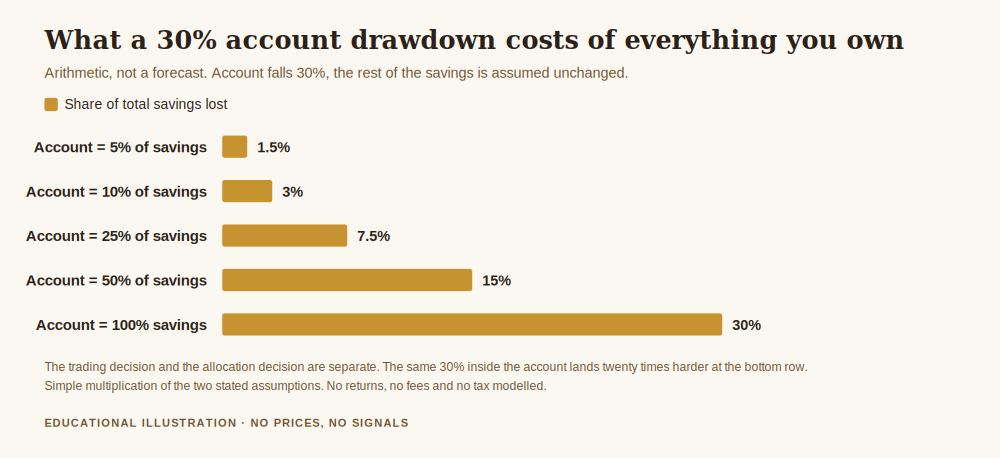
If the account holds five per cent of your savings, the damage is 1.5 per cent of what you own. If it holds half, the same thirty per cent costs you 15 per cent. If the account is everything, it costs thirty. Same trading, same discipline, same bad quarter, twenty times the consequence between the top row and the bottom.
Read that as a statement about control. You cannot control whether the bad quarter arrives. You can control, entirely and in advance, what it is allowed to reach. That control is exercised once, by transfer, not repeatedly, by willpower.
The assumptions are stated so you can disagree with them: a single thirty per cent fall, the remaining savings flat, no fees, no tax, no additional deposits. Change the drawdown to twenty or forty and the shape of the table does not change, only the scale.
The Metal Itself Has Holes You Could Fall Into
Traders think of drawdown as something that happens to accounts because of mistakes. It also happens to assets, without anybody making a mistake at all, and gold is a useful teacher here because its record is public and long.
The London Bullion Market Association runs the auction that sets the world benchmark price and publishes the whole history. Taking the afternoon auction from 4 January 2000 to 18 September 2026 gives 6,698 sessions. Measured against the highest print seen up to that point:
- The deepest fall from a peak was 44.6 per cent, from 5 September 2011 down to 17 December 2015. That descent took 1,564 calendar days, more than four years of going down.
- The benchmark did not see the 2011 level again until 24 July 2020, which is 3,245 days, just under nine years, after the peak was set.
- Across the whole 26 years, the benchmark sat more than ten per cent below its most recent peak on 52.0 per cent of sessions, and more than twenty per cent below on 26.9 per cent of sessions.
That last line is the one worth sitting with. For more than a quarter of the last twenty six years, anyone holding this asset was more than twenty per cent underwater against the best price they had seen. No leverage in that number. No bad decisions. That is simply what the thing does.
Now add leverage to it, and add a person who needs the money back by spring, and you can see why allocation is the first line of defence rather than the last.
Three Places Money Can Be
The practical version of capital management is that your money lives in three places and the rules for moving between them are written in advance.
Working capital is what sits in the trading account. It is the only money that can be lost to trading, and it should be an amount whose total loss would be painful, instructive and survivable, in that order. If the number is so large that losing it changes your housing, it is not working capital, it is your life with a chart attached.
Reserve is money set aside for the business of trading but not exposed to it. It exists so that a drawdown does not force a decision. The trader with no reserve who hits a bad month has to choose between stopping and adding money under pressure, and under pressure people add money.
Gone is money that has left and is not coming back. This is the bucket people forget, and it is the one that makes the whole structure honest. Profits that never leave the account are not profits, they are a larger position. If nothing is ever withdrawn, every good year is silently reinvested into a bigger version of the same risk, and the first bad year takes the lot.
The rules that move money between the three do not have to be clever. They have to exist before they are needed. Something like: the account is topped up on a fixed date or not at all, never after a loss; withdrawals happen on a schedule rather than a feeling; and the allocation percentage is reviewed once a year, away from the screen, ideally on a day when nothing interesting is happening.
Get the free Black Gold Market blueprint, a short document on protecting capital before you try to grow it, including how to decide what share of your money belongs in a trading account at all. One email, no spam, unsubscribe anytime.
Get the free blueprint →The Three Ways This Goes Wrong
Topping up to survive. The margin warning arrives, the transfer takes ninety seconds, and the position stays open. Nothing about the analysis improved. The only thing that changed is the size of the eventual loss, and the fact that the decision was made by fear rather than by a rule. If new money can rescue a position, then the position was larger than the account, which means the account was never the limit you thought it was.
Treating the account as a scoreboard. An account that only ever grows and never pays anything out is not a business, it is a high score. The number on the screen becomes the point, and once the number is the point, withdrawing feels like losing. That is how people end up with eight profitable years inside one leveraged account and nothing outside it.
Confusing a small percentage with a small risk. One per cent of an account holding everything you own is not a small risk, it is a small share of an enormous exposure. The percentage is calculated against the wrong denominator, and the wrong denominator is the whole problem this article is about.
What This Does Not Say
It does not say a particular allocation is right. Five per cent, twenty per cent or zero depends on your income, your obligations, your other assets and your temperament, and nobody who has not seen those numbers can tell you which. What the arithmetic says is only that the choice is consequential and that most people make it by accident.
It does not forecast anything about gold. The falls quoted above are history, measured on a public record, and history is a description of what has happened rather than a promise about what will. The metal can behave differently from here in either direction.
And it does not say that careful sizing is unimportant. It says sizing decides how much of the account one idea costs, while allocation decides how much of your life the account can cost, and the second question deserves to be answered first.
Frequently Asked Questions
What does capital management mean in trading, in one sentence?
It is deciding how much of your total money is allowed to be in a trading account at all, and writing the rules for when money enters and leaves it, before the market gives you a reason to improvise.
Is capital management the same as position sizing?
No, and the difference is the whole point of this article. Position sizing divides the account into per trade risk. Capital management decides how big the account is relative to everything else you own, which sets the ceiling that sizing operates under.
Should I add money to my account after a losing run?
Adding money as a scheduled, planned contribution is a different act from adding money while a position is going against you. The first is a business decision. The second is a rescue, and a rescue has to work every single time, whereas a rule only has to be followed.
How often should I withdraw?
On a schedule you set in advance rather than when the balance feels high. The specific frequency matters less than the fact that money genuinely leaves, because an account that never pays anything out quietly reinvests every good year into a larger version of the same risk.
Where did the numbers in this article come from?
The drawdown figures were calculated from the published London gold auction history, afternoon price, 6,698 sessions from 4 January 2000 to 18 September 2026, measured against the running peak. The allocation table is plain multiplication of the two assumptions stated beside it. No price level is quoted anywhere in the article.
Where Black Gold Market Fits
Black Gold Market is free to follow. Daily XAU/USD analysis with the level, the context and the risk stated before the outcome is known, losing days included. There is a free blueprint for anyone who wants the capital protection material in one place, and an optional Kit for people who want the whole method. Nothing here promises a profit, and nothing here is a signal service.
Deciding what the account may cost you is a Protect problem, which puts this article under how to protect your capital when gold gets volatile. The layer below it is position sizing so one trade cannot hurt you, and the hole this is all designed to avoid is described in what is drawdown and how to recover. The underlying record is published by the London Bullion Market Association, the raw file used here is the published PM auction history, and the World Gold Council maintains the wider data set on the metal.
About the author. Raphael writes Black Gold Market. He works on the unglamorous half of this job, the part that decides whether you are still trading in three years, and he has more respect for a boring transfer between two bank accounts than for any setup he has ever seen. Nothing in this article is a recommendation to trade, and no entry, stop or target discussed should be treated as a signal.
Disclaimer: This article is general educational content about capital allocation, drawdown and account structure in retail trading. It is not financial advice, not investment advice, not tax advice and not a recommendation to buy, sell or hold any instrument, product or firm. Your circumstances decide what is appropriate for you, and this article knows nothing about them. Figures are calculations from the stated public data and stated assumptions, not predictions or performance claims. Trading leveraged products carries a substantial risk of loss and most retail accounts lose money.