

The Advice That Has Never Worked for Anyone
Every article on how to control emotions in trading eventually arrives at the same instruction: be disciplined, stay calm, do not let fear and greed drive your decisions. I have read a great many of them. I have never met a trader who was helped by one, including myself.
The reason is that the advice asks for the one thing that is missing at the moment it is needed. You are not calm when a position moves against you. That is not a character flaw, it is what a nervous system does when something valuable is at stake. Telling a person under pressure to stop being under pressure is not a method.
What follows is the opposite approach. Assume the emotion arrives on schedule and cannot be argued with. Then ask a narrower question: where exactly does the feeling touch your account, and can that specific place be protected in advance, while you are calm enough to make decisions?
To be clear from the start: no entry, stop or target discussed should be treated as a signal.
How to Control Emotions in Trading Begins With Finding Where They Land
Emotion does not affect your account in a general way. It affects it at two specific points, and only two.
The first is where you take profit. A position is green, the number is real, and there is a strong pull to make it permanent before it disappears.
The second is where you cut a loss. A position is red, the loss is not yet real, and there is an equally strong pull to give it more room rather than make it permanent.
Notice that these two pulls point the same direction. Both of them shorten your winners and lengthen your losers. This is not a coincidence and it is not personal. It is the best documented pattern in the study of how ordinary people handle money at risk.
What the Record Actually Shows
Terrance Odean examined the trading records of 10,000 accounts at a large discount brokerage and measured two things. Of all the gains those investors were sitting on, what proportion did they actually realise? And of all the losses, what proportion did they realise?
The answers were 0.148 and 0.098. Investors closed 14.8 percent of their available gains and only 9.8 percent of their available losses. They were about 1.5 times more likely to take a winner off the table than a loser, and the statistical strength of that difference was overwhelming, a t statistic of 35.
The paper is called "Are Investors Reluctant to Realize Their Losses?" and the answer, across ten thousand accounts, was yes. Odean tested whether the pattern could be explained by sensible reasons instead of feeling, portfolio rebalancing, trading costs, or the winners simply being better positions going forward. None of those explanations held. The behaviour was not justified by what happened next.
I find this the single most useful piece of evidence in the whole subject, because it moves the problem out of the realm of personal weakness. Ten thousand accounts did the same thing. You are not undisciplined. You are typical, and typical is expensive.
What the Pattern Costs, in Arithmetic
Now the part that matters, because "it costs you something" is not an argument until you can say how much.
Suppose you risk one unit on each trade and call it 1R. Your setups are what they are, your read of the market is what it is, and none of that changes in what follows. The only thing that changes is where you exit.
Work out the win rate you would need just to break even.
If you let a winner reach 2R and cut a loser at 1R, you need to be right on 33.3 percent of your trades to break even. One trade in three.
If you take the winner at 1R because it felt fragile, and you let the loser run to 2R because it might come back, you now need 66.7 percent. Two trades in three.
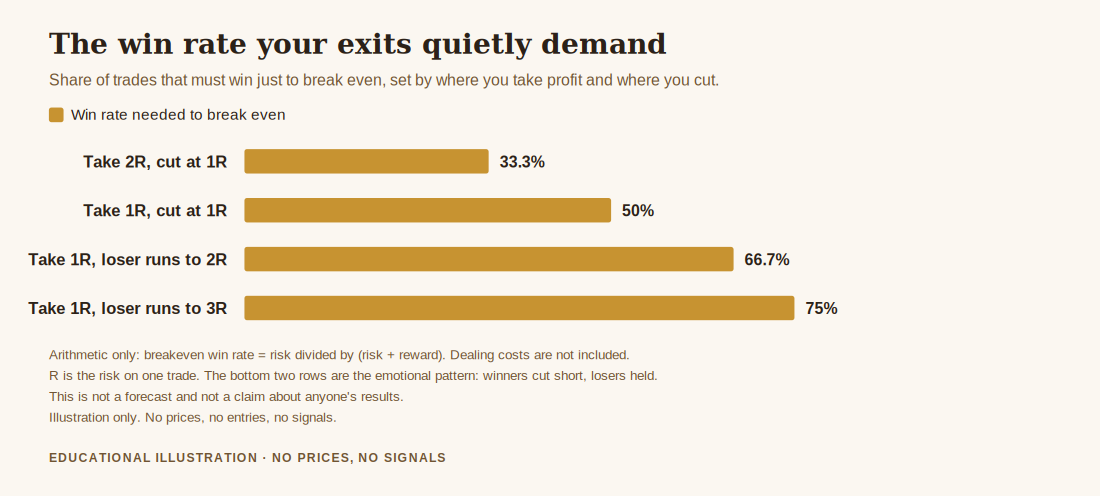
Read that again, because the size of it is easy to skim past. Emotion did not shave a few percent off your edge. It doubled the standard you have to meet, from one trade in three to two trades in three, using the same setups on the same chart. If your losers are allowed to run to 3R while you keep taking 1R, the bar rises to 75 percent.
There is a companion calculation that makes the point even sharper. Take any win rate at all, and compare the expected value of the disciplined pattern with the emotional one:
- Win 45 percent of the time. Disciplined exits are worth positive 0.35R per trade. Emotional exits are worth negative 0.65R.
- Win 55 percent of the time. Disciplined exits are worth positive 0.65R. Emotional exits are worth negative 0.35R.
- Win 65 percent of the time. Disciplined exits are worth positive 0.95R. Emotional exits are still negative, at 0.05R.
The gap is exactly 1.00R per trade, at every win rate. That is not a coincidence of the numbers I chose, it falls out of the algebra: the difference between the two patterns is one unit of R regardless of how often you are right. A trader who is right two thirds of the time and exits emotionally is still losing money.
Everything above is arithmetic on stated assumptions, not a forecast, and it does not include dealing costs, which make every row worse.
Losing Runs Are Ordinary, Which Is Exactly Why They Work On You
The other place emotion enters is after a sequence of losses, when it starts to feel as though something has broken.
Assume a win rate of 45 percent and independent trades. Over forty trades, the chance of hitting at least one run of four consecutive losses is 85.9 percent. At least one run of five is 61.8 percent. Over a hundred trades, a run of five becomes 92.0 percent and a run of six 72.9 percent.
Those runs are not evidence that your method stopped working. They are what a 45 percent win rate looks like from the inside. The feeling that something has changed is a real feeling attached to a false conclusion, and it arrives, on that arithmetic, several times a year no matter how well you are trading.
This is why I keep saying that the goal is not to feel less. The goal is to have already decided what happens during a run of five, before you are inside one.
Four Things That Hold When You Do Not
Every one of these works by removing a decision from the moment when your judgement is worst. None of them requires composure.
Decide the exit before the entry, in writing. Not the entry, the exit. Both of them, the one where you are right and the one where you are wrong, written down before the position exists. A decision made in advance is the only kind that is not affected by how the trade feels.
Use resting orders rather than intentions. A stop that lives on the broker's server is a decision you have already made. A stop that lives in your head is a decision you are going to make again, under pressure, with money on the line. The difference between the two is the whole subject of this article.
Put a hard limit on the day. Two losses and the session is over. It converts an unanswerable question, am I trading emotionally right now, into a countable one you cannot argue with. This is the ground covered in trading discipline rules that still work on a losing day.
Know when the market is scheduled to be difficult. A great deal of what feels like emotional chaos is simply volatility you did not expect. The US Federal Reserve holds eight regularly scheduled meetings a year, and the dates are published well in advance. Gold reacts to them. Knowing that a Wednesday is one of the eight is not a prediction, it is a reason to size differently or to stand aside, decided on Monday rather than at the moment the number prints.
If taking profit early is the specific version of this you recognise, why you take profit too early goes deeper into that half. If the problem shows up after a loss instead, how to stop revenge trading and overtrading, the habit that drains your account deal with what happens next. The structure that holds all of it together is how to protect your capital when gold gets volatile.
Get the free Black Gold Market blueprint, a short document for writing your exits down while you are calm, so the version of you under pressure has something to follow. One email, no spam, unsubscribe anytime.
Get the free blueprint →Frequently Asked Questions
Can you actually learn to control emotions in trading, or only work around them?
Mostly you work around them, and the working around is what people mean when they say a trader is disciplined. Experience does reduce the intensity of the feeling over years, but it never removes it, and a method that depends on the feeling being absent will fail on the day it is strongest. Build for the bad day and the good day takes care of itself.
Is it always wrong to take profit early?
No. Taking profit early on a plan is a strategy, and some approaches are built entirely on small consistent targets with a high win rate. The arithmetic in this article shows why: at a 1:1 exit you need 50 percent, which is achievable. The problem is not the short target, it is changing the target mid trade because of how the position feels. Decide the ratio in advance and the same numbers work for you instead of against you.
My stop keeps getting hit and then the market goes my way. Is that emotional?
Not necessarily, and this is worth separating carefully. Stops placed too close to the entry get hit by normal noise, which is a technical problem with a technical fix. Emotion enters when you respond by moving the stop further away on the next trade, or by removing it. Diagnose it by asking whether you changed the rule or changed your mind, and only one of those is a method.
Does journaling help, or is that just something people say?
It helps for a specific reason: it converts a memory into a record. Your memory of the last month is written by feeling and will over-weight the recent and the painful. A written log of what you planned and what you did shows you whether your exits are drifting, which is the one thing you cannot see from inside the drift.
Should I trade smaller if I am struggling emotionally?
Yes, and it is the most reliable lever available. The intensity of the feeling scales with what is at stake, so reducing size reduces the pressure directly rather than asking you to withstand it. It is not an admission of anything. It is the cheapest way to keep operating while you fix the underlying process.
How long does it take before this becomes automatic?
Following written rules becomes reliable in weeks, because it is a habit rather than a skill. The feeling itself never becomes automatic, and every trader I know still feels the pull to close a green position early. What changes is that the pull stops being connected to the mouse.
Protect First, Then Master, Then Grow
Black Gold Market is a free XAU/USD channel. We publish the level, the context, and the risk, before the trade rather than after it, and we post the losing ones too, because a record that only contains winners teaches nothing about how to survive.
Mastering the emotional side is the middle pillar, and it sits where it does for a reason. Protection comes first because a trader who is still solvent can improve, and a trader who is not has nothing to improve. Growth comes last because nothing compounds through an account that keeps having to recover. In between sits this: knowing where feeling touches your account, and having written something down in advance at exactly those two points.
If you want that in a form you can keep, the Black Gold Market blueprint is free. It is a short document, not a course. There is nothing to buy to follow along, and an optional Kit if you want more structure later. We do not sell certainty, and we publish no profit claims.
You will not be calm on the day it matters. Nobody is. The work is making sure that does not have to matter.
About the author. Raphael writes the Black Gold Market journal. He works mostly on the part of trading that happens before the order, the level, the context, and the risk, on the view that a decision made in advance is the only one that survives contact with a live position.
Disclaimer: This article is general educational content about how leveraged markets work. It is not financial advice and it is not a recommendation to buy or sell anything. Trading gold, CFDs and leveraged products carries a high risk of losing money rapidly. No entry, stop or target discussed should be treated as a signal. Figures attributed to external sources are linked so you can check them, and figures I have calculated are shown with the assumptions they rest on so you can change them.