

A member sent me a screenshot of his account on Sunday night and asked what he should change. The account was down about a fifth from its high, and every one of the last eleven trades had been taken for a reason he could explain out loud. That is exactly the situation this article is about, because the useful answer was not a new indicator or a better entry. The answer was that he had no written plan, and the question of how to build trading plan rules that still hold when the week goes badly is a very different question from the one most people think they are asking.
Most documents I get sent under the name "my trading plan" are a list of setups. That is a method, not a plan. A method describes what you are looking for. A plan describes what happens to your money when the method is wrong several times in a row, which it will be, and it says so in advance, in writing, while you are calm and the money is not yet on the line.
How to build trading plan rules that survive the week you did not plan for
The distinction matters because the two documents fail at different moments. A method fails quietly, over months, when the market changes character. A plan fails loudly, in a single afternoon, when you decide that this particular situation is the exception. Almost every account I have watched get into trouble got there through exceptions, not through a bad method.
So the first thing a plan needs is not a setup. It is a number that does not move. Before anything else is written down, decide what fraction of the account a single loss is allowed to cost, and write it at the top of the page where you cannot pretend you forgot it. Everything else in the document is downstream of that one line.
The reason I put it first is arithmetic rather than discipline, and the arithmetic is worth seeing before you pick the number.
Start with the streak, because the streak is what actually breaks people
Traders plan for the losing trade. Almost nobody plans for the losing run. The losing run is the thing that empties accounts, and it is far more common than intuition suggests.
Here is a calculation you can repeat yourself. Assume 200 trades, assume each trade is independent of the last, and assume a fixed probability of winning. Then ask: what is the chance of meeting at least one streak of six, eight or ten losses somewhere in those 200 trades? This is a standard Markov chain over streak length, and it has an exact answer rather than an estimated one.
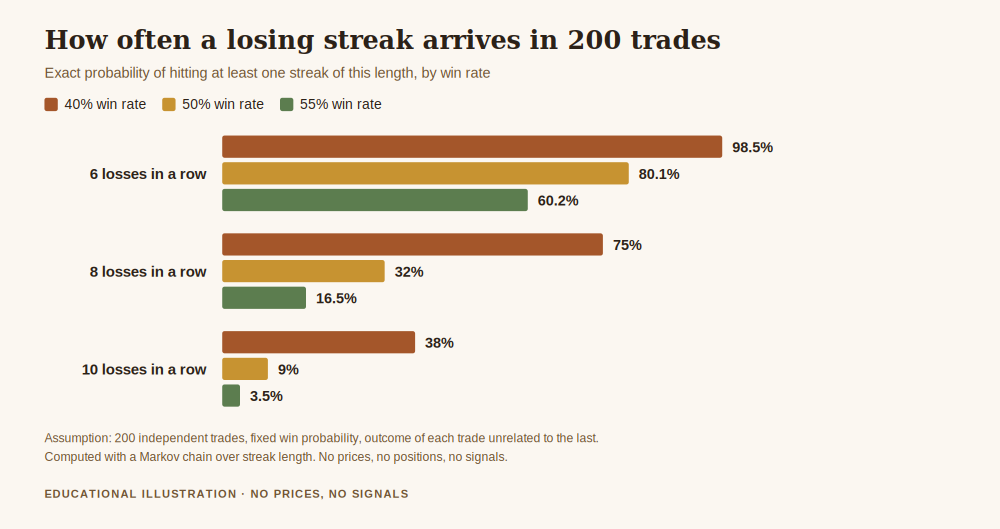
At a 50 per cent win rate, the chance of hitting at least one run of six losses is 80.1 per cent. Not 10 per cent, not a tail risk, but the ordinary case. A run of eight arrives in 32.0 per cent of samples and a run of ten in 9.0 per cent.
Raise the win rate to 55 per cent, which is a genuinely good number that most people never sustain, and a run of six still shows up 60.2 per cent of the time. Drop to 40 per cent, which is perfectly normal for a method that takes larger winners than losers, and a run of six becomes near certain at 98.5 per cent, with a run of eight at 75.0 per cent.
Read that again in plain language. If you take 200 trades this year with a respectable win rate, you should expect to lose six in a row at some point. Not fear it. Expect it. A plan that has no answer for that expected event is not a plan.
What the streak does to the account, and why the risk line goes first
Now put the two numbers together. Suppose each loss costs a fixed percentage of the capital you have left at the time. After a run of eight losses, risking 1 per cent a trade leaves 92.3 per cent of the account. Risking 2 per cent leaves 85.1 per cent. Risking 5 per cent leaves 66.3 per cent.
The 5 per cent trader has lost a third of the business on a sequence that, at a 50 per cent win rate, turns up in roughly one year in three. He has not been unlucky and he has not done anything stupid. He chose a number that could not survive an ordinary event, and he chose it without doing this arithmetic.
That is the whole argument for writing the risk line before the setup list. The setup list changes the frequency of the streak. The risk line changes whether the streak is survivable. Only one of those two is fully under your control, and it is not the first one.
If position size is the part you are least sure about, position sizing so one trade cannot hurt you is the mechanical companion to this section.
What the regulators publish about the average outcome
It helps to know the base rate you are writing a plan against, and for once we do not have to guess at it, because regulators require firms to measure it.
When the European Securities and Markets Authority set out its case for restricting contracts for difference sold to retail clients, it published what the national regulators had found across member states. In its own words, analyses of CFD trading across different EU jurisdictions show that 74 to 89 per cent of retail accounts typically lose money on their investments, with average losses per client ranging from 1,600 to 29,000 euro.
Two things in that sentence are worth separating. The first is the loss rate, which people quote constantly. The second is the range of average losses, which almost nobody quotes and which I find more instructive. The gap between 1,600 and 29,000 euro is not a gap in market conditions. It is largely a gap in position size and in how long someone kept going after the plan stopped working.
The same package of measures tells you something else useful for a plan. ESMA standardised a margin close out rule at 50 per cent of minimum required margin, meaning the provider must close positions once account equity falls to half the margin required to hold them. That is a hard floor imposed from outside. If the only stopping rule in your trading is the one your broker applies to you, you do not have a plan, you have a liquidation level.
The six lines that turn a document into a plan
After reading a lot of these, I have ended up with six lines that seem to separate the documents that hold from the ones that get quietly abandoned in month two. None of them are about entries.
One, the risk per trade. A single number, as a percentage of current equity, written before anything else. Chosen with the streak arithmetic above in front of you, not chosen because it sounded modest.
Two, the stop for the day. A loss level for one session at which you are finished, regardless of what the chart is doing. Most damage I see is not one bad trade, it is the four trades taken after it.
Three, the stop for the drawdown. A level of total decline from the account high at which you reduce size or stop entirely and review. This is the line that converts a bad month into a recoverable one. If you want the recovery arithmetic behind it, what is drawdown and how to recover works through why the climb back is steeper than the fall.
Four, what you do not trade. Instruments, sessions and conditions that are outside the plan. Writing what is excluded is more useful than writing what is included, because the damage usually arrives through something you never intended to trade.
Five, the review cadence. A fixed day and a fixed set of questions. Without a scheduled review, the plan gets amended in the middle of losing trades, which is the worst possible moment to amend anything.
Six, the conditions for changing the plan. State in advance how many trades must pass before you are allowed to alter a rule, and require that the change be written down with its reason. This single line does more for consistency than anything else on the list, because it makes the exception expensive.
Notice that all six are constraints rather than instructions. A plan is mostly a list of things you have agreed not to do. That is also why trading discipline rules and a plan are close relatives: the plan is the written form, the discipline is whether the written form survives contact with a bad afternoon.
Get the free Black Gold Market blueprint, a short document on protecting capital before you try to grow it, including the risk and drawdown lines this article argues should be written before any setup. One email, no spam, unsubscribe anytime.
Get the free blueprint →Frequently asked questions
How long should a trading plan be?
Shorter than you think, and short enough that you actually reread it. One page is plenty. The six lines above fit on half a page, and the setup description can take the other half. A twelve page document is usually a sign that someone is writing to feel prepared rather than writing to be governed. The test is not length, it is whether you can recite the risk line and the stopping line from memory right now.
Where do the streak numbers in this article come from?
They are my own arithmetic, not a survey. The model is 200 independent trades with a fixed win probability, and the probability of meeting at least one losing streak of a given length is computed exactly with a Markov chain over streak length rather than simulated. The three assumptions are stated deliberately because they are the weak points: real trades are not perfectly independent, win rates drift, and nobody takes exactly 200 trades in a year. The direction of the result is robust to all three, the precise decimals are not.
Is a lower win rate automatically worse?
No, and this is a common misreading of the chart. Win rate on its own says nothing about whether a method makes money, because it says nothing about the size of the wins relative to the losses. A method that wins 40 per cent of the time with large winners can be perfectly sound. What the chart shows is narrower than that: the lower the win rate, the more often long losing runs appear, so the more room the risk line has to leave. It is an argument about sizing, not an argument about which method is better.
What if I break the plan?
Write down that you broke it, what the rule was, and what you did instead. Do not add a penalty and do not start again from zero, because both of those are emotional responses that tend to produce more breaking, not less. A plan that is broken and logged is still doing its job, because the log is what shows you which rule is unrealistic. A rule broken five times in a month is usually a badly written rule rather than a character flaw.
Should the plan include profit targets?
It can include a review target, meaning a level at which you sit down and reassess, and it should say what you do with money taken out of the account. It should not include a monthly profit figure that you then trade towards, because a target you are behind on is one of the most reliable ways to make a position larger than the plan allows. Targets pull size upward exactly when the market is not cooperating, which is precisely when you need the risk line to hold.
Does having a plan make me profitable?
No, and I want to be direct about that. A plan does not create an edge and cannot manufacture one. What it does is stop a bad sequence from ending the account before a method has had enough trades to show what it is, and it keeps the record clean enough that you can tell the difference between a bad method and a bad week. Nobody can honestly promise you more than that, and you should be suspicious of anyone who does.
Where Black Gold Market fits
Black Gold Market is a free journal about gold, written for people who want to protect capital before they try to grow it. Everything here stays free: the journal, the daily analysis on Telegram, and the Sustainable Trader's Blueprint. There is no profit promise anywhere on this site and there never will be, because nobody can make one honestly. If the writing is useful, the Telegram channel is where the same thinking gets applied to what gold is doing that day, with the level, the context and the risk stated before the outcome is known.
If you are building the document this article describes, the two pieces that sit underneath it are position sizing so one trade cannot hurt you and what is drawdown and how to recover. The article this site is really built around is how to protect your capital when gold gets volatile, and it is the right next read once the six lines are written.
About the author. Raphael writes Black Gold Market. He traded for years with a method and no plan, and the thing that finally changed his results was not a better entry but a written limit he stopped being allowed to argue with. Nothing in this article is a recommendation to trade, and no entry, stop or target discussed should be treated as a signal.